Establishing secure connection…Loading editor…Preparing document…

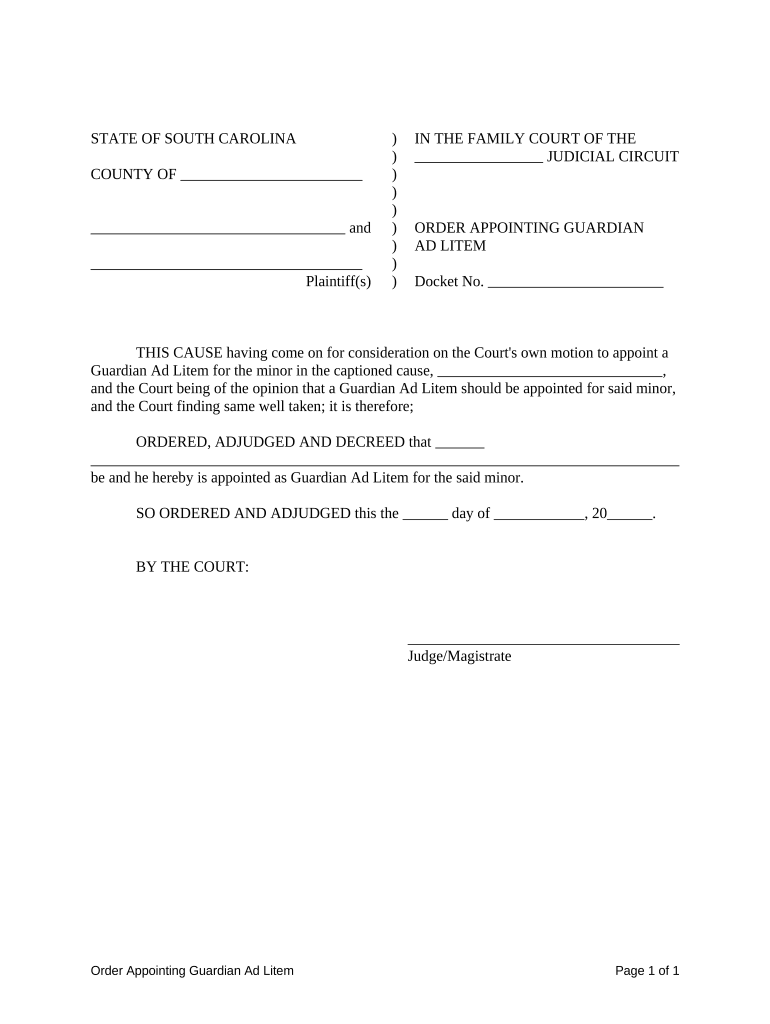
South Carolina Order Appointing Guardian Ad Litem

This template is fully customizable. Edit the text, fill out the fields, and send it for signature. Give it a try!
South Carolina Order Appointing Guardian Ad Litem

What the South Carolina Order Appointing Guardian Ad Litem Is

The South Carolina Order Appointing Guardian Ad Litem is a court-issued written directive naming an independent advocate to represent the interests of a minor, incapacitated person, or other protected party during litigation or guardianship proceedings. The order specifies the guardian ad litem's scope, duties, appointment date, reporting obligations, and authority to access records and appear in court for the protected person's best interests. Issued by family, probate, or civil courts, the order formalizes advocacy, creates an official case role, and establishes procedural and evidentiary responsibilities for the appointed representative.

Why an Order Appointing a GAL Matters

A South Carolina Order Appointing Guardian Ad Litem ensures impartial representation for vulnerable parties, clarifies duties and court expectations, and provides a documented chain of authority for investigations and testimony. It helps courts make informed decisions while protecting procedural rights.

Why an Order Appointing a GAL Matters

Common preparation pitfalls to avoid

  • Failing to specify the guardian ad litem's precise scope, leading to role confusion and disputes over investigative or testimonial authority during proceedings.
  • Submitting an order without required party contact details or service addresses, which can delay hearings and impede official notifications.
  • Omitting appointment dates or duration terms, creating uncertainty about when the guardian's authority begins and ends.
  • Failing to record court approval or entry details in the case docket, weakening enforceability and traceability of the appointment.

Who typically requests or prepares this order

South Carolina courts, family law attorneys, guardianship petitioners, and child welfare agencies request this order to secure independent representation for vulnerable parties.

  • Family law attorneys seeking neutral investigation in custody or abuse allegations.
  • Probate courts appointing a GAL for incapacitated adults or contested guardianship matters.
  • Child welfare agencies requiring independent advocacy during dependency or termination proceedings.

Key roles associated with the order

Guardian Ad Litem

A court-appointed Guardian Ad Litem represents the minor or incapacitated person's best interests, conducts investigations, interviews parties and professionals, reviews records, and files written reports or recommendations to the court. The GAL may testify and request court orders for access to information.

Presiding Judge

The presiding judge issues the Order Appointing Guardian Ad Litem, defines the GAL's mandate, and may set compensation, reporting deadlines, and confidentiality limits. Judicial oversight preserves due process and ensures the guardian's activities align with procedural rules and evidentiary standards.

Essential information to include on the order

Case Number: Court docket identification and reference
Parties' Names: Full legal names with suffixes
Appointment Date: Effective date in MM/DD/YYYY
Scope of Authority: Duties, limits, and reporting
Contact Information: Addresses, phone, and email
Confidentiality Terms: Privacy limits and records access

Consequences of incomplete or incorrect orders

Delayed Proceedings: Hearing postponement risk
Evidence Access Denied: Restricted records access
Appointment Reversal: Motion to remove GAL
Missing Service: Order not served properly
Ethics Violations: Conflict of interest exposure
Noncompliance Penalties: Sanctions or contempt risk

Real-world examples of GAL orders in South Carolina

These examples illustrate typical South Carolina GAL orders in family and probate matters and child welfare cases.

Family Court Matter

Judge appointed a guardian ad litem to investigate custody and parental fitness following allegations of neglect and conflicting medical reports.

  • GAL interviewed both parents and obtained school and medical records.
  • The GAL filed a detailed written report recommending supervised visitation and counseling, and the court adopted the recommendations in its final custody order to protect the child's safety while preserving parental rights.

Probate Dispute

In a contested guardianship for an incapacitated adult, the court named a GAL to review financial stewardship and caregiver suitability.

  • GAL reviewed bank statements and medical evaluations.
  • Findings led to interim conservatorship oversight, court-ordered family meetings, and a structured reporting schedule to monitor finances and care in the interim while the full guardianship hearing was scheduled.

Step-by-step: Completing the Order Appointing Guardian Ad Litem

Follow these steps to complete a South Carolina Order Appointing Guardian Ad Litem accurately and submit it to the proper court.

  • 01
    Prepare Case Info: Gather docket number, parties, and contact information.
  • 02
    Draft Order: Specify GAL duties, term, and compensation if applicable.
  • 03
    Serve Parties: Serve the order per South Carolina rules and file proof.
  • 04
    File with Court: Submit signed order and certificate of service to clerk.

Where to file and how the order is routed

This section outlines typical routing for filing the Order Appointing Guardian Ad Litem in South Carolina courts.

  • Family Court: File with the family court clerk in the county of venue.
  • Probate Court: Submit to probate clerk for guardianship matters post-petition.
  • Civil Docket: File on the civil docket in related litigation when appropriate.
  • Certificate of Service: Attach proof that all required parties were served.

Primary elements to include in a professional GAL order

Essential components of a professional South Carolina Order Appointing Guardian Ad Litem clarify duties, scope, authority, reporting, compensation, and access to records to guide court and GAL conduct.

Scope of Authority

Describe the GAL's investigatory powers, limits on testimony, authority to access medical, educational, and financial records, and whether the GAL may make temporary care recommendations to the court.
Duties and Reporting

Specify required written reports, deadlines, who receives reports, and the extent of court appearances; include expectations for evidence collection and timelines for interim and final submissions.

Term and Duration

State the appointment date, effective period, conditions for extension or termination, and any events that automatically trigger review or reappointment by the court, including transfer of venue or case dismissal.

Compensation

If fees apply, include hourly or flat rates, billing and reimbursement processes, court approval steps, and whether county funds or private parties will cover GAL expenses.

Records Access

Authorize specific records access, set confidentiality protections, and require compliance with HIPAA or other privacy laws when handling medical or educational records for the protected person.

Authority to Testify

Clarify whether the GAL will provide testimony, what statements are covered, and how privileged communications are treated to avoid later evidentiary objections and specify procedures for in-camera review where necessary.

Practical tips for a clear, enforceable GAL order

Apply these best practices to streamline preparation and reduce court objections when drafting and executing the South Carolina GAL order.

Use clear and specific language throughout
Avoid generic phrases; define terms such as 'temporary care' or 'medical decision-making.' Clearly state limits on investigations, deadlines for reports, and how findings will be submitted to the court to reduce ambiguity and contested motions.
Attach exhibits, releases, and records access forms
Include signed releases for medical and educational records, lists of documents the GAL may request, and relevant exhibits. Pre-attaching these materials reduces delays and supports timely, complete investigations for the court's review.
Confirm Service and Filing Procedures
Follow South Carolina rules for service and filing; include certificates of service and retain proof. Timely, correct filing prevents continuances, reduces objections about notice, and preserves the court's ability to act on GAL recommendations.
Address Confidentiality and HIPAA Limits
Specify how medical records are handled and who may receive sensitive information. If the GAL will access protected health information, cite HIPAA compliance and indicate whether a Business Associate Agreement or court order will govern disclosures.

Key milestones from appointment to final order

Key milestones for a South Carolina GAL appointment track the appointment through investigation, reporting, and final court resolution.

01

Appointment Entered

Court signs and enters the appointment order on the docket.

02

Initial Investigation

GAL conducts interviews and obtains records within assigned timeframe.

03

Interim Report

GAL files preliminary findings or recommendations as ordered by court.

04

Final Hearing

Court reviews GAL reports, hears testimony, and issues final orders.

Typical deadlines and processing expectations

Filing and service timelines vary by court type; observe local rules and include deadlines for reports, hearings, and fee petitions.

Service Deadline:

Serve parties according to S.C. Rules of Civil Procedure.

Report Filing Window:

Observe court-ordered deadlines, typically 14–30 days after appointment.

Hearing Notice:

Provide required notice period before scheduled evidentiary hearings.

Fee Petition Timing:

File fee petitions concurrently with reports or per court order.

Record Retention Expectation:

Maintain case records until final order and applicable retention period.

Configuring an electronic workflow for the GAL order

Configure e-filing and eSignature workflow to match South Carolina filing requirements and GAL procedures for accuracy.

Field Configuration
Signing Method eSignature with audit trail
Authentication Email link or SMS code
Document Format PDF or DOCX accepted
Delivery Email, download, or API push

How a GAL order compares with related court documents

Quick comparison highlights how a South Carolina Order Appointing Guardian Ad Litem differs from other related court documents.

Criteria GAL Order Guardianship Petition
Purpose advocate appointed transfer legal authority
Typical Issuer judge probate court or judge
Scope advocacy and investigation care and custody decisions
Records Access limited, case-specific broad, ongoing access

eSignature plan and pricing snapshot for document signing

Pricing and feature comparison for common eSignature plans relevant to filing and signing the South Carolina Order Appointing Guardian Ad Litem.

signNow DocuSign Adobe Sign PandaDoc HelloSign
Starting Price $8/user/mo $15/user/mo $14/user/mo $19/user/mo $15/user/mo
Free Trial 7-day free trial Varies by vendor Varies by vendor Varies by vendor Varies by vendor
Bulk Send Available on Business Premium Varies by plan Varies by plan Varies by plan Varies by plan
Audit Trail Yes Yes Yes Yes Yes
HIPAA Compliant Yes Yes Yes No No
Envelope Cap No cap 100 envelopes/user/year Varies by plan Varies by plan Varies by plan

Frequently asked questions about the GAL order

Answers to frequent questions about preparing, e-signing, filing, and preserving the South Carolina Order Appointing Guardian Ad Litem.


Need help? Contact support

be ready to get more
Join over 28 million airSlate SignNow users