Establishing secure connection…Loading editor…Preparing document…

Separation Property Form

This template is fully customizable. Edit the text, fill out the fields, and send it for signature. Give it a try!
Separation Property Form

What the Separation Property Form Is and when it's used

A Separation Property Form is a written record used by separating partners or spouses to allocate ownership, use, and responsibilities for specific real or personal property. It documents who retains which assets and any payments or transfers agreed between parties. The form may be a standalone agreement, part of a broader property settlement, or attached to transfer documents for recording. In the United States the form can be executed electronically under ESIGN and UETA where permitted, but certain categories of documents and state recording rules may still require notarization or additional formalities.

Why a clear Separation Property Form matters

A clear, signed form reduces ambiguity about property rights, lowers later litigation risk, and creates a record that supports title transfers or creditor inquiries. It can also document tax and support obligations tied to exchanged assets, making later compliance and enforcement more straightforward.

Why a clear Separation Property Form matters

Who commonly prepares and signs this form

The form is used by individuals separating property interests, their attorneys, mediators, and title or escrow agents when transfers are expected.

  • Separating spouses or partners — document agreed division of marital or joint assets and liabilities.
  • Family law attorneys and mediators — draft precise language and attach exhibits or schedules.
  • Title, escrow, or closing agents — review when transfers, deeds, or recording are required.

Essential parts of a professional Separation Property Form

Well-constructed forms combine clear identification, precise property descriptions, allocation language, payment or consideration terms, signatures, and any notarization or recording instructions required for downstream transfers.

Parties

Full legal names and addresses for each party, including any business entities, and the relationship to the property being divided. Include entity type and state of formation when applicable.
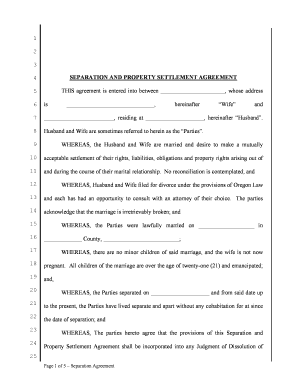
Property Description

A precise description of each item or parcel, using legal descriptions for real estate and serial or VIN numbers for vehicles or titled personal property to avoid ambiguity on later transfer or recording.

Allocation Terms

Clear statements of which party receives which asset, whether transfer is immediate or contingent, and any retained rights such as occupancy, access, or maintenance responsibilities.

Consideration and Payments

Any cash payments, offsets, or mortgage indemnities should be stated in dollars, payment schedules, and remedies for missed payments; reference escrow or settlement accounts when used.

Notarization and Recording Instructions

Specify whether notarization is required, which documents should be recorded, the county or recorder’s office, and who is responsible for recording fees and delivery.

Signature and Acknowledgement

Signature blocks for all parties with date lines, printed names and titles where applicable, and space for notary acknowledgement or witness signatures if required by state law.

Security, compliance and technical safeguards to include

Encryption: AES-256 at rest
Transport Security: TLS 1.2/1.3 in transit
Audit Trail: IP, timestamp, action log
Authentication: Email, SMS, or advanced methods
Compliance: ESIGN, UETA recognized
HIPAA Support: BAA available when required

Step-by-step: preparing and executing the form

Follow these sequential steps to prepare, sign, and complete any required post-signing actions like notarization or recording.

  • 01
    Gather Documents: Collect title, loan, and valuation documents first.
  • 02
    Draft Carefully: Include precise descriptions and allocation language.
  • 03
    Review Legal Terms: Have counsel review complex tax or lien issues.
  • 04
    Sign and Finalize: Execute with required witnesses or notary and distribute copies.

Typical routing and filing flow after signing

After execution, follow a predictable flow: deliver signed originals to the receiving party, perform any notarization, then record transfers or provide copies to stakeholders.

  • Deliver Copies: Send signed copies to all parties.
  • Notarize If Needed: Complete notary acknowledgement per state rules.
  • Record Transfers: Record deeds or title changes at recorder's office.
  • Notify Stakeholders: Provide copies to lenders, insurers, or title agents.

Digital signing and file format considerations

Use an e-signature platform that supports PDF and Word formats, audit trails, and optional advanced signer authentication for higher-assurance transactions.

  • File Types: PDF, DOCX supported
  • Integrations: Salesforce, NetSuite, Procore
  • Authentication: Email, SMS, KBA options

Timing and practical deadlines to track

Plan timing for signature, notarization, recording, and any related filings; county recorder schedules and court calendars can affect effective dates and priority.

Effective Date:

Date of signing sets rights and obligations.

Recording Window:

Record promptly to protect lien or priority interests.

Court Filing:

If part of divorce, follow family court timelines.

Tax Reporting:

Report transfers per tax-year rules if required.

Retention Requirement:

Keep originals per retention rules below.

Common consequences of an incomplete or incorrect form

Invalid Transfer: May be void as to title
Tax Exposure: Unexpected liability or reporting
Title Cloud: Liens or defects remain unaddressed
Court Rejection: Probate or family court may not accept
Notary Defect: Improper acknowledgement can invalidate
Recordkeeping Failure: Loss of enforceability over time

eSignature pricing comparison for form execution

Platform pricing and feature availability vary by plan; select an option that supports notarization workflow, audit trails, and the integrations you need for title or case management.

signNow DocuSign Adobe Sign PandaDoc HelloSign
Starting Price $8/user/mo $15/user/mo $14/user/mo $19/user/mo $15/user/mo
Free Trial Yes, 7-day trial No No Yes, limited Yes, limited
Bulk Send Yes Yes Yes Yes No
Audit Trail Yes Yes Yes Yes Yes
HIPAA Compliant Yes Yes Yes No No

How the Separation Property Form differs from related documents

Compare common document options to determine whether you need a simple allocation record, a court-filed settlement, or a recordable transfer instrument.

Criteria Separation Property Form Property Settlement Agreement
Primary Purpose record division court-enforceable settlement
Notarization usually often required
Recordable often yes
Court Filing optional typically filed

Real-world examples of using electronic signing for property documents

These examples show how organizations and practitioners use compliant e-signature workflows to finalize property-related documents efficiently.

Martin Properties — Tim Martin, Founder

Tim Martin used online execution to close property agreements without in-person meetings.

  • He emphasized mobile and offline signing capability.
  • He reported that processing and executing documents online allowed efficient turnaround while maintaining compliance and ensuring required acknowledgements were captured for recording.

Fertility Centers of Illinois — John Butler, Founder

John Butler described using integrated e-signature and API workflows for patient and operational forms.

  • The implementation supported secure audit trails.
  • The result was consistent, secure signature capture across devices with centralized records that met internal compliance checks and external audit expectations.

Practical tips for an accurate and enforceable form

Adopt a checklist approach to reduce errors: accurate descriptions, consistent names, notarization when needed, correct recording steps, and retained original records.

Confirm legal names
Verify names against government ID and title records to avoid post-signing disputes or delays when recording transfers.
Use precise property descriptions
Provide parcel legal descriptions or serial numbers rather than colloquial addresses to ensure the intended property is unambiguously identified.
Document payment terms clearly
Include exact amounts, due dates, escrow arrangements, and remedies for missed payments to prevent later contractual disputes.
Coordinate notarization and recording
Plan signing sessions so notarization and immediate delivery to the recorder or title agent occur without gaps that could affect priority.

Frequently asked questions about the Separation Property Form

Answers to common questions about signing, notarization, recording, and correcting Separation Property Forms in U.S. jurisdictions.


Need help? Contact support

be ready to get more
Join over 28 million airSlate SignNow users