Establishing secure connection…Loading editor…Preparing document…

Shareholder Agreement

This template is fully customizable. Edit the text, fill out the fields, and send it for signature. Give it a try!
Shareholder Agreement

What a Shareholder Agreement Does

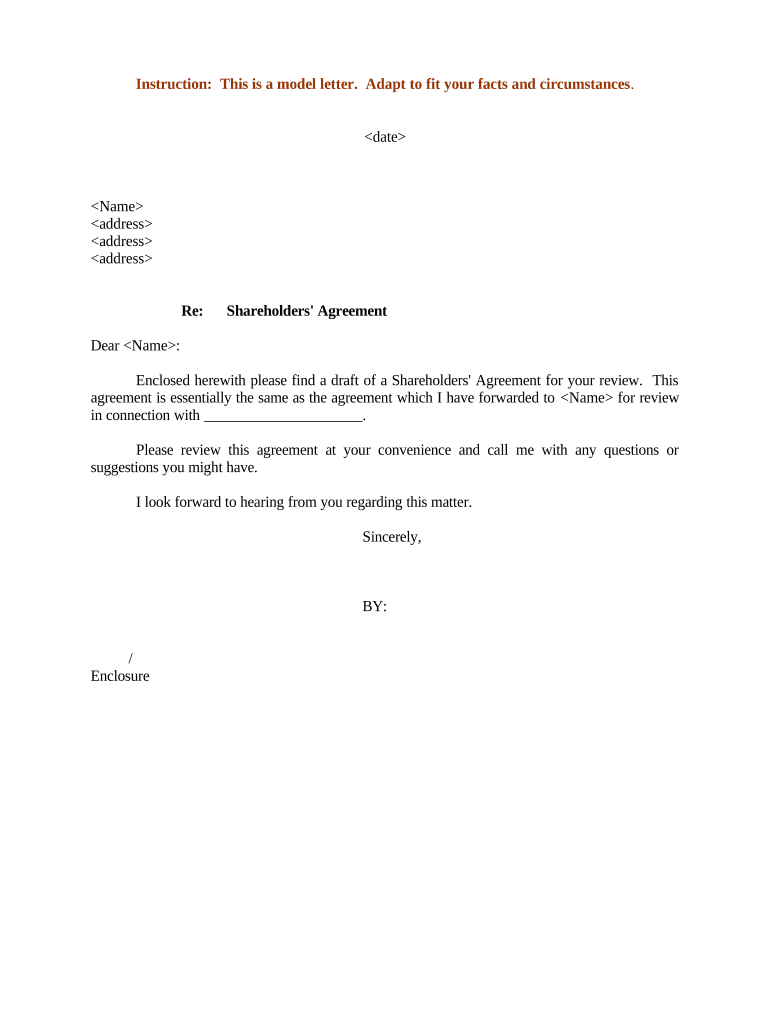
A Shareholder Agreement is a legally binding contract among a corporation's shareholders that records ownership rights, voting arrangements, transfer restrictions, buy‑sell mechanisms, valuation methods, and dispute resolution procedures. It supplements corporate bylaws and articles of incorporation by addressing deadlock resolution, preemptive and tag‑along rights, exit mechanics, and confidentiality. Well-crafted agreements set notice and closing procedures, list share classes and capitalization schedules, and require signatures from the parties to establish enforceability under state contract and corporate law.

Legal Effect and Limits of Electronic Signing

A Shareholder Agreement is enforceable when executed electronically in compliance with the ESIGN Act (15 U.S.C. ch. 96) and applicable state law such as UETA (1999). Certain categories like wills or specific court filings remain excluded from e‑signature treatment and should be handled per statutory exceptions.

Legal Effect and Limits of Electronic Signing

Who Commonly Prepares and Signs This Agreement

Typical users include founders, investors, corporate counsel, and board members responsible for documenting shareholder rights and procedures.

  • Startup founders arranging equity splits, vesting, and ownership transfers.
  • Private equity and angel investors negotiating protective provisions and exit mechanics.
  • Corporate counsel and in‑house legal teams drafting enforceable transfer and governance clauses.

Essential Sections to Include in a Professional Agreement

A complete Shareholder Agreement addresses ownership details, governance, transfers, buy‑sell mechanics, dispute resolution, and amendment procedures to reduce ambiguity and litigation risk.

Share classes

Describe each class of shares, rights, preferences, conversion mechanics, and a schedule listing issued shares and holders for clarity on ownership and economic rights.
Voting rules

Specify quorum, supermajority thresholds, board appointment rights, and any shareholder voting agreements to prevent deadlocks and clarify decision pathways.

Transfer restrictions

Include preemptive rights, right of first refusal, tag‑along and drag‑along clauses, and permitted transfers to maintain control and protect minority holders.

Buy‑sell provisions

Set valuation method, triggering events, payment terms, and timelines for buyouts following death, disability, bankruptcy, or other defined events.

Dispute resolution

Identify governing law, jurisdiction, arbitration or mediation steps, and attorneys' fee provisions to expedite resolution while limiting public litigation.

Amendment process

Define how the agreement may be amended, required majorities, and notice procedures to ensure future changes follow an agreed formal process.

Key Information to Record

Party Legal Names: Full registered entity names
Share Schedule: Class and number of shares
Capital Contributions: Record amounts and dates
Voting Rights: Percentages or special votes
Transfer Limits: ROFR/drag/tag specifics
Governing Law: State selected for interpretation

How to Complete a Shareholder Agreement

Complete, review, and execute the agreement in sequence: populate parties and share data, confirm governance terms, review transfer and buy‑sell clauses, then collect signatures and dated acknowledgements from all parties.

  • 01
    Populate parties: Enter full legal names and entity types.
  • 02
    Record shares: List class, quantity, and issuance dates.
  • 03
    Set mechanics: Define transfer rules and valuation methods.
  • 04
    Execute: Collect signatures, dates, and witness/notary if required.

Configure an Online Signing Workflow

Set up roles, required fields, and authentication to automate execution and maintain an audit trail.

Field Configuration
Signer roles Assign primary and witness roles
Required fields Mark name, date, signature required
Authentication Email, SMS code, or KBA
Audit settings Enable IP, timestamp, and history

Where to Submit and Maintain the Signed Agreement

After execution, route copies to registered agent, corporate records, and finance or legal teams; consider UCC filings for security interests when applicable.

  • Corporate Records: Store signed original in minute book.
  • Registered Agent: Provide copy for statutory notices.
  • Investor Files: Send executed copies to shareholders.
  • Secured Filing: File UCC‑1 if agreement creates security interest.

Technical Options for Electronic Execution

Choose a platform that supports required authentication, audit trails, and secure storage for corporate agreements.

  • Integrations: Salesforce, NetSuite, Google Workspace
  • Formats: PDF, DOCX, HTML
  • Security: AES‑256 at rest

Typical Timelines and Notice Periods

Agreements commonly specify notice and response windows for transfers, buyouts, and dispute steps; track deadlines in calendar and corporate systems.

Effective Date:

Date the rights and obligations begin

Transfer Notice Period:

Commonly 30–90 days to respond

Valuation Window:

30–60 days to select valuation method

Buyout Closing:

Often 30–90 days after notice

Delivery of Executed Copies:

Typically within 7–14 days of signing

Common Mistakes to Avoid

  • Using informal or inconsistent party names that conflict with formation documents and tax records leading to enforceability disputes.
  • Failing to specify valuation mechanics for buyouts, which produces costly appraisal disputes and litigation delays.
  • Neglecting to define permitted transfers or ROFR procedures, enabling unintended share sales or control shifts without notice.
  • Skipping authentication and audit settings for electronic execution, weakening attribution and increasing challenge risk.

Risks of an Incorrect or Incomplete Agreement

Unenforceability: Court may void unclear clauses
Minority Oppression: Claims may arise without protections
Tax Risk: Incorrect valuation affects tax reporting
Breach Damages: Monetary exposure for defaults
Filing Failures: Missed UCC filings risk priority
Confidentiality: Leaked terms may harm valuation

Real‑world Signing Examples

Organizations use e‑signatures to finalize ownership documents, investor consents, and share transfers across industries and company sizes.

Optica Ventures — COO

Optica uses electronic signing to streamline investor documentation and shareholder approvals.

  • The interface is simple and easy‑to‑use for our team.
  • Brian Fitzgibbons, COO, highlights that straightforward signing for customers and internal teams accelerates closing ownership actions while keeping records consistent.

Martin Properties — Founder

A regional property firm executes ownership transfers and investor agreements online to avoid in‑person delays.

  • I can process and execute all of these documents online with 100% compliance.
  • Tim Martin, Founder, reports that secure online execution reduces turnaround time and supports offsite signings during transactions.

Typical Signatory Roles

Founder / CEO

Founders execute agreements to confirm ownership splits and vesting. They often initiate amendments, manage equity schedules, and work with counsel to ensure consistency with formation documents and cap table entries.

General Counsel / Outside Counsel

Legal counsel drafts and reviews provisions on transfers, governance, and compliance. Counsel ensures enforceability, advises on state law selection, and coordinates signature, notarization, and filing procedures where required.

Practical Tips for Accurate Agreements

Follow these drafting and execution practices to reduce disputes and maintain compliance across corporate records.

Use consistent names
Match legal names exactly with formation records, tax IDs, and cap table entries to avoid ambiguities that can undermine enforceability or trigger tax issues.
Define valuation method
Specify appraisal, formula, or agreed price methodology for buyouts to prevent disputes and speed resolution when triggering events occur.
Preserve audit trails
Enable timestamps, IP logs, and signer authentication in electronic workflows to strengthen attribution and evidentiary value in challenges.
Coordinate filings
If the agreement creates a security interest or requires UCC‑1 filings, prepare filing steps and timelines concurrent with execution to protect priority.

Electronic vs Digital Signatures — Key Differences

Understand the legal and technical distinctions between general electronic signatures and cryptographic digital signatures to select the appropriate method.

Criteria Electronic Signature Digital Signature
Definition any electronic mark pki‑based cryptographic method
Legal Status accepted under esign/ueta accepted; stronger non‑repudiation
Non‑repudiation audit trail evidence certificate authority chain
Typical Use general contracts high‑assurance or regulated filings

eSignature Pricing Overview for Agreement Execution

Compare basic plan pricing and core feature availability across common eSignature vendors. signNow is listed first per comparison format; verify plan details with each provider for your use case.

signNow DocuSign Adobe Sign PandaDoc HelloSign
Starting Price $8/user/mo $15/user/mo $14/user/mo $19/user/mo $15/user/mo
Free Trial 7‑day free trial Varies by plan Varies by plan Varies by plan Varies by plan
Bulk Send Yes Yes Yes Yes No
Audit Trail Yes Yes Yes Yes Yes
HIPAA Compliant Yes Yes Yes No No

Frequently Asked Questions

Answers to common execution, enforceability, and amendment questions for Shareholder Agreements and electronic signing workflows.


Need help? Contact support

be ready to get more
Join over 28 million airSlate SignNow users