Parties and Recitals
Identify the company and each shareholder, state purpose, and record formation documents or prior agreements that the new agreement supersedes.
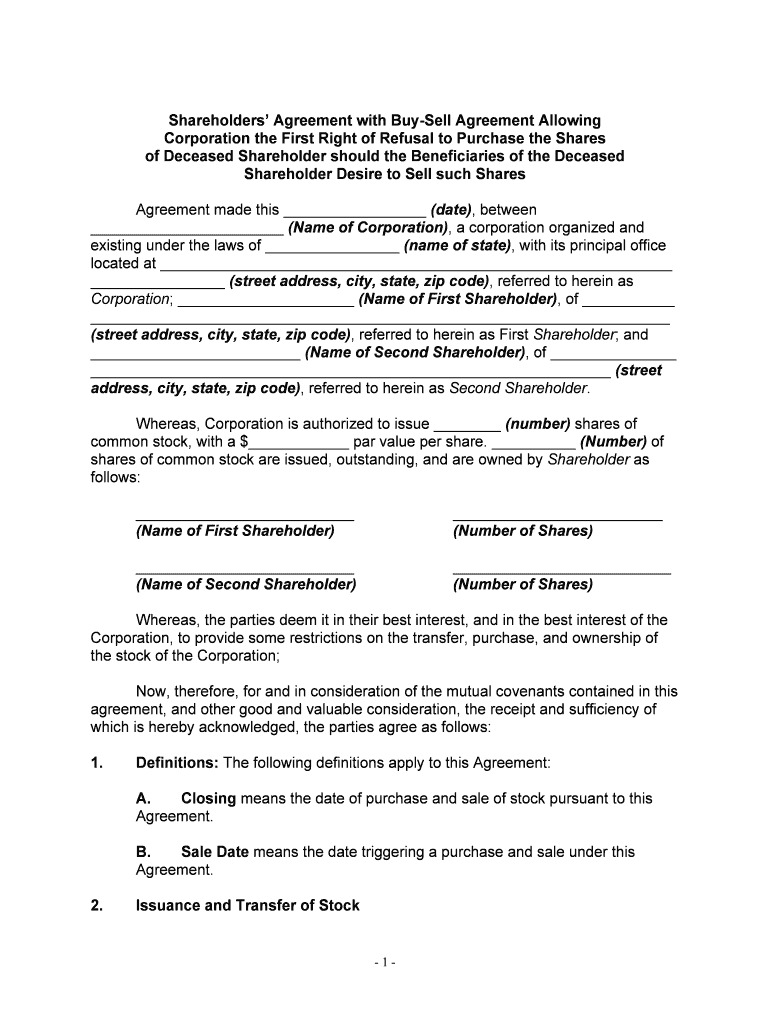
A unified Shareholders’ Agreement with Buy-Sell Agreement clarifies transfer rights, reduces dispute risk, and preserves business continuity after owner changes.

Common parties include closely held corporations, family businesses, investor groups, and professional firms seeking orderly ownership transitions.
In-house or outside counsel usually leads drafting and negotiation, ensuring corporate law compliance, tax considerations, and enforceability across the chosen governing jurisdiction. They coordinate valuation methods, funding mechanisms, and dispute resolution clauses with board and shareholders.
Individual owners, family members, or investor representatives sign and accept transfer limits, notice procedures, and buyout formulas; they must confirm identities, ownership percentages, and signatory authority for the agreement to bind the parties.
| Field | Configuration |
|---|---|
| Signing Order | Sequential or parallel signer flow |
| Authentication | Email link, SMS code, or KBA |
| Conditional Fields | Show fields only when triggered |
| Retention Settings | Set automatic archival and audit trail |
Choose a platform that supports required authentication, audit trails, and the file formats you use.
Confirm integrations and security meet corporate policy and any industry-specific compliance needs before executing high-value transfers.
30 days for notice and initial response
30–60 days to obtain appraisal or apply formula
30 days for offered party to accept or decline
60–90 days to complete transfer and payment
Follow normal year-end reporting deadlines
Event is identified and formal notice is given to parties.
Valuation method is applied or independent appraisal is ordered.
Buyout offer issued and election rights exercised within the notice period.
Final documents executed and funds transferred per agreed terms.
Identify the company and each shareholder, state purpose, and record formation documents or prior agreements that the new agreement supersedes.
Describe each class or series of shares, par values, voting rights, dividend entitlements, and conversion rights to ensure accurate transfer treatment.
List events such as death, disability, insolvency, divorce, or employment termination that give rise to buy-sell obligations.
Specify fixed formula, third-party appraisal process, timing, and any capped or floored prices to reduce valuation disputes.
Define notice procedure, right of first refusal, closing conditions, payment schedule, and escrow arrangements if applicable.
Include governing law, arbitration or litigation clauses, and forum selection to limit forum shopping and accelerate resolution.
Export the signed agreement as a PDF/A to preserve content integrity and an accompanying audit trail.
Keep a DOCX working copy in a secure location for future amendments or redlines.
Attach cap table, stock certificates, board resolutions, and appraisal reports as numbered exhibits.
Retain the platform’s certificate of completion showing signatures, timestamps, and IP addresses.
A small investment firm created a combined agreement to protect minority investors and codify exit mechanics.
A large corporate unit standardized transfer clauses for subsidiary shareholdings to streamline divestiture.
| signNow | DocuSign | Adobe Sign | PandaDoc | HelloSign | |
|---|---|---|---|---|---|
| Starting Price | $8/user/mo | $15/user/mo | $14/user/mo | $19/user/mo | $15/user/mo |
| Free Trial | 7-day free trial | Trial available | Trial available | Trial available | Trial available |
| Bulk Send | Yes (Business Premium+) | Varies by plan | Varies by plan | Varies by plan | Varies by plan |
| Audit Trail | Yes | Yes | Yes | Yes | Yes |
| HIPAA Compliant | Yes | Yes | Yes | No | No |