Establishing secure connection…Loading editor…Preparing document…

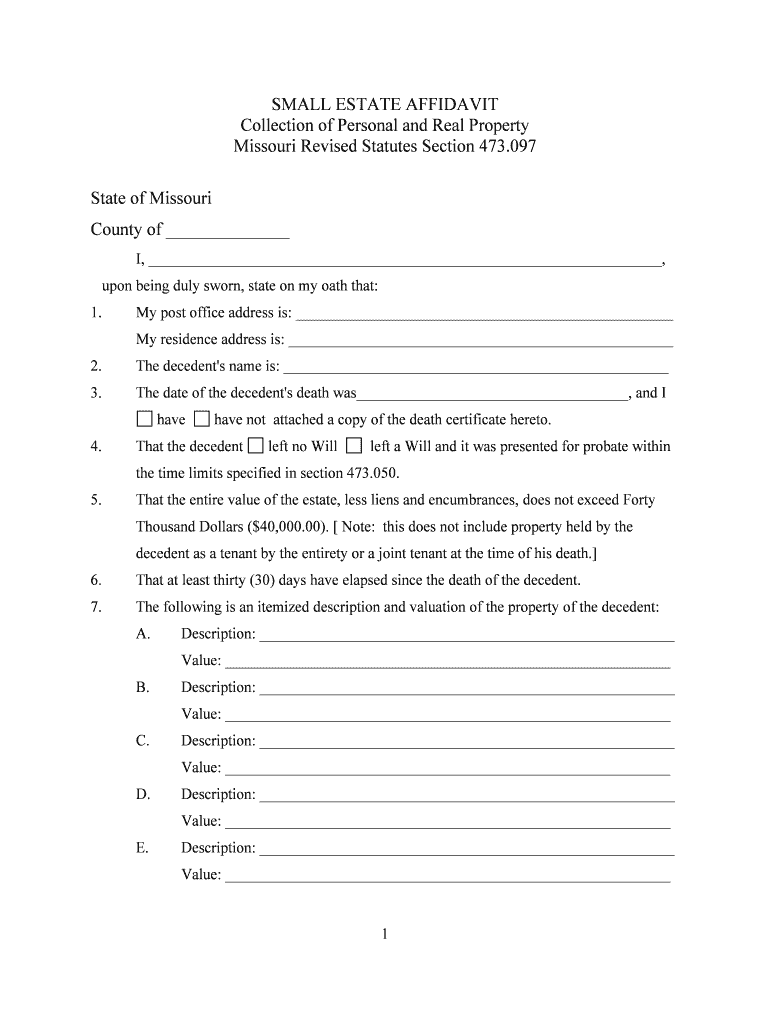
Small Estate Affidavit

This template is fully customizable. Edit the text, fill out the fields, and send it for signature. Give it a try!
Small Estate Affidavit

What a Small Estate Affidavit Is and when it applies

A Small Estate Affidavit is a sworn written statement used to collect or transfer a deceased person’s personal property without a formal probate administration when the estate falls below a state-specific value threshold. It identifies the decedent, lists assets and heirs or beneficiaries, explains the claimant’s right to possession, and is typically sworn before a notary public. States set eligibility, form, and submission rules; some require filing with a probate or county court while others permit presentation directly to banks, title companies, or other holders of assets.

When this affidavit matters for estate administration

A Small Estate Affidavit speeds asset transfer, avoids full probate for low‑value estates, and provides banks and other custodian institutions with a court‑admissible document showing claimants’ authority to collect assets.

When this affidavit matters for estate administration

Who typically prepares and relies on a Small Estate Affidavit

If eligibility or asset complexity is uncertain, consult probate counsel to confirm whether the affidavit or a traditional probate is the correct route.

  • Family members and heirs who need to collect bank accounts, vehicles, or personal items without formal probate
  • Banks and custodians asked to release assets after verifying claimant authority and identity
  • Attorneys or paralegals who prepare the affidavit or review filings for compliance with state law

Core elements included in a professional Small Estate Affidavit

A complete affidavit organizes identification, authority, and asset details so custodians can release property without additional probate steps. Clear, signed, and notarized statements reduce delays when institutions check verification requirements.

Decedent details

Full legal name, date of death, last residence, and any known aliases to allow custodians to match records precisely and avoid release to the wrong account.
Affiant identification

Name, relationship to decedent, contact information, and statement of interest (heir, beneficiary, personal representative) establishing standing to claim assets.

Asset schedule

Concise list of tangible and intangible property being claimed (bank accounts, vehicles, personal property) including account numbers or descriptions to facilitate release.

Statutory authority

Citation or reference to the applicable state small‑estate statute and a declaration that the estate falls below the statutory threshold for the affidavit process.

Oath or affirmation

Sworn declaration under penalty of perjury that the facts are true, signed by the affiant and dated to create a record for institutions and courts.

Notary or witness block

Notary acknowledgement or remote online notarization entry and any required witness signatures to meet jurisdictional formality requirements.

Step-by-step process to complete and use the affidavit

Follow a consistent flow: verify eligibility, document assets, prepare the affidavit, then notarize and submit to custodians or the court as required.

  • 01
    Confirm eligibility: Verify the estate value and state statute permit a small estate affidavit.
  • 02
    Gather documents: Collect death certificate, account statements, titles, and ID for affiant.
  • 03
    Prepare affidavit: Complete the affidavit form accurately and include statutory references if required.
  • 04
    Notarize and submit: Sign before a notary or RON provider and present the affidavit to the bank or file with court if required.

Where and how the affidavit is used after signing

After notarization, present certified copies to organizations holding assets or file with the probate court when the statute requires court filing before release.

  • Banks and financial institutions: Provide affidavit and death certificate to release account balances or close accounts.
  • Motor vehicle agencies: Use affidavit with title paperwork to transfer vehicle ownership where permitted.
  • Courts or probate clerks: File the affidavit if state law requires docketing or if institutions request a court stamp.
  • Title companies: Submit affidavit to clear personal property in conveyance or settlement processes.

Configuring an electronic workflow for this affidavit

Set up the template, signer roles, authentication, and notarization steps before sending to ensure compliance and fast processing.

Field Configuration
Document template Pre-fill decedent and statutory text; lock critical fields to prevent edits.
Signer roles Assign affiant as signer and include notary as separate role or RON step.
Authentication Use at minimum email + SMS; increase to KBA for higher assurance if required.
Storage location Save signed PDF/A to a secure repository with audit trail retention.

Digital signing and delivery considerations

Ensure the chosen workflow preserves tamper-evident signed files, audit trails, and any required notarial journals for compliance and institutional acceptance.

  • File formats: PDF and DOCX for interchange and archival.
  • Integrations: Connectors for Google Workspace, Microsoft 365, and CRM systems speed verification.
  • Authentication options: Support for email, SMS, KBA, and RON enhances acceptance by custodians.

Security and compliance essentials for electronic affidavits

Encryption: TLS 1.2/1.3 in transit; AES-256 at rest
Audit Trail: Time‑stamped events and signer attribution
HIPAA: BAA available when PHI is present
ESIGN / UETA: Legal e-signature framework support
SOC 2 / ISO: SOC 2 Type II and ISO 27001 certifications
21 CFR Part 11: Controls available for regulated records

Risks and legal consequences of defects in the affidavit

Delay in distribution: Holders may refuse release until corrected
Rejection by institution: Banks may require formal probate
Creditor claims: Improper release can expose affiant to creditor liability
Perjury exposure: False statements may trigger criminal penalties
Tax consequences: Improper transfers can affect estate tax filings
Denied notarization: Incomplete ID or improper RON invalidates notarization

Common preparation mistakes to avoid

  • Underestimating the estate value or overlooking omitted assets causes ineligibility and may require probate instead
  • Using inconsistent names or dates between affidavit, death certificate, and bank records leads to processing delays
  • Failing to include statutory citation or required attestation language can make the affidavit unacceptable to custodians
  • Skipping notarization or using the wrong notarial process (in‑person vs RON) can void the affidavit in some states

Compare eSignature providers for completing and notarizing affidavits

Platform pricing and feature availability can affect per‑document cost and notarization options; the table below compares starting price and core capabilities across common providers.

signNow DocuSign Adobe Sign PandaDoc HelloSign
Starting Price $8/user/mo $15/user/mo $14/user/mo $19/user/mo $15/user/mo
Free Trial Yes, 7-day free trial Verify Verify Verify Verify
Bulk Send Yes Yes Yes Yes No
Audit Trail Yes Yes Yes Yes Yes
HIPAA Compliant Yes Yes Yes No No

Frequently asked questions about Small Estate Affidavits

Answers to common questions about eligibility, notarization, eSign use, filing, and what to do when a custodian rejects an affidavit.


Need help? Contact support

be ready to get more
Join over 28 million airSlate SignNow users