Establishing secure connection…Loading editor…Preparing document…

Small Estate Affidavit Form Arkansas

This template is fully customizable. Edit the text, fill out the fields, and send it for signature. Give it a try!
Small Estate Affidavit Form Arkansas

What the Small Estate Affidavit Form Arkansas Is and When it Applies

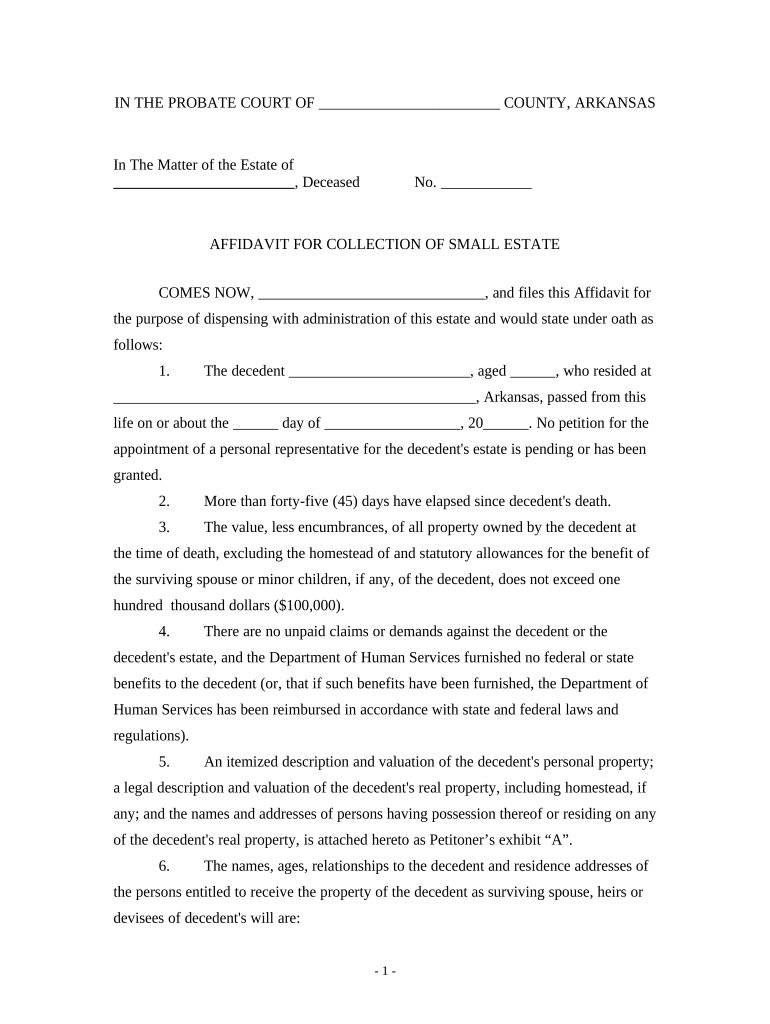
The Small Estate Affidavit Form Arkansas is a sworn, written statement used to collect and transfer certain assets of a decedent without formal probate when the estate qualifies under Arkansas statutory thresholds. It provides a streamlined way for an eligible personal representative or heir to claim bank accounts, vehicles, or other titled property by attesting to the decedent's death, heirs, and value of property. Use of the affidavit reduces court filings and delays for estates that meet the state's size and procedural requirements, but specific eligibility, notarization, and filing steps must be confirmed with the local county clerk or probate court.

Why the Small Estate Affidavit Matters for Arkansas Estates

A properly completed Small Estate Affidavit Arkansas accelerates asset transfer, avoids full probate costs, and creates a clear legal record of entitlement when statutory thresholds are met.

Why the Small Estate Affidavit Matters for Arkansas Estates

Who Typically Prepares and Uses This Affidavit

Common users prepare or submit the affidavit when the estate qualifies for simplified procedures.

  • Personal representative or executor — Often a named executor or nearest kin who will collect and distribute assets according to Arkansas law.
  • Heirs and beneficiaries — Beneficiaries who need title transfers for vehicles, bank accounts, or tangible property when probate is unnecessary.
  • Estate attorney or paralegal — Legal professionals assisting with form accuracy, notarization, and county-specific submission requirements.

Step-by-Step: Completing the Small Estate Affidavit Form Arkansas

Follow this concise sequence to complete the affidavit accurately and reduce processing delays.

  • 01
    Gather Documents: Collect death certificate, asset statements, and title documents.
  • 02
    Confirm Eligibility: Verify estate value meets Arkansas small estate threshold with county clerk.
  • 03
    Complete Form: Enter decedent and heir details, list assets and values.
  • 04
    Notarize & File: Sign before a notary and submit to the relevant county office.

Core Sections Included in a Professional Small Estate Affidavit Arkansas

A complete affidavit groups identity, asset, and authority details into clearly labeled sections so third parties can rely on the statement.

Decedent Details

Full legal name, last residence, date of death, and any identifying numbers needed by banks or title offices for verification of the decedent.
Affiant Information

Name, address, relationship to the decedent, and a statement of authority or entitlement to collect assets on behalf of the estate.

Asset Inventory

Detailed list of bank accounts, vehicles, personal property, and titles including account numbers, approximate values, and location of each asset.

Heir and Beneficiary List

Names, addresses, and how each heir is related to the decedent; used to establish distribution rights and resolve competing claims.

Oath and Notary Block

A sworn statement signed by the affiant and notarized; many institutions will not accept the affidavit without a notarized signature.

Attachments and Evidence

Death certificate, copies of titles, account statements, and any prior wills or letters testamentary that support the facts stated in the affidavit.

Essential Data Elements Required on the Form

Decedent Name: Exact legal name
Date of Death: MM/DD/YYYY
Affiant Identity: Full name and relation
Asset Descriptions: Account/title details
Heir Information: Names and addresses
Notary Acknowledgment: Notary signature/date

Common Preparation Pitfalls to Avoid

  • Incorrect names or dates — using nicknames, initials, or wrong dates frequently causes banks or title agencies to refuse the affidavit.
  • Incomplete asset details — missing account numbers or titles forces institutions to request supplementary documentation and delays transfers.
  • Unsigned or improperly notarized forms — signing before notarization or using the wrong notarial certificate can make the affidavit invalid.
  • Unverified heirship — failing to document or list heirs clearly can trigger contested claims and may require court involvement.

Risks and Legal Consequences of Errors or Misstatements

Civil Liability: Damages for wrongful distribution
Criminal Penalty: Perjury charges possible
Asset Reversal: Institutions may rescind transfers
Probate Requirement: Court probate may be ordered
Delay in Access: Extended wait for creditors
Increased Costs: Attorney fees and court costs

Where to File and How the Submission Process Works

Transmission and filing steps vary by asset type; follow these general routing options when submitting a completed affidavit.

  • County Clerk: File the affidavit where the decedent lived if local recording is required.
  • Probate Court: Some counties require notice or informal filing with the probate division.
  • Financial Institutions: Present notarized affidavit plus identification to banks to claim accounts.
  • Motor Vehicle Office: Submit affidavit with title documents to transfer vehicle ownership.

How to Set Up an Online Completion Workflow

Configure a digital workflow that collects signatures, places required fields, and stores notarized copies for later retrieval.

Field Configuration
Signature Field Require signer to sign and date
Notary Block Lock field until notarized session
Attachments Enable upload for death certificate
Audit Trail Capture timestamps and IP addresses

Digital Signing and eSubmission Requirements

When using an eSignature platform, confirm authentication, notarization, and format support before sending the affidavit.

  • Authentication: Email, SMS, or knowledge-based options
  • RON Support: Platform must support remote notarization
  • File Formats: PDF/A and DOCX accepted

Timelines, Deadlines, and What to Expect

Processing timelines depend on county practices and the receiving institution; plan for verification steps and potential requests for supplemental documents.

Local Filing Response:

Often 3–10 business days for initial acceptance

Bank Processing:

Banks may take 5–30 days to release funds

Title Transfers:

DMV or title office may require up to 30 days

Notarial Availability:

Scheduling depends on RON or in-person options

Probate Review:

Court actions can extend timelines significantly

Representative Use Cases for the Arkansas Small Estate Affidavit

Real-world scenarios highlight how the affidavit simplifies transfers when estates meet informal administration criteria.

Estate Bank Account Transfer

A single adult child uses the affidavit to claim a small bank account

  • Bank requires notarized affidavit
  • The bank verifies identity and releases funds, avoiding full probate and reducing processing fees.

Vehicle Title Transfer

A surviving spouse submits the affidavit with the vehicle title

  • DMV confirms documentation
  • The spouse receives a new title in their name after standard verification and fee payment, bypassing a probate case.

Practical Tips for Accurate and Efficient Completion

Follow these best practices to minimize rejections and speed asset transfers.

Verify Identity Documents
Compare names, dates, and identification across death certificate, IDs, and account records; resolve any discrepancies before submission.
Use Clear Asset Descriptions
Include account numbers, VINs, or title numbers when possible to help institutions match records quickly and avoid additional inquiries.
Notarize Properly
Sign only in the presence of an authorized notary or arrange a remote online notarization where permitted and accepted by the receiving institution.
Keep Originals and Copies
Retain certified copies of the death certificate and notarized affidavit; provide certified copies rather than originals when institutions permit.

Comparing eSignature Vendors for Completing and Notarizing Affidavits

This comparison shows starting prices and common capability differences for popular eSignature vendors when handling affidavits and notarizations.

signNow DocuSign Adobe Sign PandaDoc HelloSign
Starting Price $8/user/mo $15/user/mo $14/user/mo $19/user/mo $15/user/mo
Free Trial 7-day free trial Yes Yes Yes Yes
Bulk Send Yes Yes Yes Yes No
Audit Trail Yes Yes Yes Yes Yes
HIPAA Compliant Yes Yes Yes No No

Frequently Asked Questions About the Small Estate Affidavit Form Arkansas

Answers to common questions about eligibility, submission, notarization, and legal effect for Arkansas small estate affidavits.


Need help? Contact support

be ready to get more
Join over 28 million airSlate SignNow users