Establishing secure connection…Loading editor…Preparing document…

Agreement for Sale of Business

This template is fully customizable. Edit the text, fill out the fields, and send it for signature. Give it a try!
Agreement for Sale of Business

What the Agreement for Sale of Business Is and when it applies

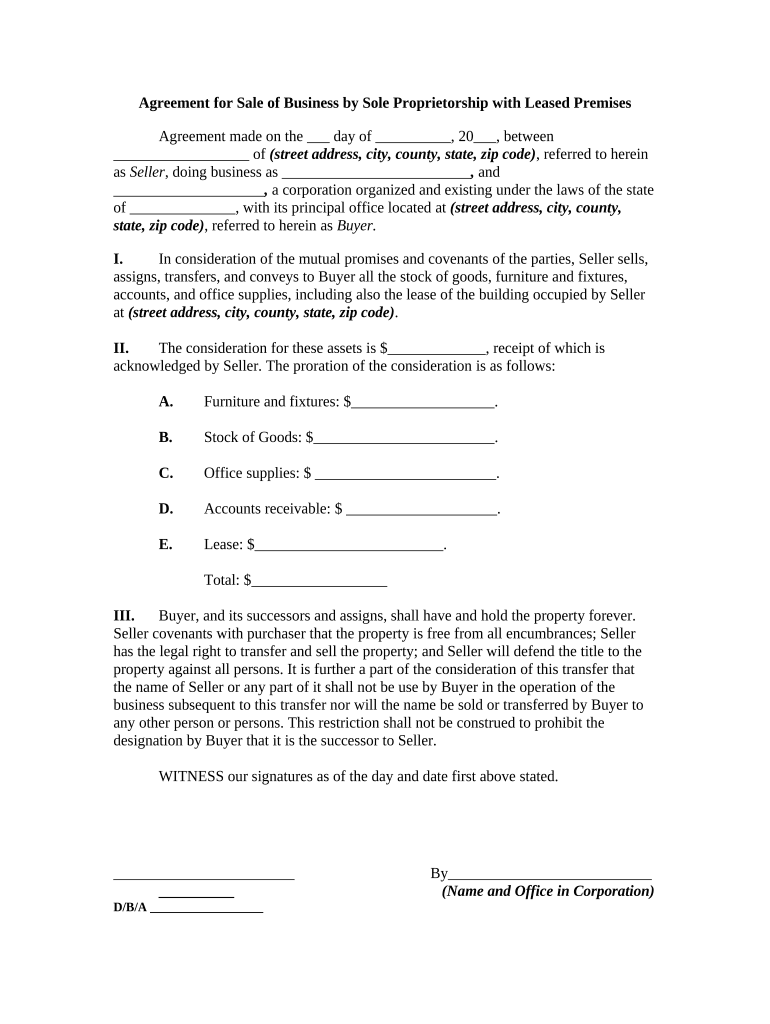
An Agreement for Sale of Business is a legally binding contract that records the transfer of ownership, assets, liabilities, and operating rights from a seller to a buyer. It defines purchase price, inventory and asset lists, warranties, representations, closing conditions, and any post-closing obligations such as noncompete or transition assistance. The document can cover an asset sale or stock sale structure and should coordinate with ancillary filings like UCC financing statements, real property deeds, and tax elections. Properly drafted and executed agreements allocate risk, preserve tax treatment options, and enable enforceable remedies after closing.

Why a clear sale agreement matters for both parties

A well-crafted Agreement for Sale of Business reduces ambiguity about what is transferred, protects against unexpected liabilities, preserves negotiated tax positions, and defines remedies and closing mechanics. It creates a clear roadmap for due diligence, financing, and integration while documenting representations and indemnities that allocate post-closing risk.

Why a clear sale agreement matters for both parties

Who prepares, reviews, and signs this agreement

Typical participants include business owners, buyers or acquiring entities, corporate counsel, accountants, and lenders coordinating closing conditions.

  • Sellers and owners: prepare asset lists and identify liabilities for disclosure.
  • Buyers and acquirers: perform due diligence and confirm financing conditions.
  • Counsel and accountants: draft tax elections and structure closing mechanics.

Common signatories and their roles

Seller — Owner/CEO

The seller signs to transfer title to assets or stock and to make the specified representations and warranties. The signer should match the legal owner name and authority recorded in corporate records.

Buyer — Authorized Officer

The buyer signs to accept assets, assume permitted liabilities, and satisfy closing conditions. The signatory must have corporate authority or board consent documented in corporate minutes or resolutions.

Essential sections every Agreement for Sale of Business should include

Six core provisions form the backbone of a sale agreement; each item clarifies obligations, risk allocation, and what transfers at closing.

Purchase Price

Specify the total consideration, payment mechanism (cash, promissory note, escrow), and any earn-out formula with clear calculation examples and timing for payments.
Assets & Exclusions

List transferred assets (inventory, IP, contracts) and expressly identify excluded items so both parties know what passes and what remains with the seller after closing.

Representations

Seller and buyer representations about ownership, authority, tax status, title, and the absence of material litigation; breach remedies should be tied to these statements.

Indemnities

Define scope, basket/deductible, survival periods, caps, and any escrow or holdback arrangements used to secure post-closing claims.

Closing Conditions

Set out conditions precedent for closing such as third-party consents, financing, UCC searches, and clear title requirements to avoid last-minute disputes.

Post-Closing

Address transition services, employee matters, noncompete or nonsolicit obligations, tax cooperation and cost allocation for any required filings or registrations.

Primary details required in the document

Legal Entity Names: Exact registered names
Purchase Price: Numeric amount
Effective Date: MM/DD/YYYY
Asset Schedule: Itemized list
Escrow Terms: Amount and duration
Signatory Authority: Title and resolution

Step-by-step: completing and executing the agreement

Follow these sequential steps to prepare, review, and execute the Agreement for Sale of Business with minimal rework and legal risk.

  • 01
    Prepare draft: Populate parties, price, assets, and closing conditions; attach exhibits.
  • 02
    Conduct due diligence: Buyer verifies title, contracts, tax records, and employee status before finalizing terms.
  • 03
    Negotiate and finalize: Resolve indemnities, purchase allocations, and any escrow or holdback language.
  • 04
    Execute and record: Sign with required authority, notarize where needed, and file UCC or deed recordings.

How to build a digital signing workflow for this agreement

Set up an ordered workflow that matches the contract's signing sequence, attaches exhibits, and captures an audit trail for each signer.

Field Configuration
Signer Order Sequential signing: seller then buyer then witness or notary
Authentication Email plus SMS code or ID check for high-assurance signers
Attachments Include asset schedules, consents, and board resolutions as required files
Audit Trail Enable IP, timestamp, and completion certificate capture

Where to send and file the signed agreement

After execution, distribute final copies to all parties, their counsel, lenders, and relevant filing offices to complete transfer and public record steps.

  • Seller and Buyer: Each receives an executed copy and escrow instructions immediately.
  • Lenders and Agents: Provide copies to lenders to satisfy financing conditions.
  • UCC Filing: File a UCC-1 financing statement if liens are affected.
  • Deed Recording: Record real property deeds at county recorder when applicable.

Technical considerations for digital signing and eSubmission

Choose a platform that supports secure eSignatures, audit trails, and required authentication levels for the transaction.

  • File formats: PDF, DOCX supported
  • Integrations: Connectors for NetSuite, Salesforce, Google Workspace
  • Security: AES-256 at rest, TLS 1.2/1.3 in transit

Ensure the platform allows notarization or RON where required and preserves tamper-evident signed PDFs and an accessible audit log for regulatory or financing reviews.

Common time-critical dates and filing deadlines

Track deadlines for tax elections, escrow releases, UCC filings, and document retention to avoid penalties or loss of priority.

Effective Date and Closing:

Set the effective and scheduled closing dates in MM/DD/YYYY format.

Tax Elections:

File any Section 338 or similar elections within IRS deadlines.

UCC-1 Filing:

File promptly to protect secured party priority; state fees vary.

Deed Recording:

Record deeds within county timelines to preserve marketable title.

Escrow Release:

Specify escrow release triggers and dates tied to post-closing deliverables.

Common mistakes to avoid when preparing the agreement

  • Failing to identify excluded assets leads to post-closing disputes over ownership and inventory.
  • Using vague indemnity caps or survival periods that create uncertainty and increase litigation risk.
  • Not coordinating tax allocations and elections, which can produce adverse tax consequences for buyer or seller.
  • Skipping secured creditor searches or UCC filings, which can result in subordinate lien priority at closing.

Risks and legal consequences of errors in the agreement

Contract Invalidity: Missing authority may void transfer
Tax Exposure: Incorrect allocations can trigger IRS adjustments
Lien Subordination: Unfiled UCCs can reduce lender priority
Indemnity Claims: Broad reps may lead to costly litigation
Regulatory Penalties: Failure to file required notices may incur fines
I-9 Liability: Employee verification errors carry penalties

Supporting documents to attach and file formats to use

Attach exhibits that the agreement references and deliver final executed copies in durable, tamper-evident formats.

Exhibits

Include asset schedules, assignment lists, consents, board resolutions, and escrow instructions as numbered exhibits referenced in the agreement.

Closing Statement

Provide a final closing statement allocating purchase price and adjustments; attach calculation worksheets for transparency.

Electronic Formats

Distribute signed PDFs (PDF/A recommended) and retain a tamper-evident copy plus an audit trail for each signing event.

Recordings

Retain any RON audio-video recordings or notary journals required by state law to support notarizations.

Key milestones in a sale timeline

Track these numbered stages from negotiation to post-closing to keep the transaction on schedule and meet filing requirements.

01

Negotiation and LOI

Agree basic terms, confidentiality, and exclusivity before spending on due diligence

02

Due Diligence

Buyers verify financials, contracts, and title; issues raise negotiation points for reps and indemnities

03

Closing

Execute documents, exchange funds, and deliver closing deliverables per checklist

04

Post-Closing Integration

Complete transfers, release escrow per conditions, and resolve transition obligations

eSignature vendor pricing and feature snapshot relevant to business sale workflows

Compare basic pricing and core capabilities for eSignature providers used to execute complex agreements with multiple signers and notarization needs.

signNow DocuSign Adobe Sign PandaDoc HelloSign
Starting Price $8/user/mo $15/user/mo $14/user/mo $19/user/mo $15/user/mo
Free Trial 7-day free trial Yes Yes Yes Yes
Bulk Send Yes Yes Yes Yes No
Audit Trail Yes Yes Yes Yes Yes
HIPAA Compliant Yes Yes Yes No No
Envelope Cap No cap 100 envelopes/user/year Varies Varies Varies

Frequently asked questions about executing an Agreement for Sale of Business

Answers to common legal and practical questions encountered during preparation, signing, and recording.


Need help? Contact support

be ready to get more
Join over 28 million airSlate SignNow users