Establishing secure connection…Loading editor…Preparing document…

Complaint for Specific Performance

This template is fully customizable. Edit the text, fill out the fields, and send it for signature. Give it a try!
Complaint for Specific Performance

What a Complaint for Specific Performance Is

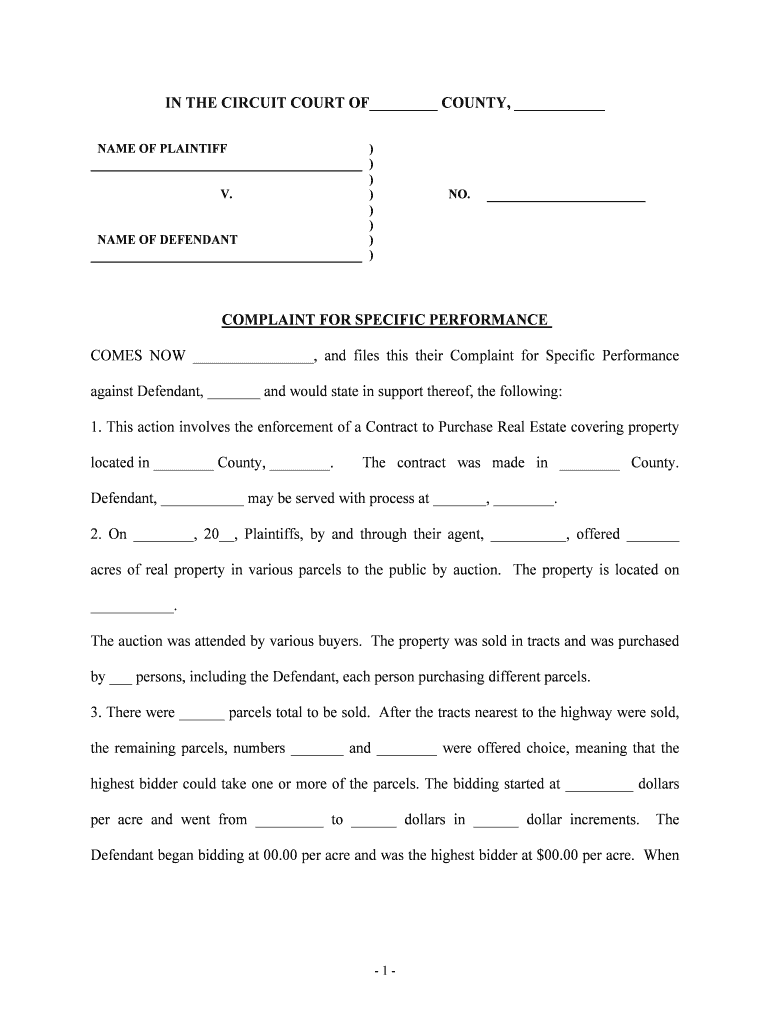
A Complaint for Specific Performance is a civil pleading filed to ask a court to compel a contracting party to carry out specific contractual obligations rather than awarding money damages. It typically arises where the subject matter is unique—real property, custom goods, or one-of-a-kind services—and where monetary compensation would not adequately remedy the plaintiff. The pleading identifies the parties, the contract, the breach, factual basis for uniqueness, plaintiff’s readiness to perform, and the precise equitable relief requested, often accompanied by a proposed form of decree.

Why Specific Performance Matters in Contract Disputes

Specific performance provides an equitable alternative when money is insufficient, enabling courts to order delivery, transfer of title, or completion of bespoke work. It preserves unique expectations, clarifies obligations, and may prevent irreversible losses that would follow the other party's refusal to perform.

Why Specific Performance Matters in Contract Disputes

Who Typically Files or Uses This Complaint

Typical filers include plaintiffs' counsel, buyers of unique property, and counterparties seeking court-ordered performance.

  • Real estate buyers seeking deed transfer when the property is unique or the seller refuses to convey under contract.
  • Commercial clients enforcing delivery of bespoke goods, artwork, or specialty manufacturing contracts with limited market substitutes.
  • Contractors, lenders, or owners in construction disputes requesting completion or transfer rather than a damages remedy.

Step-by-Step: Preparing and Filing the Complaint

Follow these steps to prepare, plead, and serve a Complaint for Specific Performance in state or federal court.

  • 01
    Review Contract: Confirm contract terms and any specific-performance clause if present.
  • 02
    Gather Evidence: Collect contracts, correspondence, receipts, and proof of unique subject matter.
  • 03
    Draft Complaint: Allege breach, readiness to perform, irreparable harm, and requested decree.
  • 04
    File & Serve: File with the court clerk and serve the defendant per local rules.

Core Elements Every Complaint Should Contain

These essential components help ensure the complaint is substantively complete and defensible across jurisdictions.

Parties

Clearly name plaintiff(s) and defendant(s), including entity type and addresses, and state authority to sue in the named capacity.
Contract

Describe the agreement, attach the signed contract as Exhibit A, and identify the clauses creating the duty sought to be enforced.

Breach

Plead specific acts or omissions with dates and factual detail; avoid conclusory boilerplate absent factual predicates.

Readiness

Allege plaintiff’s performance or tender with documentary proof such as payments, delivery attempts, or declarations of readiness.

Uniqueness

Explain why the subject matter is unique or why money damages would be inadequate, supported by market or expert evidence if available.

Relief

State the exact equitable remedy sought, request preliminary relief if needed, and attach a proposed form of order.

Required Information and Supporting Items

Court Caption: Court name, county, venue details
Parties: Full legal names and capacities
Contract Exhibit: Attach agreement as Exhibit A
Breach Details: Specific dates and factual support
Tender/Performance: Proof of readiness to perform
Requested Order: Proposed decree and enforcement terms

Penalties and Risks of an Incorrect Complaint

Dismissal Risk: Insufficient facts can lead to dismissal
Statute Limitations: Missed statutory deadlines may bar relief
Sanctions: Frivolous or unsupported pleadings risk sanctions
Bond Requirement: Court may require a security bond
Enforcement Delay: Lengthy litigation can delay relief
Cost Exposure: Significant attorney and discovery costs possible

Common Mistakes to Avoid

  • Failing to attach or identify the underlying contract often results in a motion to dismiss or demands for better particulars.
  • Neglecting to allege readiness to perform or tender can defeat equitable relief at the outset of the case.
  • Overstating uniqueness without factual support causes courts to prefer monetary damages over specific performance.
  • Missing local filing rules, incorrect captioning, or improper service can delay acceptance or lead to administrative rejection.

How the Filing and Enforcement Workflow Typically Operates

Overview of the typical filing, service, and enforcement workflow for a Complaint for Specific Performance in civil litigation.

  • Prepare Pleading: Draft complaint, attach exhibits, and assemble supporting affidavits.
  • File & Serve: E-file or paper-file and serve the defendant per local rules.
  • Preliminary Relief: Seek temporary restraining order or injunction if immediate harm exists.
  • Hearing & Enforcement: Prove entitlement at hearing and request decree with enforcement mechanisms.

Setting Up an Online Workflow for the Complaint

Configure an online workflow to assemble, review, e-sign, and file a Complaint for Specific Performance with auditability.

Field Configuration
Document Template Prepopulate contract clauses and exhibit placeholders
Signer Roles Plaintiff, counsel, and client reviewer as roles
Authentication Email or SMS code; KBA if required
Notifications Auto-notify parties at each workflow stage

Technical and Compliance Requirements for eSigning and eFiling

Ensure e-signatures and electronic filings meet court rules, produce tamper-evident copies, and preserve an audit trail for signer attribution and timestamps.

  • File Formats: PDF/A or court-accepted PDF
  • Integrations: E-filing systems and document management
  • Authentication: Email, SMS, or advanced methods

Key Deadlines and Time-Sensitive Considerations

Key timing considerations, statute of limitations, and immediate deadlines to assess after a breach that may warrant specific performance.

Statute of Limitations:

Varies by state; check the applicable contract limitations

Preliminary Injunction Deadlines:

File promptly to secure temporary relief before asset transfer

Service Requirements:

Serve defendant per state rules after filing the complaint

Discovery Period:

Expect months of discovery prior to final hearing

Hearing Scheduling:

Court calendars determine hearing dates; expect weeks to months

Milestone Timeline from Filing to Enforcement

Sequential milestones from pre-filing investigation through final enforcement for a Complaint for Specific Performance.

01

Pre-Filing Investigation

Gather contracts, evidence, and readiness proof.

02

File Complaint

Submit complaint and exhibits; obtain filing stamp.

03

Preliminary Injunction Hearing

Seek temporary relief if immediate harm exists.

04

Final Decree & Enforcement

Court issues decree; enforce via contempt or execution.

Representative Use Cases

Two typical scenarios showing when plaintiffs seek a court order for specific performance and the court’s focus in each case.

Residential Closing Dispute

A buyer sued for specific performance after a seller refused to transfer title despite a signed purchase agreement.

  • The property was unique due to location and design.
  • The court considered the buyer’s readiness to close, inspected contract terms, and weighed equitable defenses before ordering transfer and entry of a decree to enforce completion.

Custom Equipment Contract

A purchaser sought specific performance when a manufacturer failed to deliver custom machinery.

  • Monetary damages could not replace the specialized equipment.
  • The court reviewed procurement records, deposit evidence, and vendor correspondence, concluding that specific performance with injunctive relief was appropriate to compel delivery under the contract.

Practical Tips to Strengthen the Complaint

Best practices to increase the likelihood that a Complaint for Specific Performance is procedurally sound and substantively persuasive.

Document the complete contractual record and amendments
Attach signed agreements, amendments, correspondence, and payment proof. Use exhibit tabs and cite specific paragraphs so the court can easily verify the contractual basis and uniqueness.
Demonstrate readiness and tender with evidence
Provide affidavits, receipts, bank records, or deposit confirmations showing plaintiff performed or stood ready to perform; lack of readiness often defeats equitable relief.
Frame uniqueness and inadequacy of damages
Explain why money is inadequate—rarity, uniqueness, or impossibility of replacement—and support with appraisals, market evidence, or expert declarations.
Check local rules and any bond requirements
Research state and local rules for filing, service, emergency relief, and whether a bond or security is mandatory for preliminary injunctions or enforcement.

Who Signs or Authorizes the Complaint

Plaintiff - Authorized Officer

An individual plaintiff signs personally. For corporations or entities, an authorized officer or registered agent must sign and include capacity. Confirm corporate authorization to avoid defects that could require amended pleadings or joinder under procedural rules.

Attorney of Record

An admitted attorney may sign pleadings on behalf of the client and must include bar number and contact details. Counsel certifies factual and legal assertions under applicable rules of professional conduct and civil procedure.

Comparison: eSignature Plans and Features Relevant to Pleadings and Exhibits

Side-by-side pricing and feature comparison for common e-signature plans and availability of HIPAA and bulk-send features relevant to executing legal pleadings and exhibits.

signNow DocuSign Adobe Sign PandaDoc HelloSign
Starting Price $8/user/mo $15/user/mo $14/user/mo $19/user/mo $15/user/mo
Free Trial 7-day free trial Varies by vendor Varies by vendor Varies by vendor Varies by vendor
Bulk Send Yes Yes Yes Yes No
Audit Trail Yes Yes Yes Yes Yes
HIPAA Compliant Yes Yes Yes No No
Envelope Cap No envelope cap 100 envelopes/user/year Varies by plan Varies by plan Varies by plan

Frequently Asked Questions

Answers to common questions about preparing, filing, serving, and enforcing a Complaint for Specific Performance in U.S. courts.


Need help? Contact support

be ready to get more
Join over 28 million airSlate SignNow users