Establishing secure connection… Loading editor… Preparing document…
Navigation

Fill and Sign the Sprinkling Trust Form

Fill and Sign the Sprinkling Trust Form

How it works

Open the document and fill out all its fields.
Apply your legally-binding eSignature.
Save and invite other recipients to sign it.

Rate template

4.6
55 votes
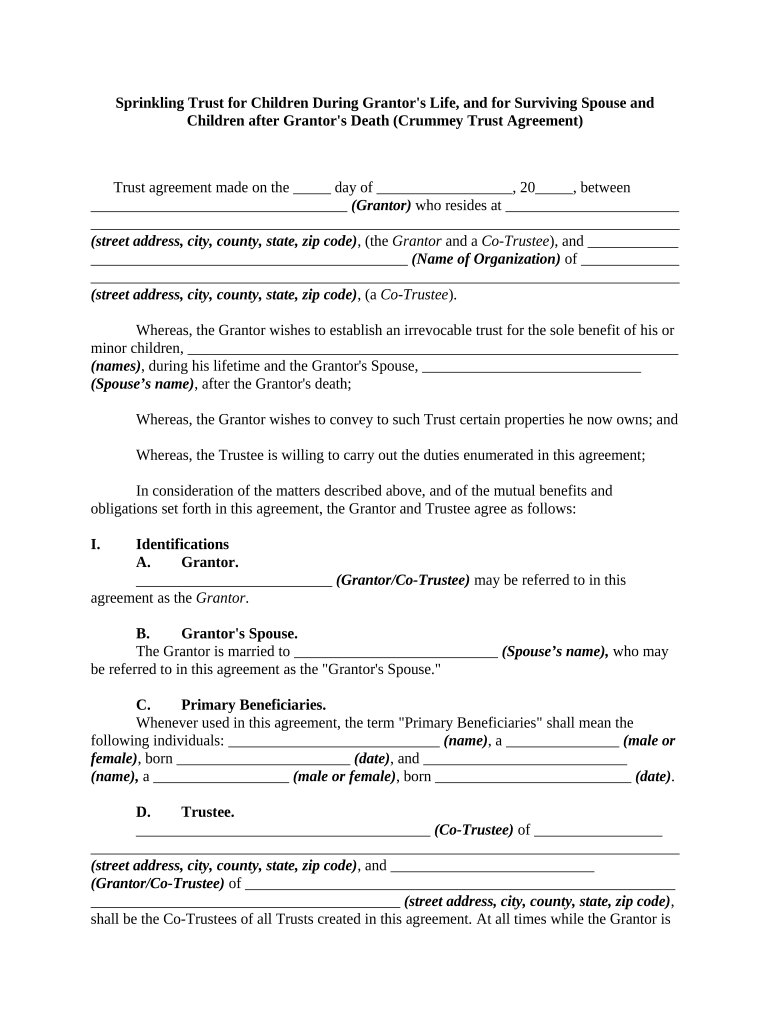
Sprinkling Trust for Children During Grantor's Life, and for Surviving Spouse and Children after Grantor's Death (Crummey Trust Agreement) Trust agreement made on the _____ day of __________________, 20_____, between __________________________________ (Grantor) who resides at _______________________ ______________________________________________________________________________ (street address, city, county, state, zip code) , (the Grantor and a Co-Trustee ), and ____________ __________________________________________ (Name of Organization) of _____________ ______________________________________________________________________________ (street address, city, county, state, zip code) , (a Co-Trustee ). Whereas, the Grantor wishes to establish an irrevocable trust for the sole benefit of his or minor children , _________________________________________________________________ (names) , during his lifetime and the Grantor's Spouse, _____________________________ (Spouse’s name) , after the Grantor's death; Whereas, the Grantor wishes to convey to such Trust certain properties he now owns; and Whereas, the Trustee is willing to carry out the duties enumerated in this agreement; In consideration of the matters described above, and of the mutual benefits and obligations set forth in this agreement, the Grantor and Trustee agree as follows: I. Identifications A. Grantor. __________________________ (Grantor/Co-Trustee) may be referred to in this agreement as the Grantor . B. Grantor's Spouse. The Grantor is married to ___________________________ (Spouse’s name) , who may be referred to in this agreement as the "Grantor's Spouse." C. Primary Beneficiaries. Whenever used in this agreement, the term "Primary Beneficiaries" shall mean the following individuals: ____________________________ (name) , a _______________ (male or female) , born _______________________ (date) , and ___________________________ (name) , a __________________ (male or female) , born __________________________ (date) . D. Trustee. _______________________________________ (Co-Trustee) of _________________ ______________________________________________________________________________ (street address, city, county, state, zip code) , and ___________________________ (Grantor/Co-Trustee) of _________________________________________________________ _________________________________________ (street address, city, county, state, zip code) , shall be the Co-Trustees of all Trusts created in this agreement. At all times while the Grantor is serving as a Trustee, there shall be a Co-Trustee to serve with the Grantor, which Co-Trustee may be referred to in this agreement as the "Independent Trustee." ________________________ ______________________ (Co-Trustee) is the initial Independent Trustee. The Grantor shall be the Investment Trustee. E. Trust Committee. The Trust Committee shall have the powers granted in Section IV of this agreement (dealing with changes in Trustees). The initial Trust Committee shall consist of the following individuals: ____________________________ (name) , of ______________________________ ______________________________________________________________________________ (street address, city, county, state, zip code) , and _____________________________ (name) , of ______________________________________________________________________________ _____________________________ (street address, city, county, state, zip code) . II. Establishment of Trusts; Disposition of Trust Property A. Establishment of the Doe Children's Long-Term Trust. 1. General. The Grantor has conveyed to the Trustee the properties listed in Exhibit A attached to and made a part of this Agreement for all purposes. The Trustee accepts such properties in trust under the terms and conditions of this agreement. The trust so established may be referred to as the " _____________________ (Family’s Last Name) Children's Long-Term Trust." 2. Beneficiaries. During the Grantor's lifetime, the Trustee shall hold and administer the trust properties for the benefit of the Primary Beneficiaries and the descendants of the Primary Beneficiaries. After the Grantor's death, the Grantor's Spouse also shall be a beneficiary of the Trust. Property subsequently transferred to the Trustee to be held in trust under this Agreement shall be treated as though such properties were among the original properties listed in Exhibit A . 3. Primary Beneficiary's Right to Withdraw. To the extent any addition by gift (including the original addition) is made to the Trust, each Primary Beneficiary may demand withdrawal, at any time from the date of the addition until _______ (number) days after the date he or she receives written notice of such addition, of an amount equal to his or her proportionate part only (determined according to the number of such Primary Beneficiaries then living) of the market value (on the date of the gift) of the addition. However, the maximum aggregate amount that may be withdrawn by any Primary Beneficiary in any calendar year pursuant to his or her demand rights shall be limited in value at the time of withdrawal to the maximum amount that would not have been considered a release of a general power of appointment under Section 2041(b)(2) of the Code if such demand rights had not been exercised and had lapsed during the same calendar year. To the extent no withdrawal demand is made within ______ (number) days of the date the Primary Beneficiary receives written notice of any such addition, the right to make such demand shall lapse. Each such withdrawal demand shall be exercisable only by a written instrument (executed by or on behalf of the beneficiary having right of such demand) delivered to the then Independent Trustee on or before the expiration of the ______ (number ) -day period that commences when the beneficiary receives written notice of his or her demand right, and the thus demanded amount shall be payable immediately upon receipt of such written instrument. If the beneficiary is then under any legal disability of any kind, execution of the withdrawal demand may be by his or her legal guardian or, if no legal guardian has been appointed, his or her natural guardian, acting solely on behalf of the beneficiary in making such demand and receiving such distribution for such beneficiary's sole benefit. Notwithstanding any other provision of this Agreement to the contrary, the Independent Trustee shall, at all times while any such withdrawal right is outstanding, retain sufficient liquid funds or transferable assets in the Trust to satisfy all such withdrawal rights which are then outstanding. Each beneficiary designated as having a withdrawal right with respect to any addition or additions (and, if he or she is then under any legal disability of any kind, his or her legal guardian or, if no legal guardian has been appointed, his or her natural guardian) shall be given written notice by the Independent Trustee within _____ (number) days following the date that each withdrawable addition is made. 4. Distributions during Life of Grantor. During the Grantor's lifetime, the Trustee shall have the power, in its sole discretion, to accumulate all or part of the net income of the Trust or to distribute all or part of the income or principal of the Trust for the comfort and welfare of the Primary Beneficiaries and the descendants of the Primary Beneficiaries. It is the Grantor's intention that the beneficiaries be enabled, insofar as possible, to maintain the standard of living to which they are accustomed. The Trustee may (but is not so directed) take into consideration all other sources of income or principal available to each beneficiary in determining what distributions will be made among the beneficiaries of the Trust. The Trustee may make unequal distributions from the Trust among the beneficiaries of the Trust, and no such distributions shall be taken into account upon either the division of the Trust, as provided in Subparagraph A(8) of this Section, or upon final distribution of the Trust properties. It is the Grantor's desire, but not direction, that, in determining which beneficiaries shall receive distributions, the Trustee shall give preference to the needs of the beneficiaries in the following order: first to the Primary Beneficiaries and the descendants of the Primary Beneficiaries taken on a per stirpes basis at the time of any distribution, and second to the further descendants of the Primary Beneficiaries. 5. Distributions after Grantor's Death. After the death of the Grantor, the Trustee shall have the power, in its sole discretion, to accumulate all or part of the net income of the Trust or to distribute all or part of the income or principal of the Trust to or for the Grantor's Spouse, the Primary Beneficiaries, and the descendants of the Primary Beneficiaries, in order to provide for their health, support, maintenance, and education. 6. Standards for Distribution after Grantor's Death. It is the Grantor's desire, but not direction, that, in determining which beneficiaries shall receive distributions after the death of the Grantor, the Trustee shall give preference to the needs of the beneficiaries in the following order: first to the Grantor's Spouse, second to the Primary Beneficiaries and their descendants taken on a per stirpes basis at the time of any distribution, and third to the further descendants of the Primary Beneficiaries. It is the Grantor's intention that the beneficiaries be enabled, insofar as possible, to maintain the standard of living to which they are accustomed. In determining what distributions, if any, should be made from the Trust, the Trustee may (but is not so directed to) take into consideration all other sources of income or principal available to each beneficiary. The Trustee may make unequal distributions from the Trust among the beneficiaries of the Trust, and no such distributions shall be taken into account upon either the division of the Trust, as provided in Subparagraph A(8) of this Section, or upon final distribution of the Trust properties. 7. Distributions after Grantor's Spouse's Death. After the deaths of the Grantor and the Grantor's Spouse, the Trust shall be held, administered and distributed as follows: a. Income and Principal. After the death of the Grantor and the Grantor's Spouse, the Trustee shall have the power, in its sole discretion, to accumulate all or part of the net income of the Trust or to distribute all or part of the income or principal of the Trust to or for the Primary Beneficiaries and the descendants of the Primary Beneficiaries in order to provide for their health, support, maintenance, and education. b. Standards for Distribution. It is the Grantor's desire, but not direction, that, in determining which beneficiaries shall receive distributions, the Trustee shall give preference to the needs of the beneficiaries in the following order: first to the Primary Beneficiaries and their descendants taken on a per stirpes basis at the time of any distribution, and second to the further descendants of the Primary Beneficiaries. It is the Grantor's intention that the beneficiaries be enabled, insofar as possible, to maintain the standard of living to which they are accustomed. In determining what distributions, if any, should be made from the Trust, the Trustee may (but is not so directed to) take into consideration all other sources of income or principal available to each beneficiary. The Trustee may make unequal distributions from the Trust among the beneficiaries of the Trust, and no such distributions shall be taken into account upon either the division of the Trust, as provided in Subparagraph A(8) of this Section, or upon final distribution of the Trust properties. c. Special Distribution to House Children. After the deaths of the Grantor and the Grantor's Spouse, the Trustee is authorized, in its sole discretion, to distribute to the person with whom any Primary Beneficiary less than the age of _____ (number) resides, an amount sufficient (after the payment by the recipient of income taxes, if any, on the distribution) to defray the expense of making additions or improvements to that person's residence or to purchase a larger residence to accommodate such child of the Grantor. The distributee shall not be required to reimburse the Trust for any amount so expended. The Trustee's discretion as to any distribution shall be conclusive as to the advisability of such distribution and shall not be subject to judicial review. 8. Division of the Trust into Separate Trusts. After the deaths of the Grantor and the Grantor's Spouse and when the youngest then-living Primary Beneficiary has attained the age of ______ (number) years (or upon the death of the Grantor, the Grantor's Spouse, and all of the Primary Beneficiaries), the Trustee shall divide and partition the Trust into separate portions of equal value, one portion for each Primary Beneficiary who survives such event and one portion for the descendants of each Primary Beneficiary who shall fail to survive such event but who leaves descendants who survive such event. The Trustee shall hold the portion for each Primary Beneficiary who survives such event as a separate Trust and each such separate Trust shall be designated by the name of that particular Primary Beneficiary. Each such Trust shall be held and administered for the benefit of the Primary Beneficiary whose name designates that particular Trust and for that Primary Beneficiary's descendants. The portion of the Trust for each Primary Beneficiary who shall fail to survive such event but who leaves descendants who survive such event shall be distributed to such descendants, per stirpes, subject, however, to the other provisions of this agreement. a. Distributions of Income and Principal. The Trustee shall have the power, in its sole discretion, to accumulate all or part of the net income of each Trust or to distribute to and among the beneficiaries of each Trust such amounts of income and principal (even to the exhaustion of the Trust) as are necessary for the health, support, maintenance, and (where applicable) education of the respective beneficiaries, with such standards to be construed liberally. In determining what distributions, if any, should be made, the Trustee may (but is not so directed to) take into consideration all other sources of income or principal available to each beneficiary. The Trustee may make unequal distributions among the beneficiaries of each Trust, and no such distributions shall be taken into account in determining the respective shares of beneficiaries upon the final distribution or division of each Trust. b. Distribution Priorities. It is the Grantor's desire, but not direction, that, in determining which beneficiaries of each Trust shall receive distributions, the Trustee shall give preference to the needs of the beneficiaries of the Trusts in the following order: first to the Primary Beneficiary whose name designates that Trust, second to the descendants of such Primary Beneficiary whose name designates such Trust taken on a per stirpes basis at the time of any distribution, and third to the further descendants of such Primary Beneficiary whose name designates such Trust. 9. Final Distributions of the Separate Trusts. a. Partial Terminating Distribution. At the time when the Grantor and the Grantor's Spouse have died and the Primary Beneficiary whose name designates that Trust has reached the age of ______ (number) years, the Trustee shall distribute ______________________ (fraction) of all of the principal and undistributed income then remaining in that Trust to the Primary Beneficiary whose name designates that Trust. b. Final Terminating Distribution. At the time when the Grantor and the Grantor's Spouse have died and the Primary Beneficiary whose name designates that Trust has reached the age of ________ (number) years, or has sooner died, the Trustee shall distribute all of the principal and undistributed income then remaining in that Trust to the Primary Beneficiary whose name designates that Trust and the then-living descendants of such Primary Beneficiary, per stirpes, but if such Primary Beneficiary is then deceased and has no then-living descendants, then to the Grantor's then-living descendants, per stirpes, and that Trust shall terminate. 10. Major Disaster. If at the time of the death of the later to die of the Grantor and the Grantor's Spouse, the Grantor shall have no living descendants, or, if after the death of the Grantor and the Grantor's Spouse, all of the Grantor's descendants shall die before or at the time of the final termination of each Trust as provided in Subparagraph A(9)(b) above, then each Trust shall terminate and the principal and undistributed income of the Trust shall be divided into two equal shares. One such share shall be distributed to the Grantor's Heirs, and the other such shall be distributed to the Grantor's Spouse's Heirs. 11. Distribution to Beneficiary for Whom Trust Already Established . If any distribution of any property previously held in trust under this agreement for any beneficiary is to be made to another beneficiary for whom at such time the Trustee holds property in any Trust, then such distribution may, in the Trustee's sole and absolute discretion, be made to the latter beneficiary or may be added to and become a part of the latter beneficiary's trust. B. Contingent Trust for Persons Less Than the Age of ______ (number) . Notwithstanding the preceding provisions of this Section II, this Paragraph B shall apply if any portion of the principal of any Trust created in this instrument would be distributable to a beneficiary (other than a Primary Beneficiary) who has not reached his or her ________ th (number) birthday and no other Trust is created in this instrument for that beneficiary. If the Trustee, in its sole discretion so elects, that portion shall be retained by the Trustee as a separate Trust for the benefit of the beneficiary. Until the beneficiary reaches his or her _______ th (number) birthday, the Trustee shall have the power to accumulate all or part of the income of that Trust or to distribute so much of the income and principal of that Trust to or for the benefit of the beneficiary as the Trustee, in its sole judgment and discretion, deems necessary for the education, maintenance, support, and health of the beneficiary. When the beneficiary reaches his or her _______ th (number) birthday, the Trustee shall distribute all of the then-remaining principal and undistributed income of the Trust to the beneficiary. If the beneficiary dies before reaching his or her ________ th (number) birthday, the Trustee shall distribute the then-remaining principal and undistributed income of the Trust to the estate of the beneficiary. C. Payments to Incapacitated Person. During the minority or physical or mental incapacity of any person to whom principal or income of any Trust created in this agreement may be paid (either during the term of a trust or upon final distribution of a trust), the Trustee may make such payment in any one or more of the following ways: 1. To such person directly; 2. To the guardian, committee, conservator, or other similar official of such person; 3. To a relative of such person to be expended by such relative for the benefit of such person, including payment to such relative; 4. To a custodian under an applicable Uniform Transfers (or Gifts) to Minors Act; or 5. By the Trustee expending the same directly for the benefit of such person. The Trustee's determination of the minority or incapacity of any such person shall be final, and the Trustee shall not be responsible for the application of any payment after the same has been made to any person in accordance with the provisions of this Paragraph C . D. Spendthrift Clause. All trusts created in this instrument shall be Spendthrift Trusts. E. Undistributed Income Added to Principal. Any income of any Trust not distributed within the first _______ ( number) days following the end of the taxable year of that Trust shall be added to the principal of the Trust and administered as a part of such principal. III. Powers, Rights and Duties of Trustee A. Definition of Trustee; Distribution of Powers. The Trustee, whether one or more, whether male or female, whether individual or corporate, whether original, successor, or substitute, is called "Trustee" in this Agreement. The Independent Trustee shall have the sole authority to exercise the Tax Sensitive Powers. The Investment Trustee shall have the powers stated in Section V, Paragraph H of this Agreement. Otherwise, each Trustee shall have the same duties, powers, and discretions. However, no Trustee shall have the power to participate in any decision relating to a distribution of either principal or income to provide any benefit for any beneficiary that such Trustee is legally obligated to support in his or her personal capacity. B. General Powers. In the administration of any Trust established in this agreement, the Trustee shall have the powers set forth in Exhibits B, C, D and E attached to and made a part of this agreement for all purposes, which powers shall be exercised in a fiduciary capacity. All powers and discretions of the Trustee shall be exercised free of court supervision. C. Limitations on Powers. No powers of the Trustee enumerated in this agreement (including Exhibits B, C, D and E ) or now or later conferred upon trustees generally, shall be construed to enable a Grantor to purchase, exchange, or otherwise deal with or dispose of all or any part of the principal or income of any Trust for less than an adequate consideration in money or money's worth, or to enable a Grantor to borrow all or any part of the principal or income of any Trust, directly or indirectly, without adequate interest or security. No person, other than the Trustee, shall have or exercise the power to vote or direct the voting of any stock or other securities of any Trust, to control the investment of any Trust either by directing investments or by vetoing proposed investments, or to reacquire or exchange any property of any Trust by substituting other property of an equivalent value. D. Liability of Trustee and Persons Dealing With Trustee. The liability of the Trustee and persons dealing with the Trustee shall be according to Exhibit D attached to and made a part of this agreement for all purposes. E. Release of Power by Amendment of Trusts. Any Trustee shall have the power and authority to amend the provisions of the Trusts in order to surrender, release, renounce, or disclaim any one or more of the discretionary powers given by this agreement to that Trustee. Any such amendment shall be made by written instrument acknowledged and filed in the ____________________________________________ (clerk of county where document would be recorded) of the Grantor's County. After any power has been so surrendered, released, renounced, or disclaimed, it shall never again be exercised by that Trustee. F. Records; Inspection. The Trustee shall keep accurate and complete records of Trust transactions. Any beneficiary (or his or her representative authorized in writing) may inspect the records at any reasonable time. G. Annual Report. Upon written request by the beneficiary or his or her personal representative, the Trustee shall make an annual report in writing to any living beneficiary over the age of _____ (number) years who could, in the discretion of the Trustee, receive any income or distribution from the Trust estate during that year. Such report shall be for a calendar or fiscal year beginning each year on a date selected by the Trustee as appropriate for this purpose and shall be submitted to such income beneficiary (or to the guardian, conservator, committee, or other like official of any incapacitated beneficiary) with reasonable promptness after the end of such period. Each report shall include a statement of all property on hand at the end of such year, all receipts and disbursements during such year, all sales and purchases made during such year, and of such other acts of the Trustee as may be necessary to furnish such beneficiary with adequate information as to the condition of the Trust estate. H. Compensation and Bond. Each Trustee, other than the Grantor, shall be entitled to reasonable fees commensurate with its duties and responsibilities, taking into account the value and nature of the Trust estate and the time and work involved. The Trustee shall be reimbursed for the reasonable costs and expenses incurred in connection with its fiduciary duties under this agreement. No Trustee, whether original or successor, shall be required to furnish a bond or other security, except as expressly provided in this agreement. IV. Irrevocability; Change in Trustee and Trust Committee A. Trusts Irrevocable. This agreement and the Trusts created by it shall be irrevocable and shall not be altered, amended, revoked, or terminated, in whole or in part, by the Grantor. B. Renouncement of Interest by Grantor. Notwithstanding any other provision in this agreement, no part of the principal or income of any Trust established in this agreement shall ever revert to or be used for the satisfaction of legal obligations of the Grantor; and no income of any Trust established in this agreement shall be applied to the payment of premiums of insurance on the life of the Grantor or the Grantor's Spouse without the prior written approval of all the Primary Beneficiaries, or if there are no Primary Beneficiaries, then all of the then income beneficiaries of such Trust. The Grantor renounces for ____________ ( himself or herself) and _______ (his or her) estate any interest, either vested or contingent, including any reversionary right or possibility of reverter, in the principal and income of the Trusts, and any power to determine or control, by alteration, amendment, revocation, termination, or otherwise, the beneficial enjoyment of the principal or income of the Trusts. C. Resignation of Trustee. Any Trustee may resign by filing a written instrument acknowledged of record in the __________________________________________________ (clerk of county where document would be recorded) of the Grantor's County, which filing shall deprive the resigning Trustee of all powers as Trustee under this agreement on the effective date of the instrument or, if no effective date is stated, immediately; provided, nevertheless, that at least _______ (number) days prior to such filing, the resigning Trustee shall give written notice of the resignation to those persons who could in the discretion of the Trustee receive income from the Trust estate and are at such time sui juris . No purchaser from or other person dealing with any Trustee is obligated to examine such public records, and any such person shall be protected in all transactions with any Trustee whether or not any such resignation has taken place. If the Investment Trustee shall resign or otherwise cease or fail to serve as Trustee, the Independent Trustee shall serve as the sole Trustee. If the Independent Trustee shall resign or otherwise cease or fail to serve, the Trust Committee shall appoint a successor Independent Trustee in the manner set forth in the following Paragraph D. D. Removal of Trustee and Appointment of Successor by Trust Committee. The Trust Committee shall have the power to remove the Independent Trustee named in this Agreement and any successor Independent Trustee. The Trust Committee also shall have the power to appoint successor Independent Trustees but shall not have the power to appoint more than _________ (number) Independent Trustees to serve at one time. If a Trustee expressly is appointed for administration of the Trust because the Trustee or Trustees otherwise serving are prohibited from exercising a power or performing an act, then the Trust Committee may limit that Trustee's powers to the power or act the exercise or performance of which is prohibited to the other Trustee or Trustees. The Trust Committee shall act in its sole discretion in taking any action authorized in this paragraph and shall act by a majority vote of the members then serving. Any successor Independent Trustee appointed by the Trust Committee shall be either (a) any individual who is not a beneficiary of the Trust of which such individual is to be appointed Trustee (but not an individual listed in Subparagraph E(2) of this Section), or (b) any national or state bank, trust company, or other financial institution in the United States having trust powers and a capital and surplus of $_____________________ (amount ) or more. Such removal and appointment shall be by written instrument executed and acknowledged by a majority of the Trust Committee members then serving and by the successor Independent Trustee and filed in the _____________________________________________ (clerk of county where document would be recorded) of Grantor's County. A member of the Trust Committee or the successor Independent Trustee shall promptly deliver a copy of such instrument to the Independent Trustee then serving, which shall immediately deprive such Independent Trustee of all powers as Trustee under this agreement, except those powers appropriate to the administration of the Trust during the time required for the transfer of the Trust assets. No purchaser from, or other person dealing with, any Trustee is obligated to examine such public records, and any such person shall be protected in all transactions with any Trustee, whether or not any such replacement has taken place. E. Administration of Trust Committee. 1. Replacement of Members. If, through any member's ceasing or failing to serve, the membership of the Trust Committee shall be reduced to less than ________ (number) individuals, the remaining members shall appoint by majority vote a sufficient number of persons to bring the total membership to ________ (number) individuals. Any person may be reappointed to serve as a member of the Trust Committee. 2. Limitations Regarding Committee Members. The following individuals shall be ineligible to serve as a member of the Trust Committee if the appointment of such an individual would result in the Trust Committee's having a membership more than half of whom are: a Grantor or any beneficiary; the spouse of a Grantor or of any beneficiary; the father, mother, lineal descendant, brother, or sister of a Grantor or of any beneficiary; an employee of a Grantor or of any beneficiary; an employee of a corporation in which the stockholdings of the Grantor, the Trust, and the beneficiaries of the Trust are significant from the viewpoint of voting control; an employee of a corporation in which a Grantor or any beneficiary of the Trust is an executive; a partner of a partnership in which the interest of the Grantor, the Trust, and the beneficiaries of the Trust are significant from the viewpoint of operating control or distributive share of partnership income; or an employee of a partnership in which a Grantor or any beneficiary of the Trust is a partner. 3. Fiduciary Capacity; Bond; Compensation. In carrying out its duties, the Trust Committee shall act in a fiduciary capacity, but shall not be required to furnish bond. Each member of the Trust Committee shall be entitled to reimbursement for any out-of-pocket expenses incurred in the performance of such member's duties. No member of the Trust Committee shall be entitled to compensation. 4. Limitation on Scope of Trust Committee's Powers. Anything in this Agreement to the contrary notwithstanding, neither the Trust Committee nor any member of it, as a member of the Trust Committee, shall have any power to establish or alter the beneficial enjoyment of principal or income of any Trust created or authorized in this Agreement. F. Powers and Duties of Successor Trustee. Upon the appointment and qualification of any successor Independent Trustee, the same duties shall devolve upon, and the same rights, powers, authorities, privileges, and discretions shall inure to it as to the Independent Trustee originally designated under this Agreement; and all rights, powers, authorities, privileges, and discretions shall be exercised without the supervision of any court. G. Reorganization of Corporate Trustee. If a corporate Trustee should, before or after qualification, change its name; be reorganized, merged, or consolidated with, or acquired by any other corporation; or be converted into or assign its trust functions to a different type of entity, the resulting entity shall be deemed a continuation of the former one and shall continue to act as Trustee or continue to be eligible to become a Trustee, as the case may be. V. Definitions A. Survive. For purposes of this agreement, one person shall be regarded as having survived another only if the former survived the latter by _____ (number) days or more. B. Grantor's County. Wherever used in this agreement, the term "Grantor's County" shall mean ___________________County, ________________________ (state) . C. Code. All references in this agreement to the "Code" shall mean the Internal Revenue Code of 1986, as amended, and shall be deemed to refer to corresponding provisions of any subsequent federal tax law. D. Issue and Descendants. Wherever used in this agreement, the word "issue" or the word "descendants" shall mean legitimate descendants of whatever degree, including descendants both by blood and by adoption. A person shall be regarded as having been adopted by another only if the adoption is by court proceedings, the finality of which is not being contested by the adopting person. A child en ventra sa mere shall be regarded for purposes of this agreement, as though he or she were then living, but only if he or she survives birth. E. Per Stirpes . All references in this Agreement to per stirpes shall mean a distribution in accordance with this paragraph. Except for discretionary distributions which may be made unequally among a group of beneficiaries, whenever a distribution is to be made to the descendants of any person, the property to be distributed shall be divided into as many shares as there are living children of the person and deceased children of the person who left descendants who are then living. Each living child (if any) shall take one share and the share of each deceased child shall be divided among his or her then-living descendants in the same manner. F. Education. Whenever used in this agreement, the term education shall include elementary, secondary, college, and postgraduate study or vocational training or study, so long as pursued to advantage by the beneficiary at an institution of the beneficiary's choice. In determining distributions for education, the Trustee may consider the beneficiary's reasonable living expenses. G. Spendthrift Trust. Wherever used in this agreement, the term Spendthrift Trust shall mean a trust no part of the income or principal of which shall ever be transferred or assigned by any beneficiary or distributee, or subjected to any judicial process against any beneficiary or distributee before the same has been paid. No part of the interest of any beneficiary or distributee shall in any event be subject to sale, hypothecation, assignment, or transfer. Nor shall the principal or income of any Spendthrift Trust estate be liable for the debt of any beneficiary or distributee. Nor shall any part of the principal or income be seized, attached, or in any manner taken by judicial proceedings against any beneficiary or distributee on account of the debts, assignments, sale, divorce, or encumbrance of any beneficiary or shall pay to the beneficiary or distributee the sum payable to him or her according to the Trust terms, notwithstanding any purported sale, assignment, hypothecation, transfer, attachment, or judicial process, exactly as if the same did not exist. Nothing contained in this paragraph shall be construed as restricting the exercise of any power of appointment granted in this Agreement. H. Investment Trustee. Wherever used in this agreement, the term Investment Trustee shall mean the person to whom the powers to make any decision or take any action regarding the retention, sale, exchange, lease, or any other acquisition or disposition of, or decision regarding, any property held in any Trust under this Agreement are allocated. I. Independent Trustee. Wherever used in this agreement, the term Independent Trustee shall mean the Trustee to whom the Tax Sensitive Powers are allocated. J. Tax Sensitive Powers. Wherever used in this agreement, the Tax Sensitive Powers held by the Independent Trustee shall mean the following powers, which the Independent Trustee shall have, alone and without joinder of the Investment Trustee, under the authority and discretion granted to the Trustee in the following provisions of this agreement: Section II, Subparagraph A(4) (dealing with distributions during the lifetime of the Grantor); Section II, subparagraph A(11) (dealing with distributions to beneficiaries for whom trusts already exist); Section II, Paragraph C (dealing with payments to incapacitated persons); Section VI, Paragraph A (dealing with change of situs); Exhibit C (dealing with certain "Additional Powers"); and Exhibit E (dealing with Trustee's rights and responsibilities as regards life insurance). K. Grantor's Heirs. Whenever used in this Agreement, the term Grantor's Heirs shall mean those persons who would inherit from the Grantor in accordance with the laws of intestate distribution then in effect in the State of _______________, as if the Grantor had died intestate at the termination of the Trust not survived by the Grantor's Spouse and descendants. L. Grantor's Spouse's Heirs. Whenever used in this agreement, the term Grantor's Spouse's Heirs shall mean those persons who would inherit from the Grantor's Spouse in accordance with the laws of intestate distribution then in effect in the State of ________________, as if the Grantor's Spouse had died intestate at the termination of the Trust not survived by the Grantor and descendants. VI. Miscellaneous A. Situs of Trusts. The Trusts created in this Agreement shall be deemed ______________________ (State) Trusts and shall, in all respects, be governed by the laws of the State of ___________________. However, if the Trustee, in its sole discretion, determines that a change of situs would be beneficial to the purposes of any separate Trust established by this agreement, the Trustee shall have the discretion and authority to change the situs of any such Trust to another state. Formal notice of any change of situs may be given by the Trustee by the filing of a written declaration in the ______________________________________________ (clerk of county where document would be recorded) of the Grantor's County. If the situs of any such Trust is changed to another state, then the Trust shall, in all respects, be governed by the laws of the state that is the new situs. No such change of situs shall be authorized, however, which would result in a termination of the Trust for federal tax purposes. B. Use of Words. As used in this agreement, wherever the context so indicates, the gender of all words shall include the masculine, feminine, and neuter, and the number of all words shall include the singular and plural. The failure to capitalize any word or term, or the erroneous capitalization of any word or term, shall not affect the definition. C. Maximum Duration of Trusts. Notwithstanding any other provision of this agreement, if any Trust created or authorized in this agreement has not otherwise fully terminated under the terms of this agreement, then that Trust shall terminate fully and all principal and undistributed income shall be distributed to the respective income beneficiary or beneficiaries at the end of ______ (number) years and _______ (number) months after the death of the last to die of the following persons living on the date of this agreement: the Grantor, the Grantor's Spouse, and all of the Primary Beneficiaries. D. Parties Bound. This Agreement shall extend to and be binding upon the Trustee, the Grantor, and upon their heirs, executors, administrators, successors and assigns, and the beneficiaries designated in this agreement. E. Invalid Provisions. If any part of this Agreement or the Trusts created by it shall be invalid, illegal, or inoperative for any reason, it is the Grantor's intention that the remaining parts, so far as possible and reasonable, shall be effective and fully operative. The Trustee may seek and obtain court instructions for the purpose of carrying out as nearly as may be possible the intention of this agreement as shown by the terms of this agreement, including any terms held invalid, illegal, or inoperative. F. Headings. The headings used throughout this Agreement have been inserted for administrative convenience only, and do not constitute matter to be construed in interpreting this Agreement. G. Photocopy Original. The original copies of this instrument may consist of multiple counterparts which are executed photocopies of a typed or printed master. The Grantor and the Co-Trustees have executed this Agreement at __________________ _________________________________________________ (designate place of execution) the day and year first above written. _______________________________________ _______________________________________ (Signatures) (Acknowledgments) (Attach Exhibit A, list of property) EXHIBIT B TRUST POWERS The Trustee shall have the following powers: A. Standard. To exercise all powers granted to trustees by the common law or any applicable statutes (as they exist at this date or are subsequently amended), to the extent they increase the powers granted to trustees. If, however, those powers are in conflict with the provisions of this instrument (including this Exhibit and other Exhibits to this instrument), the terms of this instrument shall prevail. B. Selection and Retention of Assets. To retain, without liability for loss or depreciation resulting from such retention, any property or undivided interests in property received from any source, including residential property, regardless of any lack of diversification, risk, or nonproductivity, for such time as the Trustee shall deem advisable, and the Trustee shall be under no obligation to dispose of or convert any such property. Any investments made by the Trustee pursuant to the terms of this instrument need not be diversified, may be of a wasting nature, and may be made or retained with a view to possible increase in value. The Trustee, except as otherwise specifically provided in this agreement, shall have as wide a latitude in the selection, retention, or making of investments as an individual would have in retaining or investing his or her own funds, and shall not be limited to, nor be bound or governed by, any rules of law, statutes, or regulations respecting investments by trustees. C. Sale or Disposition of Trust Property. To sell, exchange, give options upon, partition, convey, or otherwise dispose of, with or without covenants (including covenants of warranty of title), any property that may from time to time be or become a part of the Trust estate, at public or private sale or otherwise, for cash or other consideration, or on credit, and upon such terms and conditions as the Trustee shall think advisable, and to transfer and convey the same free of all Trusts. D. Investment of Trust Property. To invest and reinvest the Trust estate from time to time in any property, real, personal, or mixed, including (without limiting the generality of the foregoing language) securities of domestic and foreign corporations and investment trusts, bonds, preferred stocks, common stocks, mortgage participations, and interests in common trust funds, with complete discretion as to converting realty into personalty, or personalty into realty, or otherwise changing the character of the Trust estate, even though such investment (by reason of its character, amount, proportion to the total Trust estate, or otherwise) would not be considered appropriate for a fiduciary apart from this provision, and even though such investment causes a greater proportion of the total Trust estate to be invested in investments of one type or of one business or company than would be considered appropriate for a fiduciary apart from this provision. E. Loans of Trust Property. To make loans, secured or unsecured, in such amounts, upon such terms, at such rates of interest, and to such persons, firms, or corporations as the Trustee shall think advisable. F. Acquisition of Non-Productive Property. Except as limited by other provisions of this agreement, to acquire property returning no income or slight income, or to retain any such property, so long as the Trustee shall think fit, without the same being in any way chargeable with income, or the proceeds in case of sale or other disposition being in any part deemed income. G. Improving and Leasing Trust Property. To improve any real estate comprising a part of the Trust estate; to demolish any buildings in whole or in part; to erect buildings; to lease real estate or personal property on such terms and conditions and for such length of time (including 99 years or more) as the Trustee shall think fit, even though such lease may extend beyond the term of any Trust; to foreclose, extend, renew, assign, release, or partially release, and discharge mortgages or other liens, and to accumulate income for the purpose of doing so (except where the Trustee is required in this agreement to distribute income). H. Borrowing Money. To borrow money and to execute promissory notes for the same; to secure such obligations by mortgages or other liens or pledges of any property of the Trust estate; to make any type of purchase or contract, including installment contracts or credit arrangements, the effect of which is to borrow money; and to accumulate income for the purpose of repaying any indebtedness owed by the Trustee under this agreement. I. Adjustment of Claims and Suits; Prepayment of Existing Mortgage. To prosecute or defend any suit; to compromise or arbitrate any claim (including a claim for taxes) and any litigation, either in favor of or against the Trust estate or the Trustee in its capacity under this agreement; to pay claims upon such evidence as the Trustee shall think sufficient; and to prepay all or part of any mortgage. J. Employment of Agents. To employ such brokers, bank custodians, investment counsel, attorneys, and other agents or servants, and to delegate to them such duties, rights, and powers of the Trustee for such period as the Trustee shall think fit; and to pay such persons reasonable compensation out of the Trust estate, all regardless of whether any such person or entity is (or is a partner, employee, or employer of, or is owned by) a beneficiary or Trustee under this agreement. K. Voting Securities; Reorganization. To vote, in person or by proxy, any stocks or other properties having voting rights; to enter into voting trusts and voting agreements; to exercise any options, rights, or privileges pertaining to any property in the Trust estate; to participate in any merger, reorganization, or consolidation affecting the Trust estate; and, in connection with the same, to take any action that an individual could take with respect to property owned outright by such individual, including the payment of expenses or assessments, the deposit of stock or property with a protective committee, the acceptance or retention of new securities or property, and the payment of such amounts of money as may seem advisable in connection with the same. L. Insurance. To insure any part of the Trust estate against such risks as the Trustee shall think fit, such insurance to be based on market values or costs, and the coverage to be full or partial as the Trustee shall think fit; to pay the premiums and to collect or adjust the losses; except as limited by other provisions of this agreement, to acquire, hold, and pay premiums on insurance upon the life of any person or persons, and to exercise any and all rights to ownership of the insurance; and to purchase other types of insurance or annuities for any beneficiary; provided, however, all incidents of ownership with respect to any policies of insurance on the life of any Trustee shall be vested in and exercisable solely by another Trustee. M. Mineral Contracts and Sales. To execute and deliver oil, gas, and other mineral leases containing such unitization or pooling agreements and other provisions as the Trustee shall think fit; to execute mineral and royalty conveyances; to purchase leases, royalties, and any type of mineral interest; and to execute and deliver drilling contracts and other contracts, options, and other instruments necessary or desirable to participate actively in the oil, gas, or mining business. All of the foregoing may include such terms, conditions, agreements, covenants, provisions, or undertakings as the Trustee shall think fit. N. Corporations. To incorporate any property in the Trust estate; to convey any such property to a corporation for all or part of its capital stock or other securities (whether or not any Trustee is also a security holder, officer, director, or manager of such corporation in an individual, fiduciary, or other capacity); to dissolve such corporation or any other corporation, the securities of which comprise a part of the Trust estate; and to hold or dispose of, as a part of the Trust estate, any property so received upon such dissolution; all in such manner, at or for such times, and on such terms as the Trustee shall think fit. O. Partnerships. To enter into partnerships; to transfer any property in the Trust estate to one or more partnerships for interests in such partnerships; to act as a partner in any partnership or with respect to any property, any part of which may be or become part of the Trust estate originally or later; to so act as a partner with itself acting in an individual, fiduciary, or other capacity; to participate in the management of such partnerships; to dissolve any partnership in which the Trustee acts as a partner; and to hold or dispose of, as part of the Trust estate, any property received upon any such dissolution; all in such manner, at or for such times, and on such terms as the Trustee shall think fit. P. Businesses. To start or to enter into any business enterprise, or to continue to operate any business interest which becomes part of the Trust estate; to delegate all or part of the management of the business; to invest other funds of the Trust estate in the business; to convert such business from one form (e.g., proprietorship, partnership, corporation, etc.) to another; to enlarge, diminish, or change the scope or nature of the activities of any business; to authorize the participation and contribution by the business in any form of plan to benefit employees, whether or not the contributions qualify as being tax deductible; to use the general assets of the Trust estate for the purposes of the business; to invest additional capital in or make loans to such business, regardless of the speculative nature or nonproductivity of such investment or loan, and without regard to diversification of investment; to endorse or guarantee on behalf of the Trust estate any loan or loans made to the business, and secure such loan or loans by pledge or mortgage of any property of the Trust estate; to employ such officers, managers, employees, or agents as the Trustee deems advisable in the management of the business, including electing or employing directors, officers, or employees of the Trustee to take part in the management of the business as directors or officers or otherwise, and to pay such person or persons reasonable compensation; and to rely upon the reports of certified public accountants as to the operations and financial condition of the business without independent investigation; all in such manner, at or for such times, and on such terms as the Trustee shall think fit (except where the Trustee is required to distribute income). Q. Special Farm Powers. To retain any farm or farm property received from any source, and to acquire and retain other such property; to engage in farm operations and the production, harvesting, and marketing of farm products, including livestock breeding and feeding and poultry and dairy farming, by operating directly with hired labor, by retaining farm managers or management agencies, by renting on shares or for cash, or in any other manner; to enter into farm programs; to purchase or rent farm machinery and equipment, livestock, poultry, seed and feed; to improve farm property and to repair, improve, and construct farm buildings, fences, and drainage facilities; to borrow money for any of these purposes; and in general to do all things customary or desirable in farm operations. R. Payment of Expenses and Taxes. To incur such expenses or charges in the management of the Trust estate as the Trustee shall think fit; to render the Trust estate for taxes if the Trustee shall think it desirable, or to refuse to do so if the Trustee shall think it undesirable; to pay taxes, charges, and governmental assessments against the Trust estate; and, in anticipation of such expenses, charges, taxes, and assessments, to set up such sinking funds or reserves as the Trustee shall think fit (except where the Trustee is required to distribute income). S. Reliance on Business Documents . To rely upon the authenticity of affidavits, certificates, opinions of counsel, letters, notices, faxes, e-mails, telegrams, cablegrams, and other methods of communication in general use and usually accepted in business as genuine and as what such documents or communications purport to be. T. Acceptance of Additional Property. Except as limited by other provisions of this agreement, the Trustee (1) may accept from any source any property acceptable to the Trustee to be held as part of any Trust under this agreement; and (2) is authorized (but not directed) to accept from the Executor, at the termination of the administration of any estate of which any Trust established in this agreement may be the beneficiary, the assets delivered by the Executor to the Trustee on the basis of the estate accounting as submitted by the Executor, without requiring an audit or other independent accounting of the acts of such Executor. No Trustee under this agreement shall have any duty, responsibility, obligation, or liability whatsoever for, or any duty, responsibility, obligation, or liability whatsoever for failure to rectify, the acts or omissions of the Executor. U. Powers under Changed Conditions. To exercise such powers as may be necessary or desirable in the management and control of the Trust estate, whether or not such powers are of like kind or character to those enumerated in this instrument; and in particular to enable the Trustee to act under changed conditions, the exact nature of which cannot now be foreseen. V. Custody of Trust Estate; Nominees; Disbursement of Funds. To retain sole custody of the Trust estate; to keep any of the property of the Trust estate in any place or places in the State of or elsewhere in the United States or abroad, or with a depository or custodian at such place or places; to hold any of the securities or other property of the Trust estate for any length of time in the name of a nominee or nominees without mention of any Trust created in this agreement in any instrument of ownership; to make all disbursements of the Trust funds without any counter-signature; and to make all reports, including tax returns, to any agency of the government, local, state, or federal. W. Execution of Documents. To execute and deliver agreements, assignments, bills of sale , contracts, deeds, leases, notes, powers of attorney, warranties, covenants, guaranties, receipts, releases, discharges, acquittances, and other papers or documents reasonably necessary or desirable to carry out the powers granted to a Trustee. X. Division into Shares or Separate Trusts. To hold, manage, invest, and account for the several shares or separate Trusts that may be held in trust, either as separate funds or as a single fund, as the Trustee shall think fit; if as a single fund, to make division of the fund only upon the books of account, to allocate to each share or Trust its proportionate part of the principal and income of the single fund, and to charge against each share or Trust its proportionate part of the common expenses. Y. Occupancy of Trust Property. Except as limited by other provisions of this agreement, to allow any beneficiary to use or occupy Trust property without payment of rent. EXHIBIT C ADDITIONAL TRUST POWERS The Trustee shall have the following additional powers: A. Certain Transactions with Beneficiaries and Others. To make loans (secured or unsecured), to buy property from, to sell property to, and to otherwise deal with: 1. Any trust beneficiary; 2. The estate of any beneficiary (whether living or dead); 3. Any trust created by or for the benefit of any beneficiary (whether living or dead) or for others; 4. Any executor or trustee of any estate or trust, including the estate of the Grantor; 5. Any executor or trustee acting in his individual capacity; or 6. Any business or trust controlled by any beneficiary or trustee or of which any such beneficiary or trustee, or any director, officer, employee, or partner of any such beneficiary or trustee, is also a director, officer, employee, or partner. B. Apportionment of Income and Expenses. Where not otherwise clearly provided by law or otherwise set forth in this agreement, to determine with finality, as to each sum of money or other thing of value held or received by any Trustee, whether and to what extent the same shall be deemed to be principal or to be income, and as to each charge or expense paid by the Trustee, whether and to what extent the same shall be charged against principal or against income, including, but not limited to, power to apportion any receipt or disbursement between principal and income and to determine what part, if any, of income is available for distribution according to the terms of this agreement, and what part, if any, of the actual income received upon a wasting investment, or upon any security purchased or acquired at a premium, shall be returned and added to principal to prevent a diminution of principal upon exhaustion or maturity of the same; and to set up such reserves out of principal or income as the Trustee shall think fit. 1. Mineral Interests. As regards periodic payments for oil, gas, and other minerals physically severed, however, the following provisions shall apply: a. Definitions. (1) Gross Proceeds. Gross Proceeds shall mean the total amount payable, without deduction for any tax, expense, or other charge. (2) Net Proceeds. Net Proceeds shall mean Gross Proceeds, less, if and to the extent applicable, according to generally accepted accounting principles, all recurring taxes (except income taxes), depreciation on equipment, lifting costs, and other expenses usually chargeable to income, including intangible drilling and development costs, but excluding depletion. In a determination of net proceeds, the Trustee shall adopt such accounting periods, not longer than one year, as the Trustee may deem proper. (3) Receipts. Receipts shall mean the amounts actually received by the Trustee, whether Gross or Net Proceeds. (4) Interest. Interest shall mean each tract or property the title to which is evidenced by a separate conveyance, assignment, lease, or other instrument that establishes the legal right to receive monetary payments in connection with the same; provided, however, that if the title to two or more areas that are non-contiguous is derived from a single instrument, each of such areas shall constitute a separate interest. b. Allocations . Receipts from each interest, treated by the Trustee as a separate asset, shall be apportioned as follows: (1) If a production payment is acquired by the Trustee by gratuitous conveyance or purchase, and at time of acquisition the property in respect of which it exists is producing, in commercial quantities, oil or gas from which the payment is or will be payable, to income, an amount equivalent to _______% (percentage ) of the Net Proceeds, and the balance to corpus, provided that if and when there shall have been so added to corpus an amount equivalent either to cost, if the payment was purchased by the Trustee, or to value at gratuitous acquisition, if so acquired, subsequent receipts shall be divided between corpus and income, equally. If the property, however, when the payment was acquired either gratuitously or by purchase, was not so producing, or if the payment was created by reservation by the Trustee, whether or not the property was then producing, to income, the equivalent of ___________________ (fraction) of the Net Proceeds, and the balance, to corpus. (2) If, by virtue of a so-called net profits contract, apportionment shall be in such manner as the Trustee deems equitable. (3) If from any other interest in oil, gas, or other minerals, to corpus, an amount equivalent to (a) _____% of the Gross Proceeds limited to____ % of the Net Proceeds from a working interest, or (b) depletion based on cost, computed in accordance with generally accepted accounting principles, whichever is greater, and the balance, to income; provided, however, that if such apportionment is, in Trustee's opinion, substantially inequitable when compared with the net income from the entire corpus of the trust, then to corpus an amount equal to (one-half or other fraction) of the Net Proceeds derived from such asset, and to income, the balance. (4) Cash bonuses received upon execution of leases shall be ___________ __________________ (fraction) to income and _____________________ (fraction) to corpus, and delay rentals, wholly income. (5) Income, determined as provided above, shall bear all pertinent deductible charges enumerated in the above definition of Net Proceeds, whether paid or deducted by Trustee or others, and, in turn, income and corpus shall, respectively, bear all additional charges, if any, in the same manner as other income and corpus would bear similar charges. 2. Personal Property and Buildings. Whenever corpus includes tangible personal property used in or for the production of income or includes buildings, the Trustee is authorized to establish such depreciation reserves as the Trustee shall deem reasonable, the amounts for such reserves to be retained out of income and to be corpus. 3. Allocation of Deductions. If the full deduction allowable by income tax law for depletion of oil, gas, and other minerals is less, in any tax period, than the amount that is to be treated as corpus under Subparagraph 1 above, the Trustee shall, in computing the tax payable by the trust, take the full allowable deduction, but if it be greater than the amount so to be treated as corpus, the Trustee shall claim the allowable deduction only to the extent of the amount so to be treated as corpus, and the balance of such allowable deduction shall be available to the income beneficiary or beneficiaries, in the manner provided that if such income is accumulated and added to corpus, the Trustee shall take the full deduction, and if part is so accumulated and part distributed, the excess deduction shall be apportioned between the Trustee and income beneficiary in the same proportions as such income shall be accumulated or distributed. The allowable tax deduction for depreciation shall be allocated or apportioned in a like manner, depending upon whether and to what extent depreciation reserves are maintained. This Subparagraph 3 shall apply only so long as present pertinent income tax laws remain substantially unchanged. 4. Property Treated as Corpus. Corpus shall bear income taxes in respect of property treated as corpus for trust purposes, even though treated as income for t

Useful hints on readying your ‘Sprinkling Trust’ digitally

Are you fed up with the inconvenience of managing paperwork? Look no further than airSlate SignNow, the premier eSignature solution for both individuals and businesses. Bid farewell to the dreary process of printing and scanning documents. With airSlate SignNow, you can efficiently finalize and sign documents online. Utilize the comprehensive features included in this user-friendly and affordable platform and transform your method of document handling. Whether you need to sign forms or gather eSignatures, airSlate SignNow manages it all effortlessly, with just a few clicks.

Follow these comprehensive steps:

  1. Sign in to your account or register for a complimentary trial with our service.
  2. Click +Create to upload a document from your device, cloud storage, or our template library.
  3. Open your ‘Sprinkling Trust’ in the editor.
  4. Click Me (Fill Out Now) to complete the form on your end.
  5. Add and assign fillable fields for other parties (if necessary).
  6. Continue with the Send Invite settings to request eSignatures from others.
  7. Save, print your version, or convert it into a multi-usable template.

No need to worry if you need to collaborate with your colleagues on your Sprinkling Trust or send it for notarization—our platform provides you with everything required to accomplish such tasks. Sign up with airSlate SignNow today and enhance your document management to a new level!

Here is a list of the most common customer questions. If you can’t find an answer to your question, please don’t hesitate to reach out to us.

Need help? Contact Support

The best way to complete and sign your sprinkling trust form

Save time on document management with airSlate SignNow and get your sprinkling trust form eSigned quickly from anywhere with our fully compliant eSignature tool.

How to Sign a PDF Online How to Sign a PDF Online

How to complete and sign documents online

In the past, coping with paperwork took lots of time and effort. But with airSlate SignNow, document management is easy and fast. Our powerful and user-friendly eSignature solution enables you to effortlessly fill out and electronically sign your sprinkling trust form online from any internet-connected device.

Follow the step-by-step guidelines to eSign your sprinkling trust form template online:

  • 1.Register for a free trial with airSlate SignNow or log in to your account with password credentials or SSO authorization option.
  • 2.Click Upload or Create and import a file for eSigning from your device, the cloud, or our form library.
  • 3.Click on the file name to open it in the editor and use the left-side menu to complete all the blank fields accordingly.
  • 4.Place the My Signature field where you need to eSign your sample. Provide your name, draw, or upload a photo of your handwritten signature.
  • 5.Click Save and Close to finish modifying your completed document.

Once your sprinkling trust form template is ready, download it to your device, save it to the cloud, or invite other parties to eSign it. With airSlate SignNow, the eSigning process only requires a few clicks. Use our powerful eSignature tool wherever you are to deal with your paperwork productively!

How to Sign a PDF Using Google Chrome How to Sign a PDF Using Google Chrome

How to fill out and sign forms in Google Chrome

Completing and signing documents is easy with the airSlate SignNow extension for Google Chrome. Adding it to your browser is a quick and efficient way to manage your paperwork online. Sign your sprinkling trust form sample with a legally-binding eSignature in a couple of clicks without switching between tools and tabs.

Follow the step-by-step guidelines to eSign your sprinkling trust form template in Google Chrome:

  • 1.Go to the Chrome Web Store, find the airSlate SignNow extension for Chrome, and install it to your browser.
  • 2.Right-click on the link to a form you need to sign and choose Open in airSlate SignNow.
  • 3.Log in to your account using your credentials or Google/Facebook sign-in buttons. If you don’t have one, sign up for a free trial.
  • 4.Use the Edit & Sign menu on the left to complete your sample, then drag and drop the My Signature option.
  • 5.Insert a picture of your handwritten signature, draw it, or simply enter your full name to eSign.
  • 6.Verify all the details are correct and click Save and Close to finish editing your form.

Now, you can save your sprinkling trust form template to your device or cloud storage, send the copy to other people, or invite them to electronically sign your document via an email request or a secure Signing Link. The airSlate SignNow extension for Google Chrome improves your document workflows with minimum effort and time. Try airSlate SignNow today!

How to Sign a PDF in Gmail How to Sign a PDF in Gmail How to Sign a PDF in Gmail

How to fill out and sign paperwork in Gmail

Every time you get an email with the sprinkling trust form for signing, there’s no need to print and scan a document or download and re-upload it to a different program. There’s a better solution if you use Gmail. Try the airSlate SignNow add-on to promptly eSign any paperwork right from your inbox.

Follow the step-by-step guidelines to eSign your sprinkling trust form in Gmail:

  • 1.Navigate to the Google Workplace Marketplace and find a airSlate SignNow add-on for Gmail.
  • 2.Install the tool with a corresponding button and grant the tool access to your Google account.
  • 3.Open an email containing an attached file that needs signing and use the S symbol on the right sidebar to launch the add-on.
  • 4.Log in to your airSlate SignNow account. Choose Send to Sign to forward the document to other people for approval or click Upload to open it in the editor.
  • 5.Place the My Signature option where you need to eSign: type, draw, or import your signature.

This eSigning process saves efforts and only requires a few clicks. Take advantage of the airSlate SignNow add-on for Gmail to update your sprinkling trust form with fillable fields, sign forms legally, and invite other individuals to eSign them al without leaving your inbox. Improve your signature workflows now!

How to Sign a PDF on a Mobile Device How to Sign a PDF on a Mobile Device How to Sign a PDF on a Mobile Device

How to fill out and sign documents in a mobile browser

Need to rapidly submit and sign your sprinkling trust form on a smartphone while doing your work on the go? airSlate SignNow can help without needing to set up extra software programs. Open our airSlate SignNow solution from any browser on your mobile device and add legally-binding eSignatures on the go, 24/7.

Follow the step-by-step guidelines to eSign your sprinkling trust form in a browser:

  • 1.Open any browser on your device and follow the link www.signnow.com
  • 2.Sign up for an account with a free trial or log in with your password credentials or SSO authentication.
  • 3.Click Upload or Create and pick a file that needs to be completed from a cloud, your device, or our form collection with ready-made templates.
  • 4.Open the form and complete the blank fields with tools from Edit & Sign menu on the left.
  • 5.Put the My Signature field to the sample, then enter your name, draw, or upload your signature.

In a few simple clicks, your sprinkling trust form is completed from wherever you are. Once you're finished editing, you can save the file on your device, build a reusable template for it, email it to other individuals, or invite them eSign it. Make your documents on the go prompt and productive with airSlate SignNow!

How to Sign a PDF on iPhone How to Sign a PDF on iPhone

How to fill out and sign forms on iOS

In today’s corporate environment, tasks must be done rapidly even when you’re away from your computer. Using the airSlate SignNow application, you can organize your paperwork and sign your sprinkling trust form with a legally-binding eSignature right on your iPhone or iPad. Install it on your device to close deals and manage documents from just about anywhere 24/7.

Follow the step-by-step guide to eSign your sprinkling trust form on iOS devices:

  • 1.Go to the App Store, find the airSlate SignNow app by airSlate, and install it on your device.
  • 2.Open the application, tap Create to import a template, and choose Myself.
  • 3.Select Signature at the bottom toolbar and simply draw your autograph with a finger or stylus to eSign the sample.
  • 4.Tap Done -> Save after signing the sample.
  • 5.Tap Save or take advantage of the Make Template option to re-use this document in the future.

This process is so easy your sprinkling trust form is completed and signed within a few taps. The airSlate SignNow application works in the cloud so all the forms on your mobile device remain in your account and are available whenever you need them. Use airSlate SignNow for iOS to boost your document management and eSignature workflows!

How to Sign a PDF on Android How to Sign a PDF on Android

How to fill out and sign paperwork on Android

With airSlate SignNow, it’s easy to sign your sprinkling trust form on the go. Install its mobile app for Android OS on your device and start enhancing eSignature workflows right on your smartphone or tablet.

Follow the step-by-step guidelines to eSign your sprinkling trust form on Android:

  • 1.Open Google Play, find the airSlate SignNow app from airSlate, and install it on your device.
  • 2.Sign in to your account or register it with a free trial, then upload a file with a ➕ option on the bottom of you screen.
  • 3.Tap on the uploaded file and choose Open in Editor from the dropdown menu.
  • 4.Tap on Tools tab -> Signature, then draw or type your name to electronically sign the sample. Fill out blank fields with other tools on the bottom if needed.
  • 5.Utilize the ✔ button, then tap on the Save option to finish editing.

With an easy-to-use interface and full compliance with primary eSignature laws and regulations, the airSlate SignNow application is the perfect tool for signing your sprinkling trust form. It even operates offline and updates all record changes when your internet connection is restored and the tool is synced. Complete and eSign forms, send them for eSigning, and create re-usable templates anytime and from anywhere with airSlate SignNow.

Sign up and try Sprinkling trust form
  • Close deals faster
  • Improve productivity
  • Delight customers
  • Increase revenue
  • Save time & money
  • Reduce payment cycles