Establishing secure connection…Loading editor…Preparing document…

Notice by Landowner to Prevent Adverse Possession

This template is fully customizable. Edit the text, fill out the fields, and send it for signature. Give it a try!
Notice by Landowner to Prevent Adverse Possession

What a Notice by Landowner to Prevent Adverse Possession Is

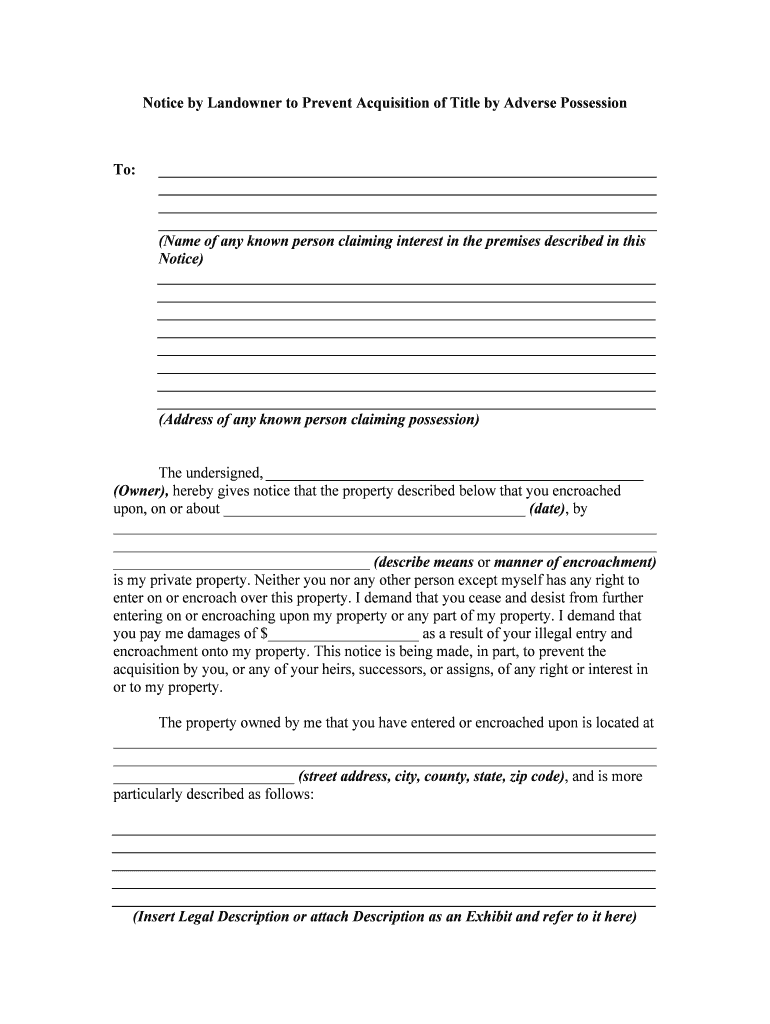
A Notice by Landowner to Prevent Adverse Possession is a written declaration filed or recorded by a property owner to publicly assert ownership and oppose any claim of continuous, exclusive possession by another party. The notice identifies the property, states the landowner's title or interest, and establishes a record date to interrupt the adverse possession timeline recognized by many state statutes. While procedures vary by jurisdiction, recording a timely, properly executed notice creates public notice of the owner's objection and can strengthen defenses against quiet-title claims, boundary disputes, or claims of prescriptive rights.

Why Filing a Formal Notice Matters for Property Owners

Filing a notice creates a public record that documents the owner's assertion of title and can interrupt or complicate an adverse possession claim, making it harder for a claimant to demonstrate uninterrupted possession. The notice also signals intent and provides evidence of active property management and monitoring.

Why Filing a Formal Notice Matters for Property Owners

Who Typically Prepares and Uses This Notice

Property owners, title professionals, and attorneys commonly prepare the notice to preserve rights and protect title against encroaching or long-term trespassers.

  • Individual owners protecting private parcels and preventing long-term adverse use.
  • Title companies and closing attorneys clearing risk before sale or refinance.
  • Municipal or government property managers preserving public land and easements.

Core Elements Every Professional Notice Should Include

A complete notice combines precise property identification, a clear ownership statement, an effective date, and execution formalities so it is recordable and persuasive in court or title review.

Property ID

Legal description or assessor parcel number (APN) that unambiguously locates the parcel for recording and title searches.
Ownership

Full legal name of the owner as recorded, including entity type and state of formation for corporate or trust ownership.

Statement

Clear assertion that the owner objects to any claim of adverse possession and reserves all rights to enforce title.

Effective Date

Specific MM/DD/YYYY date establishing when the owner gave public notice; this date can affect statutory accrual calculations.

Execution

Signature block with signer name and role, plus notary acknowledgement consistent with local recording office requirements.

Recording Info

Space for county recorder stamp, book-and-page or instrument number, and a place to note any attached exhibits or maps.

Required Information and Typical Fields

Owner Name: Exact legal name
Property Description: Legal description
Assessor ID: Parcel or APN
Effective Date: MM/DD/YYYY
Signature: Owner signature
Notary Block: Acknowledgement text

Step-by-Step: Prepare, Execute, and Record the Notice

Follow this concise sequence to prepare a defensible notice and place it in the public record; adjust for county recorder rules and local filing formats.

  • 01
    Draft: Complete property description, ownership statement, and effective date.
  • 02
    Review: Have title counsel verify description and execution language.
  • 03
    Execute: Sign before a notary or follow remote notarization rules where allowed.
  • 04
    Record: File with county recorder or land records office; retain stamped copy.

How to Configure an Online Notice Workflow

Set up a digital workflow that captures signatures, notarization if available, and delivers a recordable PDF suitable for county recording offices.

Field Configuration
Document Upload Upload final PDF/A with legal description and exhibits.
Signer Roles Assign owner and witness/notary roles with required fields.
Authentication Enable email or SMS codes; use stronger ID verification when needed.
Recording Copy Generate flattened, notarized PDF for submission to recorder.

Where to File and Which Offices to Notify

Notices are typically recorded in the county where the property is located; additional service to occupants or adjoining owners may be prudent.

  • County Recorder: Record the notice instrument in local land records for public notice.
  • Title Company: Provide copy to title insurer or closing agent for title file.
  • Adjacent Owners: Deliver notice to adjoining property owners as a courtesy or legal requirement.
  • Occupant/Claimant: Serve the claimant when appropriate under state rules.

Digital Signing and File Format Considerations

Use e-signature platforms that produce recordable, tamper-evident PDFs and support notarization workflows where permitted.

  • File Formats: PDF, PDF/A, Word DOCX
  • Integrations: Salesforce, NetSuite, Google Workspace
  • Notarization: In-person or RON where allowed

Timing, Statutes, and Filing Expectations

Timing matters because adverse possession statutory periods vary by state; provide public notice promptly and preserve documentary evidence of control and objection.

Record Promptly:

File as soon as notice is executed.

Statute Ranges:

Statutes commonly span 5–20 years; verify state law.

Evidence Window:

Retain contemporaneous photos and postings with dates.

Title Searches:

Request updated title reports after recording.

Follow-Up Filings:

Record supplemental notices if facts change.

Common Preparation and Filing Mistakes to Avoid

  • Using an ambiguous property description that does not match county records and leads to rejection or confusion during title searches.
  • Failing to notarize when the county requires a notary acknowledgement for recordable instruments, resulting in non-recording.
  • Relying solely on informal notices (letters or posts) without recording a formal instrument in land records.
  • Not obtaining legal review when underlying title or easement rights are disputed, which can weaken the notice.

Risks of an Incorrect or Insufficient Notice

Non-Recording: Loss of public notice
Title Risk: Increased vulnerability to quiet-title actions
Costs: Higher legal and litigation expenses
Delay: Recording rejection and resubmission
Statute Harm: Failure to interrupt adverse timeline
Evidence Loss: Weakened proof in court

eSignature Provider Pricing Snapshot for Recording-Ready Notices

Basic pricing and feature availability for common eSignature providers. signNow is shown first; confirm plan details and enterprise features with vendors before purchase.

signNow DocuSign Adobe Sign PandaDoc HelloSign
Starting Price $8/user/mo $15/user/mo $14/user/mo $19/user/mo $15/user/mo
Free Trial 7-day trial Varies Varies Varies Varies
Bulk Send Yes Yes Yes Yes No
Audit Trail Yes Yes Yes Yes Yes
HIPAA Compliant Yes Yes Yes No No

Frequently Asked Questions About Notices to Prevent Adverse Possession

Answers to common questions about enforceability, recording, notarization, e-signature use, and next steps when a claim arises.


Need help? Contact support

be ready to get more
Join over 28 million airSlate SignNow users