Establishing secure connection…Loading editor…Preparing document…

Stock Certificate

This template is fully customizable. Edit the text, fill out the fields, and send it for signature. Give it a try!
Stock Certificate

What a Stock Certificate Represents

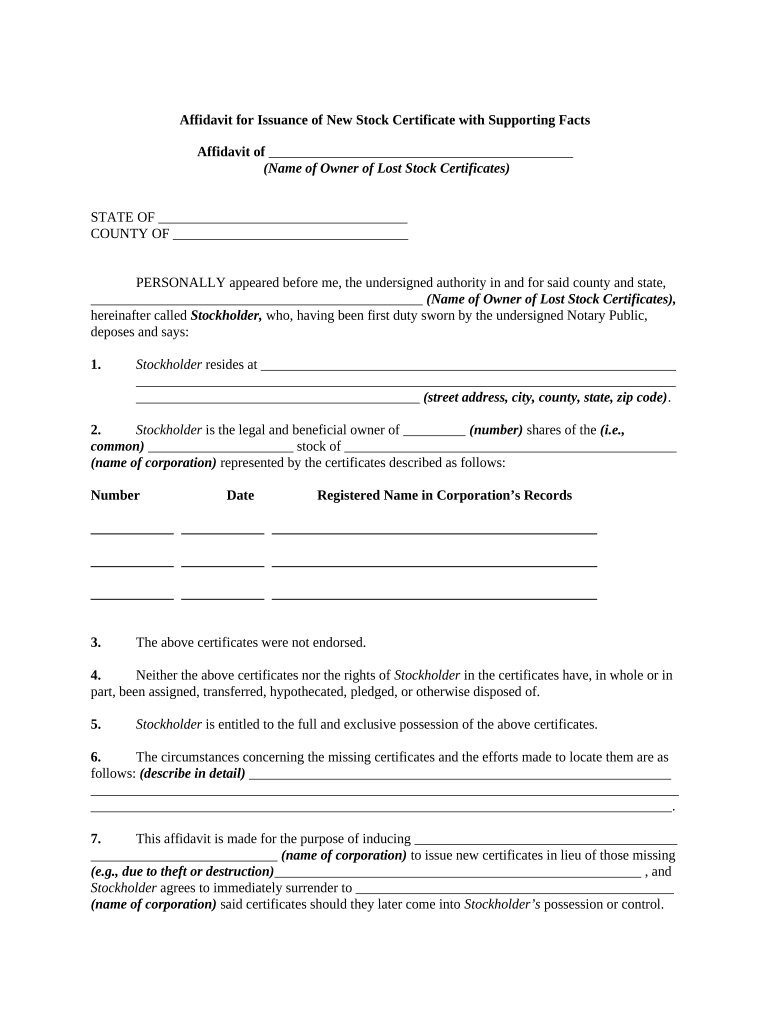
A Stock Certificate is a formal record issued by a corporation that documents ownership of a specified number of shares in that corporation. It typically includes the shareholder name, certificate number, class and number of shares, par value (if any), issuance date, and authorized signatures. Historically issued as printed paper, certificates can also be represented and delivered electronically where permitted by law and corporate governance. The certificate functions as evidence of ownership for transfer, dividend, and voting purposes and must be matched against the corporate stock ledger to be effective.

Why a Proper Stock Certificate Matters

A correctly completed Stock Certificate prevents ownership disputes, supports accurate corporate records, and ensures valid transfers under corporate law. Accuracy also supports tax reporting and investor rights.

Why a Proper Stock Certificate Matters

Typical Parties Who Prepare or Receive a Stock Certificate

Corporations, transfer agents, and shareholders commonly prepare or receive stock certificates when shares are issued or transferred.

  • Real Estate investors and holding companies — use certificates for ownership records and capital allocation.
  • Healthcare and nonprofit boards — issue certificates for equity in affiliated entities or joint ventures.
  • Financial services and broker-dealers — coordinate certificates with transfer agents and custodians for settlement.

Primary Roles Involved in Issuance

Corporate Secretary

Responsible for preparing the certificate, recording the issuance in the corporate stock ledger, and ensuring authorized signatures and corporate seal (if required) are present; maintains records for corporate governance and audit purposes.

Shareholder / Transferee

Receives the certificate as proof of ownership, verifies legal name and share quantity, and completes any transfer instructions or medallion guarantee requirements when selling or endorsing shares.

Core Elements to Include on a Professional Stock Certificate

A complete Stock Certificate contains specific, standardized data fields and visual elements that support legal recognition and administrative processing.

Certificate Number

Unique identifier for tracking and ledger reconciliation, printed clearly on each certificate.
Shareholder Name

Full legal name matching government ID and tax records to avoid transfer or withholding issues.

Number of Shares

Exact share count issued, avoiding ambiguous terms like 'some' or 'undetermined'.

Class and Series

Designate common or preferred shares and any series or rights attached to the class.

Date of Issuance

Clear issuance date to establish rights, dividend eligibility, and tax basis.

Authorized Signatures

Signatures of authorized corporate officers and, if used, the corporate seal or transfer agent endorsement.

Step-by-Step: Issuing a Stock Certificate

Follow these sequential steps to issue and record a valid Stock Certificate and maintain the corporate record.

  • 01
    Board Authorization: Adopt resolution approving issuance and specifying share details.
  • 02
    Prepare Certificate: Populate all fields per the stock ledger and subscription agreement.
  • 03
    Obtain Signatures: Authorized officers sign; use medallion guarantee when required by broker.
  • 04
    Update Ledger: Record issuance date, certificate number, and transferee details in the stock ledger.

Where to Send or File the Completed Certificate

After execution, distribute the certificate copies to the parties and record issuance with corporate recordkeepers as required.

  • Shareholder Delivery: Deliver original or electronic certificate to the shareholder for safekeeping.
  • Corporate Records: Retain an executed copy and ledger entry in the company minute book or electronic repository.
  • Transfer Agent: If applicable, forward endorsed certificates to the transfer agent for registration or dematerialization.
  • Broker / Custodian: When shares are held in street name, coordinate with broker-dealer for recording and settlement.

Digital Delivery and File Format Considerations

Store the final executed certificate and audit trail in a secure, access-controlled repository to preserve evidentiary value.

  • Document Formats: PDF, Word DOCX — ensure PDF/A or flattened PDF for long-term preservation.
  • Integrations: Connectors to systems like Salesforce, NetSuite, and Google Workspace ease recordkeeping.
  • Authentication: Use two-factor or stronger signer authentication for high-value transfers.

Risks and Penalties from Incorrect Certificates

Ownership Disputes: Invalid transfer claims
Tax Exposure: Incorrect basis reporting
Transfer Delays: Broker or agent holds
Regulatory Violations: Securities law noncompliance
Monetary Fines: Costs from corrective filings
Reputational Harm: Investor trust erosion

Common Mistakes to Avoid When Preparing a Stock Certificate

  • Using a name that does not match tax or broker records, which can trigger backup withholding or transfer rejection.
  • Failing to record the issuance in the corporate stock ledger immediately, creating reconciliation and legal proof problems.
  • Omitting required officer signatures or corporate seal where bylaws or transfer agents expect them, delaying registration.
  • Not confirming transfer agent or broker requirements such as medallion guarantees for public-company share transfers.

Practical Tips for Accurate, Efficient Certificate Issuance

Follow these best practices to reduce errors, accelerate processing, and preserve legal effect of stock certificates.

Confirm Identity and Name
Verify shareholder legal name against government ID and tax records before issuance; require updated W-9 information to avoid TIN-related backup withholding.
Use Clear Numbering
Assign sequential certificate numbers and update the ledger immediately to prevent duplicate issuances or reconciliation gaps.
Document Board Authorization
Attach or reference the board resolution authorizing issuance to the corporate records for audit and legal defensibility.
Preserve an Audit Trail
Keep signed copies, eSignature audit logs, and transfer endorsements in a secure, access-controlled repository.

Real-World Examples of Electronic Record Use in Capital Management

These brief examples show how organizations simplify ownership processes while maintaining compliance and records integrity.

Optica Ventures — COO

The interface is simple and easy-to-use for our team; more importantly, it is just as easy for our customers.

  • Streamlined signature collection reduced turnaround time.
  • Optica preserved signed records and improved customer experience while keeping compliance-ready logs and audit data for back-office reconciliation.

Martin Properties — Founder

I can process and execute all of these documents online with 100% compliance and built-in security.

  • Mobile-ready signing enabled remote closings.
  • The company reduced physical storage needs, accelerated transfers, and maintained accessible, tamper-evident records for future audits and investor queries.

Supporting Documents Often Paired with a Stock Certificate

Include these companion documents to provide context and authority for the issuance and transfer of shares.

Board Resolution

Formal authorization stating number of shares approved for issuance and any conditions attached; attach or reference in the corporate minute book.

Subscription Agreement

Agreement documenting purchase terms, payment, and representations; ensures consideration and buy-in terms are recorded.

Stock Ledger Entry

Internal record matching certificate number, issuance date, and shareholder details; primary evidence of ownership for the corporation.

Transfer Endorsement

Endorsement or medallion guarantee (if required) on the back of a certificate when transferring shares to another party.

Timing Considerations and Typical Processing Windows

Track these dates to ensure shareholder rights, tax reporting, and corporate records remain aligned after issuance or transfer.

Issuance Effective Date:

Date recorded on certificate determines dividend eligibility and voting rights.

Record Date:

Set date for determining registered shareholders for corporate actions.

Dividend Payment Date:

Date dividends are distributed; must align with the record date process.

Tax Reporting Window:

Provide required forms and basis data for annual tax reporting in line with IRS schedules.

Transfer Agent Processing:

Allow agent processing time — ranges from same-day to several business days depending on agent.

eSignature Provider Comparison for Stock Certificate Workflows

Basic pricing and capability differences across common eSignature vendors. signNow is listed first per product comparison conventions.

signNow DocuSign Adobe Sign PandaDoc HelloSign
Starting Price $8/user/mo $15/user/mo $14/user/mo $19/user/mo $15/user/mo
Free Trial 7-day trial Varies Varies Varies Varies
Bulk Send Yes Yes Yes Yes No
Audit Trail Yes Yes Yes Yes Yes
HIPAA Compliant Yes Yes Yes No No

Frequently Asked Questions About Stock Certificates

Answers to common questions about validity, signing, corrections, and recordkeeping for Stock Certificates.


Need help? Contact support

be ready to get more
Join over 28 million airSlate SignNow users