Establishing secure connection…Loading editor…Preparing document…

Stock in Corporation

This template is fully customizable. Edit the text, fill out the fields, and send it for signature. Give it a try!
Stock in Corporation

What a Stock in Corporation document is and when it’s used

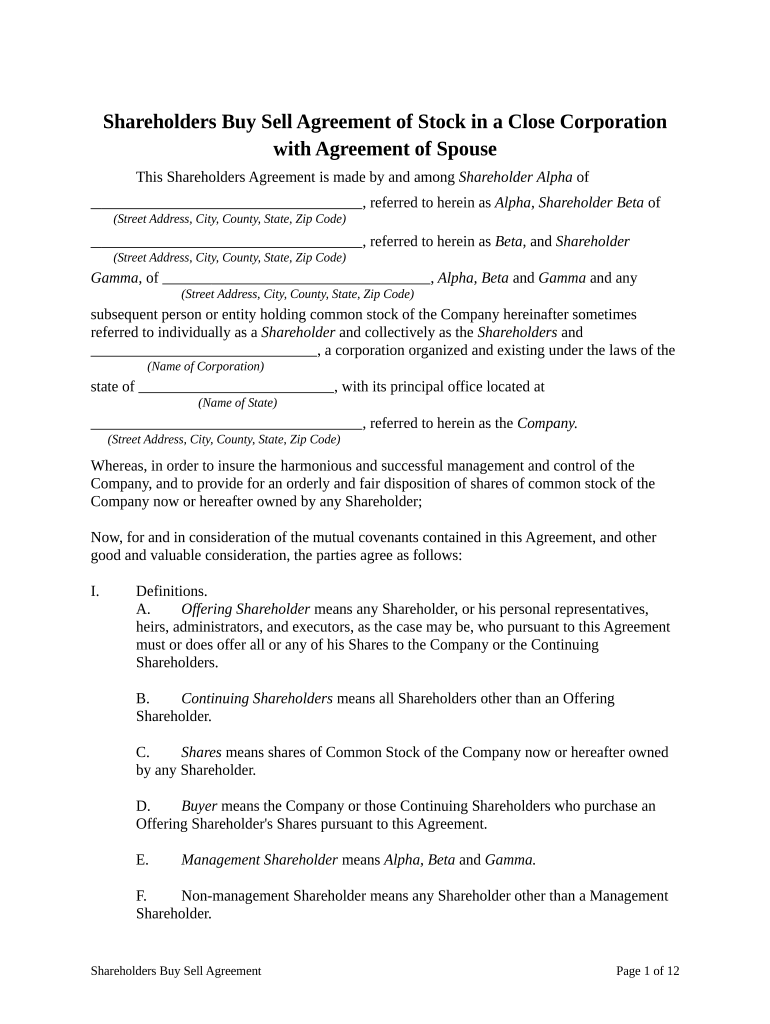
A Stock in Corporation document records the issuance, transfer, or ownership of corporate stock and establishes the rights attached to those shares. It can take the form of a stock certificate, stock ledger entry, or an assignment instrument used to transfer ownership. Corporations use this document to document equity ownership, record consideration paid, and preserve accurate corporate records for board approvals and regulatory compliance. Proper execution ensures shareholder rights, dividend entitlements, and voting power are traceable for corporate governance and tax reporting purposes.

Why a clear Stock in Corporation record matters

Accurate documentation protects shareholder rights, supports corporate governance, and creates an auditable trail for tax and legal compliance under state corporate law and federal recordkeeping standards.

Why a clear Stock in Corporation record matters

Who typically completes or receives this document

Keep an executed copy with the corporate minute book and provide scanned copies to shareholders and the transfer agent for reliable recordkeeping.

  • Corporate secretary or transfer agent: Prepares ledger entries, issues certificates, and records consideration paid for shares.
  • Company officers (CEO, CFO): Approve issuance through board resolutions and sign required officer attestation lines.
  • Shareholders and transferees: Sign transfer instruments and confirm purchase price, tax ID, and delivery instructions.

Essential components of a professional Stock in Corporation document

A complete document combines transactional facts, corporate authorization, signer identity, and retention instructions to create a legally meaningful record.

Share details

Number and class of shares (common, preferred), par value if any, and certificate or ledger reference to identify the issued units precisely.
Consideration

Specify cash, property, services, or cancellation of indebtedness paid for the shares; include exact dollar amounts or a clear description of noncash consideration.

Corporate approval

Reference the board or stockholder resolution authorizing the issuance, including date, resolution number, and the approving officers or directors.

Signature block

Officer signature(s), printed name and title, and countersignature if the corporate bylaws or transfer agent require a countersignature or medallion guarantee.

Transfer endorsement

If transferring shares, include a detachable endorsement or assignment clause showing transferor, transferee, and date of transfer with required signatures.

Ledger and certificate

Reference to the corporate stock ledger entry and, if used, certificate number; state whether the ledger or certificate is the controlling record.

Required factual fields and data points

Share count: Exact number of shares
Share class: Common or preferred
Consideration type: Cash, services, property
Certificate number: Ledger reference
Signer identity: Officer name and title
Effective date: MM/DD/YYYY

Consequences of incorrect or incomplete stock documentation

Title disputes: Ownership challenges may arise
Tax exposure: Incorrect basis reporting
Corporate governance: Invalid board approvals risk
Regulatory fines: Securities law notices possible
Transfer invalidation: Unenforceable transfers
Recordkeeping penalties: Failure to retain records

Common errors to avoid when preparing stock documents

  • Using informal initials or unsigned endorsement fields that do not meet officer signature requirements and can render a transfer ineffective.
  • Failing to reference the board resolution authorizing issuance, which creates ambiguity about corporate authority and can impede registration or transfer.
  • Entering the wrong class or number of shares in the ledger versus the certificate, creating inconsistencies that complicate reconciliations.
  • Omitting effective dates or using ambiguous date formats rather than MM/DD/YYYY, which can affect vesting, dividend rights, and tax reporting.

Step-by-step checklist for issuing or transferring stock

Follow a consistent sequence to ensure corporate authorization and accurate recording.

  • 01
    Board approval: Adopt resolution authorizing issuance
  • 02
    Prepare document: Complete certificate or assignment
  • 03
    Signatures: Officer and any countersignatures
  • 04
    Record entry: Post to corporate stock ledger

Typical eSigning workflow settings for stock documents

Configure your digital workflow to preserve authorization, signer identity, and an immutable audit trail before sending.

Field Configuration
Signer order Sequential or parallel by role
Authentication Email link + optional SMS code
Reminders Auto reminders every 3–7 days
Expiration Set a 30–90 day expiration

How electronic execution typically works

Electronic signatures follow a standard, auditable flow to capture intent and record attribution for each signer.

  • Upload: Add the stock certificate or assignment
  • Place fields: Add signature, date, and text fields
  • Send link: Distribute to named signers
  • Finish: Signed copy plus audit log

Technical considerations for eSigning stock documents

Ensure chosen software supports record export, legal admissibility under ESIGN/UETA, and any industry-specific compliance such as HIPAA where relevant.

  • Audit trail: IP, timestamp, action log
  • Integrations: Connect to NetSuite or Salesforce
  • File formats: PDF/A, DOCX supported

Practical tips for accurate and efficient stock recordkeeping

Apply consistent, documented processes for issuance, signing, and ledger updates to reduce disputes and audit friction.

Standardize templates
Use a single, approved template for certificates and transfers to minimize drafting errors and ensure required clauses are always present.
Capture approvals
Attach or reference board minutes and resolutions within the electronic record so corporate authority is evident and auditable for third parties.
Maintain ledger control
Designate a single custodian for the stock ledger and require chronological entries tied to certificate numbers and executed documents.
Preserve audit trail
For electronic signatures, keep timestamps, IP addresses, and authentication logs to support attribution and legal admissibility under ESIGN and UETA.

Real-world examples of eSigning corporate documents

Companies use eSignature workflows to speed issuance, centralize records, and support remote transactions with secure audit trails.

Martin Properties

Martin Properties needed remote execution for corporate documents as deals closed off-site

  • They adopted eSigning for certificates and assignments
  • "I can process and execute all of these documents online with 100% compliance and built-in security. Whether on mobile or working offline, I can get forms back to their necessary parties efficiently."

BIS

BIS required strong compliance for corporate records across distributed teams

  • They integrated eSign into internal approvals
  • "We felt most comfortable with airSlate SignNow given their SOC 2 certification and strict focus on ESIGN and UETA act compliance."

eSignature vendor comparison for handling Stock in Corporation documents

Comparison of common plan features and pricing models to consider when selecting an eSignature provider; signNow is listed first per vendor criteria.

signNow DocuSign Adobe Sign PandaDoc HelloSign
Starting Price $8/user/mo $15/user/mo $14/user/mo $19/user/mo $15/user/mo
Free Trial 7-day free trial Varies by plan Varies by plan Varies by plan Varies by plan
Bulk Send Yes Yes Yes Yes No
Audit Trail Yes Yes Yes Yes Yes
HIPAA Compliant Yes Yes Yes No No

Frequently asked questions about signing and recording stock

Answers to common procedural and legal questions encountered when issuing, transferring, and storing stock documentation.


Need help? Contact support

be ready to get more
Join over 28 million airSlate SignNow users