Establishing secure connection…Loading editor…Preparing document…

Stock Purchase Agreement

This template is fully customizable. Edit the text, fill out the fields, and send it for signature. Give it a try!
Stock Purchase Agreement

What a Stock Purchase Agreement Is and when it's used

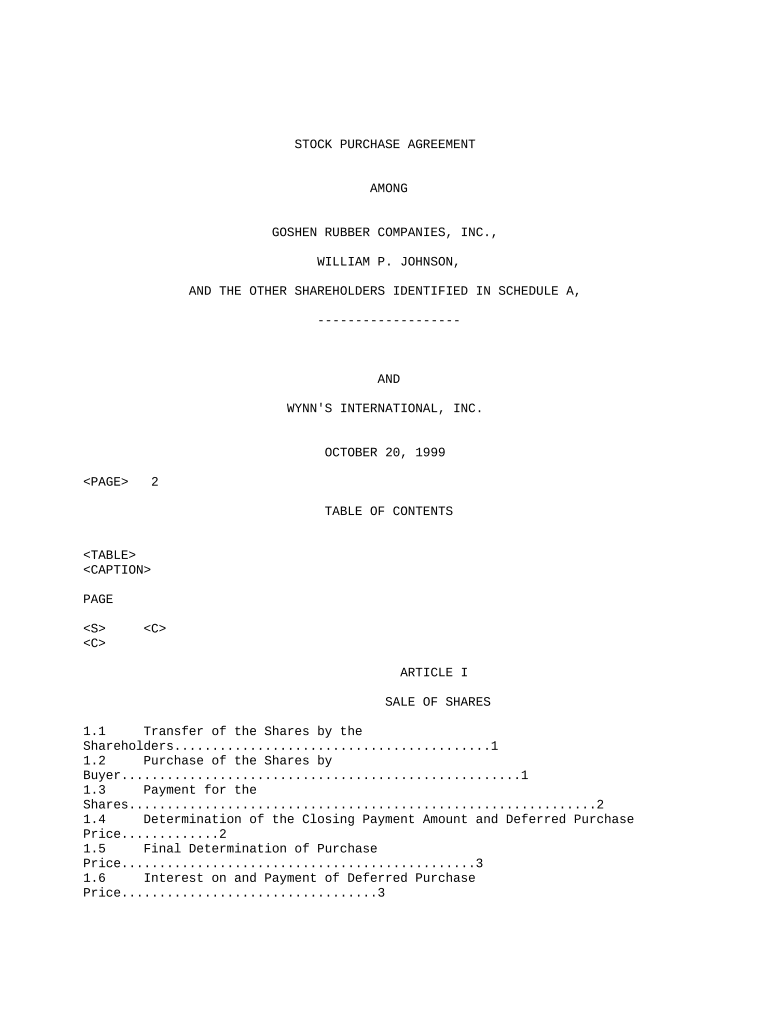
A Stock Purchase Agreement is a legally binding contract that documents the sale and transfer of corporate stock from one party to another. It identifies the buyer and seller, describes the shares being transferred, states the purchase price and payment terms, and sets closing conditions, representations and warranties, covenants, and indemnification terms. The agreement governs post-closing obligations such as delivery of certificates, corporate approvals, and any escrow arrangements. Parties often use this document to record private-company share transfers, investor purchases, and buyouts under state corporate law and applicable securities rules.

Why a clear Stock Purchase Agreement matters

A well-drafted Stock Purchase Agreement allocates risk, documents price and closing mechanics, preserves enforceable rights, and creates a record for tax and corporate governance purposes. It reduces ambiguity for shareholders, transfer agents, and regulatory reviewers.

Why a clear Stock Purchase Agreement matters

Who typically prepares and signs this agreement

Parties and advisors involved vary by transaction size; the agreement is used by individuals, private investors, and companies in corporate and M&A contexts.

  • Individual sellers and buyers handling private share transfers and small-cap deals.
  • Corporate officers and boards executing company-level approvals and share ledger updates.
  • Outside counsel, accountants, and transfer agents managing legal, tax, and recordkeeping tasks.

Coordination among legal, tax, and corporate-record stakeholders ensures valid transfer, proper tax reporting, and accurate capitalization records after closing.

Core sections to include in a professional Stock Purchase Agreement

A comprehensive agreement organizes transactional terms, legal protections, and post-closing obligations so each party understands rights, risks, and remedies.

Sale Terms

Describe the shares (class, series, certificate numbers), number of shares, and whether the sale is of outstanding or newly issued stock.
Purchase Price

Specify total price, per-share price, payment method, deposit/earnest money, and mechanics for adjustments or escrow holdbacks.

Closing Conditions

List conditions that must be satisfied at closing, such as board approvals, consents, clearances, and absence of material adverse events.

Representations & Warranties

Include seller and buyer representations on authority, title to shares, capitalization, tax status, and absence of undisclosed liabilities.

Covenants

Set pre- and post-closing covenants (e.g., noncompetition, notification of claims, deliverables) and any restrictive covenants affecting the parties.

Indemnification

Define indemnity triggers, caps, survival periods, defense procedures, and remedies for breach or misrepresentation.

Essential data elements to capture on the form

Seller Name: Legal entity name
Buyer Name: Legal entity name
Shares: Number and class
Price: Price per share
Effective Date: MM/DD/YYYY
Signatures: Authorized signer(s)

Step-by-step: completing a Stock Purchase Agreement

Follow these sequential steps to ensure the agreement is accurate, authorized, and enforceable at closing.

  • 01
    Gather details: Collect legal names, share schedule, and board resolutions before drafting.
  • 02
    Set price terms: State total consideration, per-share math, and payment timing.
  • 03
    Confirm approvals: Obtain corporate approvals, third-party consents, and transfer agent requirements.
  • 04
    Sign and record: Execute by authorized signers and update the company share ledger.

How to configure a digital workflow for this agreement

Set up fields, signer order, authentication, and post-signature distribution before sending the agreement for signature.

Field Configuration
Signature block Place signer name, title, and date fields for each party
Signer order Set buyer or seller to sign first as required
Authentication Enable email link or SMS code per risk level
Record distribution Auto-send copies to counsel, corporate secretary, and transfer agent

Where to send or file the executed agreement

After signing, route the agreement to internal and external stakeholders to complete transfer and recordkeeping steps.

  • Corporate Records: Deliver executed agreement to the corporate secretary for the minute book and ledger update.
  • Transfer Agent: Provide certificates and a stock power to the transfer agent if applicable.
  • Tax Reporting: Share transaction details with tax advisors and prepare required information returns if applicable.
  • Escrow Agent: If funds or documents are escrowed, deliver copies and instructions to the escrow agent.

Digital signing and technical compatibility notes

Electronic execution requires a platform that supports PDF/DOCX, audit trails, and signer authentication appropriate to transaction risk.

  • File formats: PDF and DOCX supported
  • Integrations: Connect to CRMs and cloud storage
  • Authentication: Email, SMS, or advanced options

Typical timing milestones to track for closing and post-closing

Monitor key dates around signature, closing, and post-closing obligations to avoid contractual or tax consequences.

Effective Date:

Date when the agreement becomes operative

Closing Date:

Date when shares and funds are exchanged

Payment Deadline:

When buyer must deliver purchase funds

Certificate Delivery:

When seller must transfer share certificates

Post-Closing Obligations:

Deadlines for indemnity claims and covenant performance

Common preparation mistakes to avoid

  • Failing to verify the seller has clear title to shares, which can leave buyers exposed to undisclosed liens or transfer restrictions.
  • Using ambiguous price language or failing to document holdbacks and escrow terms, leading to disputes over final consideration.
  • Skipping corporate approvals or shareholder consents required by bylaws or shareholder agreements, which can render the transfer voidable.
  • Neglecting tax reporting and backup withholding triggers, potentially causing penalties for incorrect or late information returns.

Key legal and financial risks

Tax Liability: Potential capital gains or withholding issues
Breach Damages: Monetary liability for contract violations
Invalid Transfer: Failure to update share ledger
Securities Violations: Unregistered offerings or disclosure failures
Title Defects: Undisclosed liens or restrictions
Escrow Disputes: Conflicts over release conditions

Who is authorized to sign and why their role matters

Seller — Chief Executive Officer

The CEO may sign for a corporate seller when the board has authorized the sale; confirm board resolutions and corporate authority to bind the entity and update the stock ledger after closing.

Buyer — Chief Financial Officer

The CFO or another authorized officer typically signs on behalf of a corporate buyer; documentation of delegated authority reduces later challenges to the validity of the purchase.

Supporting documents commonly included with the agreement

Attach exhibits and corporate authorizations to create a complete transaction record and support enforceability and transfer mechanics.

Share Schedule

Schedule listing classes, series, certificate numbers, and pre- and post-closing capitalization to reconcile ledger entries with the transfer.

Board Resolutions

Certified corporate minutes or resolutions authorizing the sale and delegating signing authority to the executing officer.

Escrow Instructions

If funds or documents are held in escrow, include the escrow agreement defining release conditions and agent obligations.

Tax Forms

Supporting tax documentation and tax advisor memos related to withholding, reporting, and any anticipated tax elections.

Practical tips for accurate and efficient completion

Adopt consistent practices to reduce rework, speed closing, and preserve the evidentiary value of the executed agreement.

Confirm authority before signing
Obtain board or shareholder authorizations in writing and attach certified copies to the agreement to prevent later disputes over corporate authority.
Use precise numeric fields
Calculate totals with explicit formulas or tables and include rounding rules to avoid arithmetic ambiguities that can lead to litigation.
Record delivery procedures
Specify delivery methods for certificates, powers, and funds and identify the entity responsible for updating corporate records post-closing.
Maintain an audit trail
Preserve signed copies, timestamps, and chain-of-custody records—especially when using electronic signatures or remote notarization.

Real-world examples of executing agreements with eSignature

Here are examples where digital signing and secure workflows supported agreement execution in real organizations.

Optica Ventures LLC — COO

Optica needed remote execution for investor transactions and streamline counterparty signing

  • The platform simplified multi-party signatures across time zones
  • Brian Fitzgibbons, COO, observed that the interface was simple for the team and equally easy for their customers, reducing turnaround time on executed agreements and enabling consistent recordkeeping.

Martin Properties — Founder

A small real estate firm required compliant remote signatures for share transfers in affiliated entities

  • Mobile signing and offline capability were critical for agents in the field
  • Tim Martin, Founder, reported processing and executing documents online with compliance and security while improving efficiency across mobile and desktop workflows.

eSignature vendor comparison for executing Stock Purchase Agreements

Compare typical vendor features and starting prices for eSignature solutions used to execute legal agreements; signNow is listed first per standard comparison formatting.

signNow DocuSign Adobe Sign PandaDoc HelloSign
Starting Price $8/user/mo $15/user/mo $14/user/mo $19/user/mo $15/user/mo
Free Trial 7-day free trial Varies Varies Varies Varies
Bulk Send Yes Yes Yes Yes No
Audit Trail Yes Yes Yes Yes Yes
HIPAA Compliant Yes Yes Yes No No

Frequently asked questions about Stock Purchase Agreements

Answers to common legal, technical, and process questions that arise when drafting, signing, and recording stock purchase transactions.


Need help? Contact support

be ready to get more
Join over 28 million airSlate SignNow users