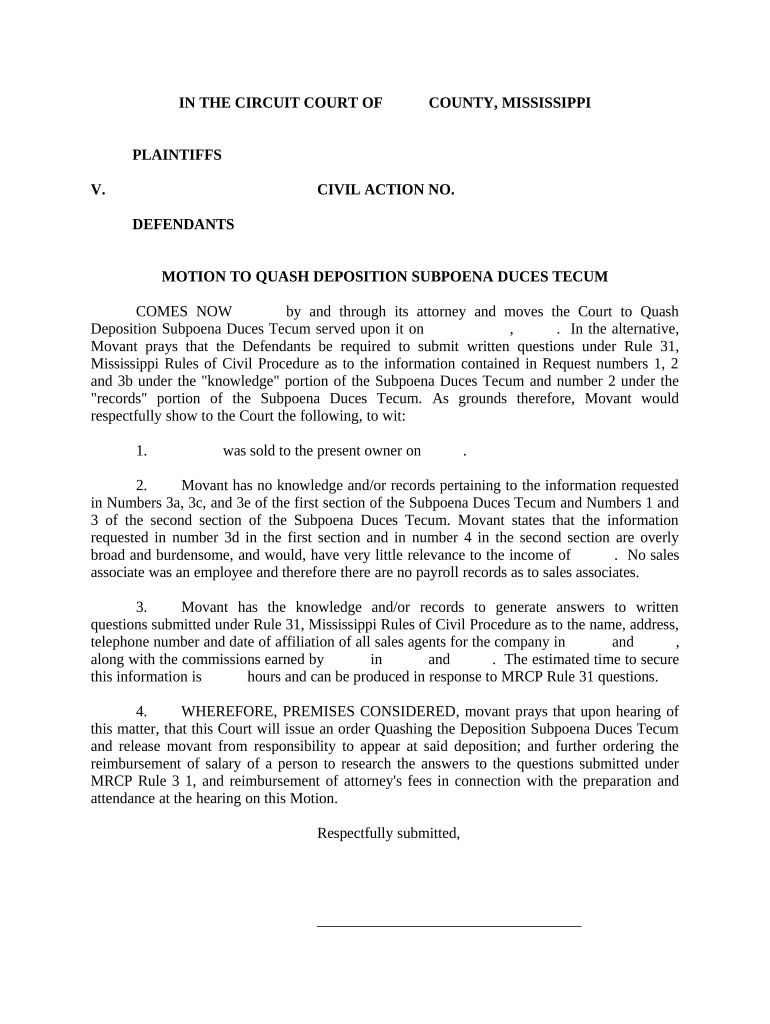
Subpoena Duces Tecum
What a Subpoena Duces Tecum Is and when it applies
Why a Subpoena Duces Tecum matters in evidence gathering
A Subpoena Duces Tecum compels production of evidence needed to prove facts, preserve records, and narrow issues for trial or hearing. It helps obtain third‑party documents, supports discovery, and can secure electronically stored information when properly tailored and served under applicable rules.
Who issues and who responds to Subpoena Duces Tecum requests
Common users who issue or respond to a Subpoena Duces Tecum include legal counsel, corporate records custodians, and government agencies in investigations.
- Litigators and defense counsel seeking records for discovery or trial preparation.
- Corporate compliance officers and records custodians who must collect and produce responsive files.
- Government prosecutors, regulators, and administrative agencies issuing subpoenas in investigations.
Key roles involved in a subpoena production
Litigation Counsel
Attorney who drafts and files the Subpoena Duces Tecum, specifies documents or categories sought, and oversees proper service and follow-up. They must tailor requests to meet court rules and avoid overbroad demands that could be quashed.
Records Custodian
Individual or corporate officer responsible for locating, collecting, and producing responsive documents, maintaining chain of custody, and certifying authenticity when required. Custodians should document searches and apply privilege logs to withheld materials.
Potential legal risks and penalties for noncompliance
Common pitfalls when preparing a Subpoena Duces Tecum
- Overly broad requests that fail to specify date ranges or document types, prompting objections and possible motions to narrow or quash.
- Improper service or jurisdictional errors, including serving out-of-state entities without following applicable rules, can invalidate a subpoena.
- Failing to preserve ESI metadata or using non-forensic collection tools, which can lead to spoliation claims or excluded evidence.
- Not documenting privilege assertions or using incomplete privilege logs, resulting in disputes and potential court-ordered disclosures.
Step-by-step: preparing, serving, and enforcing a Subpoena Duces Tecum
-
01Identify Records: Specify documents, date range, and format requested.
-
02Draft Subpoena: Include court caption, issuing authority, and return date.
-
03Serve Properly: Serve per local rules; use personal or certified service.
-
04Enforce/Follow Up: File motions to compel or quash as needed.
How production works after a subpoena is issued
-
Notice: Recipient receives subpoena and review timeline for compliance.
-
Search: Custodian conducts targeted search and preserves originals.
-
Produce: Responsive documents delivered or made available for inspection.
-
Certificate: Custodian certifies completeness and authenticity when required.
Typical e-workflow settings for a subpoena production process
| Field | Configuration |
|---|---|
| Requester Info | Name, firm, contact details |
| Document Scope | Specific categories, date range, formats |
| Authentication | E-sign method: email link, SMS code, KBA |
| Delivery Method | Secure upload, encrypted email, or portal |
Platform capabilities for e-submission and secure production
Platforms for e-signing and secure delivery must support authenticated signatures, audit trails, and encrypted transmission for legal documents.
- Integrations: CRM, document repositories, and case management
- Formats: PDF, DOCX, and native formats supported
- Authentication: Email link, SMS code, KBA, SSO options
Timing expectations and common deadlines
Service and Notice Requirements:
Follow court or rule-mandated methods and timing for service.
Typical Response Window:
Often 14–30 days but jurisdiction-dependent.
Production Deadline Expectations:
Production may be due within the subpoena's specified return date.
Motions to Compel or Quash:
File within local motion practice windows if disputes arise.
Preservation Obligations:
Immediate legal hold is recommended upon receipt to prevent spoliation.
Key milestones from issuance to enforcement
Issuance
Court or attorney signs and issues subpoena.
Service Completed
Proof of service filed as required by rules.
Response/Production
Documents produced or objections and privilege logs submitted.
Enforcement
Motion to compel or contempt proceedings if noncompliant.
Subpoena Duces Tecum compared with Request for Production
| Criteria | Subpoena Duces Tecum | Request for Production |
|---|---|---|
| Scope of Use | third-party & party | parties only |
| Authority Needed | issued by court or counsel | served under discovery rules |
| Service Method | formal service required | served on party with counsel |
| Enforceability | contempt available | court sanctions possible |
Pricing snapshot for e-sign solutions relevant to subpoena workflows
| signNow | DocuSign | Adobe Sign | PandaDoc | HelloSign | |
|---|---|---|---|---|---|
| Starting Price | $8/user/mo | $15/user/mo | $14/user/mo | $19/user/mo | $15/user/mo |
| Free Trial | 7-day trial | Varies by vendor | Varies by vendor | Varies by vendor | Varies by vendor |
| Bulk Send | Yes | Yes | Yes | Yes | No |
| Audit Trail | Yes | Yes | Yes | Yes | Yes |
| HIPAA Compliant | Yes | Yes | Yes | No | No |
Practical examples of electronic workflows in legal document production
Optica Ventures — Brian Fitzgibbons
Optica Ventures relied on electronic document workflows to send and receive third‑party records during discovery, reducing turnaround times.
- The interface is simple and easy-to-use.
- Using a secure e-signature platform allowed the team to coordinate custodians, preserve audit trails, and deliver certified copies quickly to opposing counsel, minimizing service disputes and speeding responsive production in multiple matters.
BIS — Dan Rotelli
BIS adopted secure e-sign workflows to centralize legal document collection and evidence certification across cases.
- SOC 2 and e-sign compliance increased confidence.
- The team preserved chain-of-custody metadata, kept centralized audit trails, and reduced attorney hours spent on manual service and tracking, improving responsiveness to subpoena requests while maintaining compliance standards.
Practical best practices to reduce disputes and speed production
Frequently asked questions about Subpoena Duces Tecum
-
Is electronic service valid for subpoenas?
Validity of electronic service depends on local court rules and opposing counsel consent. ESIGN and UETA permit electronic transactions generally, but many jurisdictions still require personal or certified service for subpoenas; confirm local rules before relying on e-service.
-
How do HIPAA protections affect production?
Protected health information may require patient authorization or a court order before disclosure. When PHI is involved, use HIPAA-compliant transmission, ensure a BAA is in place with vendors, and consult counsel prior to production.
-
Must metadata and native files be produced?
Courts often expect native file formats and relevant metadata; specify required metadata fields in the subpoena to preserve timestamps, authorship, and change history and reduce disputes about completeness.
-
How should I object or seek to quash?
Serve timely written objections and attempt to narrow the request through meet-and-confer. If unresolved, file a motion to quash or for a protective order under local rules, explaining burden, privilege, or privacy concerns.
-
Can custodians use e-signatures for certifications?
E-signatures satisfy legal requirements where ESIGN/UETA conditions are met: intent, consent, attribution, and retention. Use authenticated electronic signatures and retain an audit trail to support custodian certifications.
-
When must preservation obligations begin?
A subpoena or reasonable anticipation of litigation triggers preservation duties. Immediately implement a legal hold, suspend routine deletion, and document preservation steps to mitigate spoliation risk and potential sanctions.