Establishing secure connection…Loading editor…Preparing document…

Voluntary Act of Surrender for Adoption

This template is fully customizable. Edit the text, fill out the fields, and send it for signature. Give it a try!
Voluntary Act of Surrender for Adoption

What the Voluntary Act of Surrender for Adoption Is

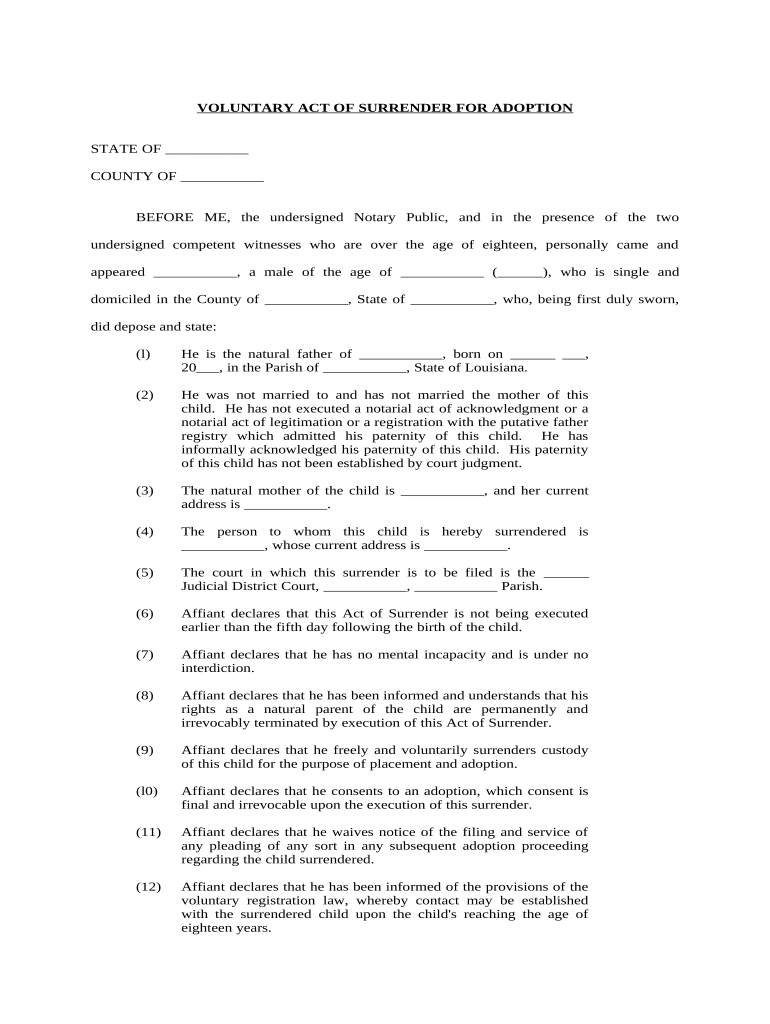
The Voluntary Act of Surrender for Adoption is a formal legal document by which a parent or legal guardian voluntarily relinquishes parental rights to allow adoption. It records the surrendering party’s identity, the child’s identifying information, the effective date of surrender, and any stated conditions. Courts and licensed agencies typically require a properly executed surrender as part of a permanent adoption file. Because statute and execution requirements differ by state, the form is executed under state adoption law and may include notary or witness steps.

Why a Clear, Compliant Surrender Form Matters

A properly completed Voluntary Act of Surrender for Adoption creates a clear record of consent that supports timely placement and court finalization, reduces administrative uncertainty, and documents rights relinquished. To be enforceable, the document must meet electronic-signature rules (ESIGN Act 15 U.S.C. §7001 and applicable UETA provisions) and state adoption statutes; execution errors can delay adjudication or permit revocation where state law allows.

Why a Clear, Compliant Surrender Form Matters

Step-by-Step: Completing and Submitting a Surrender Form

Follow a consistent sequence: prepare the form, confirm identity and authority, complete required acknowledgements, and transmit to the receiving agency or court according to state rules.

  • 01
    Prepare the form: Use the state-approved surrender form or a court-accepted equivalent.
  • 02
    Verify identity: Confirm signer identity using ID or approved RON/KBA procedures.
  • 03
    Sign and acknowledge: Execute signature, obtain required notary or witness attestations.
  • 04
    File or deliver: Submit to agency or clerk of court per local filing rules.

Essential Parts of a Professional Surrender Form

A complete Voluntary Act of Surrender for Adoption groups the elements courts typically review: identity, consent language, child details, execution evidence, revocation terms, and filing instructions.

Parties

Names and contact details of surrendering parent(s) and, when applicable, legal guardian or agency representative to establish who is consenting.
Child details

Child’s full name, birthdate, hospital record number, and any relevant identifying data to prevent mismatches in agency or court records.

Consent language

Clear statement surrendering parental rights, specifying voluntariness, absence of coercion, and scope of rights being relinquished.

Revocation clause

Any statutory or contract-based revocation window must be stated clearly, with instructions for how to exercise revocation where permitted.

Notary/witness

Notary acknowledgement or witness declarations required by state law; may include remote online notarization (RON) references where authorized.

Filing direction

Instructions for where to file or deliver the executed surrender (agency, hospital records, court clerk) and any required supporting documents.

Security and Compliance Essentials to Record

Encryption: TLS 1.2/1.3; AES-256 at rest
Audit trail: Time-stamped signature log
HIPAA: BAA required for PHI
ESIGN/UETA: Meets legal signature tests
Access control: Role-based permissions
Retention: Tamper-evident archival

Risks and Consequences of Improper Surrender Forms

Invalid execution: Form may be void
Delayed finalization: Court processes delayed
Revocation exposure: Rights may be rescinded
Agency rejection: Additional documentation needed
Privacy violation: HIPAA breach risk
Legal challenge: Costly litigation possible

Common Preparation Errors to Avoid

  • Missing or inconsistent names between the surrender and government ID, leading to agency rejection or court challenges.
  • Omitted notarization or witness attestations where state law requires them, causing execution to be invalid or incomplete.
  • Failure to document or preserve revocation rights and timelines, which can produce later disputes about consent validity.
  • Submitting scanned or partial copies without the original signed document or notarized acknowledgement when the receiving authority requires originals.

Who Typically Completes and Handles This Form

Common signers and handlers include the surrendering parent, adoption agency staff, hospital representatives, and family law counsel.

  • Surrendering parent — executes consent at hospital or agency intake and provides identifying documentation.
  • Adoption agency staff — verify completeness, retain a copy, and forward to the court as required.
  • Family law attorney — reviews form, advises on legal consequences and potential revocation issues.

Roles and responsibilities vary by jurisdiction; confirm who must retain originals and who files the document with the court or agency.

Representative People Involved

Birth Parent

An individual who is the legal parent executing surrender. They must understand rights being relinquished, provide government-issued identification, and sign with any required witnesses or notary present. Counsel or an advocate may be provided in many states to ensure informed consent.

Agency Caseworker

A licensed agency employee responsible for intake and verification. They confirm identity, record the surrender in agency files, advise on next steps, and usually transmit the signed surrender to the court or child welfare authority for inclusion in the permanent record.

Where the Completed Surrender Usually Flows

A signed surrender moves through a short set of custody and records steps from execution to court or agency storage; each recipient has a distinct role in finalizing the adoption.

  • Hospital intake: Immediate execution and initial documentation where surrender occurs at birth.
  • Adoption agency: Receives, verifies, and retains the signed form for placement processes.
  • Court filing: Clerk of court receives surrender for case file and adoption petition.
  • Permanent records: Agency or court archives the final executed document per retention rules.

Digital Workflow Settings for Online Completion

Configure an online workflow that mirrors the in-person process: upload the state form, collect identity verification, require notary/witness fields, and route to agency or court.

Field Configuration
Document upload Accept PDF or DOCX; lock final version
Identity check Require government ID and photo or RON/KBA
Signature order Parent sign first, then agency witness or notary
Notifications Email confirmation to parties and agency

Technical Requirements and Integration Points

Ensure the platform supports the file types, signer authentication, and record retention required by your state and agency.

  • File formats: PDF and DOCX supported
  • Integrations: Salesforce, NetSuite, Google Workspace
  • Authentication: Email, SMS code, or RON

eSignature Platform Pricing Snapshot for Surrender Workflows

Comparing common commercial eSignature options for managing Voluntary Act of Surrender for Adoption forms; signNow is listed first for column alignment.

signNow DocuSign Adobe Sign PandaDoc HelloSign
Starting Price $8/user/mo $15/user/mo $14/user/mo $19/user/mo $15/user/mo
Free Trial 7-day free trial Varies by vendor Varies by vendor Varies by vendor Varies by vendor
Bulk Send Yes (premium tier) Yes Yes Varies by plan Varies by plan
Audit Trail Yes Yes Yes Yes Yes
HIPAA Compliant Yes (BAA) Yes (BAA) Yes (BAA) No No

Key Milestones from Execution to Finalization

Typical sequential milestones start at execution and continue through agency review, court filing, and final decree or adoption registry entry.

01

Execution

Parent signs and acknowledges consent, with required witnesses or notary present.

02

Agency review

Agency verifies identity and completeness, placing the form in the case file.

03

Court filing

Agency or counsel files the surrender and adoption petition with the clerk of court.

04

Finalization

Court issues final order and record is archived per statute.

Timing Considerations and Typical Deadlines

Timelines are set by statute and vary; electronic execution can speed processing but does not change statutory revocation or filing deadlines.

Effective date:

Date entered on the form; controls when rights transfer.

Revocation window:

Varies by state; check local statute for allowable rescission period.

Agency filing:

Agency deadlines differ; some require immediate intake submission.

Court review:

Court docketing and hearing times depend on local procedures.

Record retention:

Follow retention timelines in retention_timeline and state law.

Practical Tips for Accurate and Efficient Completion

Adopt consistent procedures to reduce rework and ensure legal compliance when handling surrenders.

Verify identity before signing
Confirm government-issued ID and document any remote identity proofing (KBA or RON) to prevent later challenges to consent authenticity.
Use state-approved forms
Where available, use the statutory surrender form or a court-approved template to avoid form-rejection and simplify court intake.
Preserve original records
Retain the original signed paper or certified electronic original; provide copies to parties and file with the court or agency promptly.
Document counsel and advice
Record whether the signer received independent legal advice; some jurisdictions require counsel or an opportunity to consult before surrender.

How Organizations Use eSignature for Surrender Workflows

Adoption agencies and hospitals use eSignature to speed intake while preserving execution evidence; providers report better turnaround and fewer lost documents.

Optica Ventures

An agency digitized intake to reduce paperwork and improve accuracy.

  • Their team used secure signing to collect consistent records.
  • "The interface is simple and easy-to-use for our team; more importantly, it is just as easy for our customers." — Brian Fitzgibbons, COO

Martin Properties

A field-based provider adopted mobile signing to capture consents at point of service.

  • Mobile signing removed delays from paper routing.
  • "Whether on mobile or working offline, I can get forms back to their necessary parties efficiently." — Tim Martin, Founder

Frequently Asked Questions About Voluntary Surrenders

Answers to common questions about validity, revocation, signature methods, and record handling for Voluntary Act of Surrender for Adoption forms.


Need help? Contact support

be ready to get more
Join over 28 million airSlate SignNow users