Establishing secure connection…Loading editor…Preparing document…

Virginia Request for Ore Tenus Hearing

This template is fully customizable. Edit the text, fill out the fields, and send it for signature. Give it a try!
Virginia Request for Ore Tenus Hearing

What a Virginia Request for Ore Tenus Hearing Is

A Virginia Request for Ore Tenus Hearing is a formal filing asking a court to hear testimony or argument orally rather than decide the matter from written submissions alone. Common in civil, family, and evidentiary proceedings, an ore tenus request seeks live oral presentation so the judge can assess witness demeanor, clarify factual disputes, or permit in‑court argument on legal issues. Procedures vary by court (circuit court, general district court, or family court) and by case type; parties should check local rules and any standing orders before filing to confirm format and timing requirements.

Why Parties Request an Ore Tenus Hearing

Requesting an ore tenus hearing preserves the opportunity for live testimony, immediate judicial clarification, and assessment of witness credibility. Judges may grant oral hearings when factual disputes, credibility issues, or complex legal arguments benefit from in‑court explanation rather than paper briefing.

Why Parties Request an Ore Tenus Hearing

Who Typically Prepares This Request

The request is usually drafted by attorneys but may be filed by self‑represented litigants when appropriate.

  • Private attorneys representing plaintiffs or defendants in civil and family matters, who need live testimony or argument.
  • Pro se litigants preparing their own motions when factual hearings or oral argument could affect outcomes.
  • Court clerks and judicial staff, who process scheduling, calendaring, and notification once the request is granted.

Verify local court rules or standing orders for required language, supporting affidavits, and any procedural steps before filing.

Essential Parts of a Proper Ore Tenus Request

A well‑crafted request is concise, cites controlling rules, and explains why live oral hearing is necessary rather than advisory paper ruling.

Caption

Court name, case title, docket number, and party names exactly as on the complaint or answer.
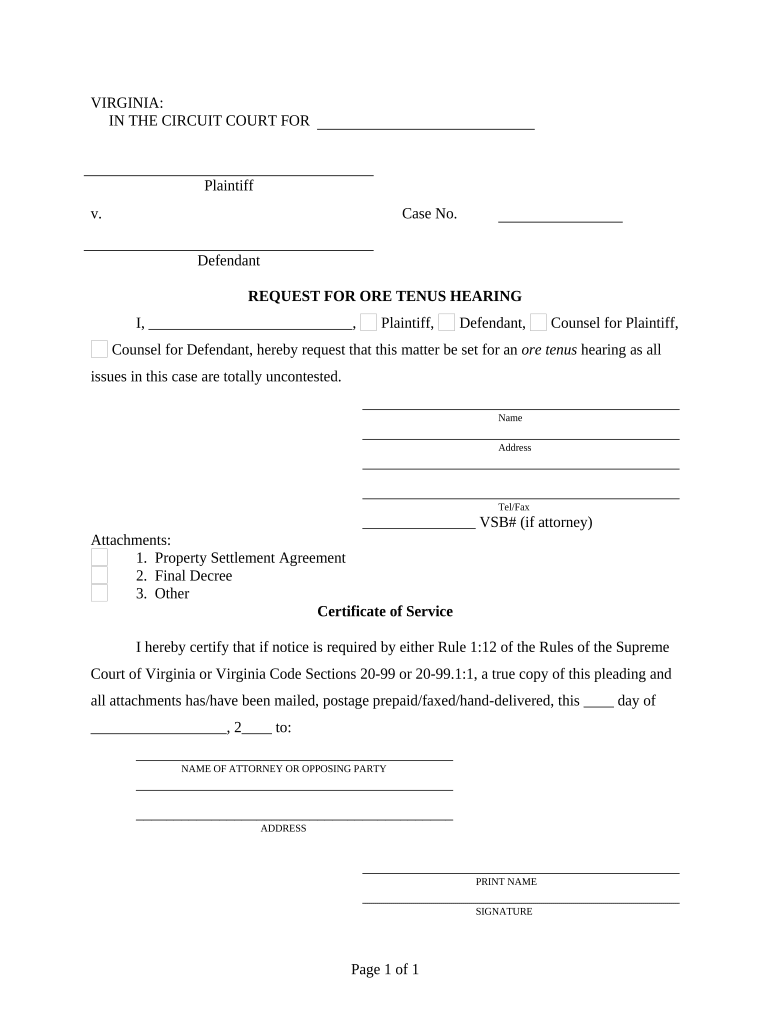
Title

Clear heading such as 'Motion/Request for Ore Tenus Hearing' specifying the relief sought and the statutory or rule basis.

Statement of Facts

Short factual background highlighting disputes of fact, credibility issues, or procedural history that justify oral hearing.

Legal Basis

Cite relevant Virginia procedural rule or statute and explain why oral testimony is required for resolution.

Relief Sought

Specific scheduling request (dates or timing window), estimated hearing length, and whether witnesses will testify.

Signature Block

Typed name, bar number if applicable, contact information, and certificate of service with date and method.

Step-by-Step: Preparing and Filing the Request

Complete the request carefully and follow local filing steps to avoid delays or rejection.

  • 01
    Draft Request: Prepare a concise motion describing factual disputes and the need for oral testimony.
  • 02
    Attach Evidence: Include relevant affidavits or exhibits that frame the contested facts for the court.
  • 03
    Sign and Serve: Sign, date, and serve opposing counsel per local rules; include certificate of service.
  • 04
    File with Court: Submit to the clerk by e‑filing or in‑person filing and request a hearing date or consult the clerk for scheduling.

What Happens After You File the Request

Understanding post‑filing steps helps manage expectations and prepare witnesses if the judge grants oral hearing.

  • Clerk Review: Clerk accepts or returns for deficiency and may set preliminary scheduling instructions.
  • Opposition: Opposing party may file a brief opposing the ore tenus request within local deadlines.
  • Judge's Decision: Judge may grant, deny, or set a limited in‑court conference to refine issues.
  • Hearing Logistics: If granted, the clerk issues a hearing date; parties exchange exhibits and witness lists per court order.

Electronic Filing and Distribution Options

Many Virginia courts accept electronic filing and service; confirm the court's e‑filing system and permitted formats before submission.

  • E‑Filing Format: PDF is standard for pleadings in most e‑file systems.
  • Service Methods: E‑service via court portal, email service where permitted, or traditional mail if rules require.
  • eSignature Use: Electronic signatures are generally accepted under ESIGN and UETA when procedural rules allow.

Check the specific court's e‑file and electronic service guidelines, and include any required cover sheets, proposed orders, or hearing calendars when filing.

Timing and Deadlines to Watch

Timeliness matters: some courts require the request be filed a set number of days before a scheduled hearing or trial; other rules set deadlines for opposing responses.

Advance Filing:

File as soon as factual disputes emerge; some courts expect requests at least 7–14 days before a hearing.

Opposition Deadline:

Local rules commonly allow 7–14 days to respond after service of the request.

Continuances:

If a continuance is needed, file jointly or show good cause; check local continuance rules.

Scheduling Orders:

Comply with any deadlines in pretrial or scheduling orders issued by the court.

Remote Notation:

If remote testimony is requested, provide proposed remote hearing procedures in advance.

Common Preparation Mistakes to Avoid

  • Failing to cite the local rule or statute that permits ore tenus hearings.
  • Omitting witness names, expected testimony, or exhibit lists that justify live testimony.
  • Mismatching party names or docket numbers in the caption, causing filing delays.
  • Neglecting certificate of service specifics required by local rules.

Consequences of an Improper or Late Request

Denied Request: Judge may deny oral hearing and decide on papers, potentially limiting ability to present testimony.
Sanctions Risk: Court may impose sanctions for failing to follow local rules or for untimely filings.
Scheduling Delay: Incorrect filings can produce delays in case resolution and additional administrative costs.
Evidentiary Exclusion: Key testimony or evidence may be excluded if not timely disclosed or noticed.
Service Defect: Improper service can void the hearing request and restart timing requirements.
Appeal Impact: Failure to present live testimony at the trial court level may limit appellate arguments on credibility.

How an Ore Tenus Request Functions in Practice

Two illustrative scenarios show common uses and expected court responses.

Family Court Custody Dispute

A parent requests live testimony about safety concerns

  • Witnesses include teachers and counselors to address credibility
  • The judge schedules a limited ore tenus hearing to assess demeanor and rule on temporary custody measures.

Civil Summary Judgment Opposition

Defendant asks for ore tenus hearing to dispute material facts

  • Expert witness testimony is proposed to resolve technical issues
  • The court allows oral testimony and limits time for direct and cross‑examination.

eSignature Vendor Pricing and Feature Snapshot

Common eSignature providers and their typical starting prices and capabilities; signNow is listed first per vendor comparison conventions.

signNow DocuSign Adobe Sign PandaDoc HelloSign
Starting Price $8/user/mo $15/user/mo $14/user/mo $19/user/mo $15/user/mo
Free Trial Yes, 7‑day trial No No Yes, limited Yes, limited
Bulk Send Yes Yes Yes Yes No
Audit Trail Yes Yes Yes Yes Yes
Envelope Cap No cap 100 envelopes/user/year Varies by plan Varies by plan Varies by plan

Frequently Asked Questions and Practical Answers

Common questions about filing and following up on an ore tenus hearing request, with concise, practical answers.


Need help? Contact support

be ready to get more
Join over 28 million airSlate SignNow users