Establishing secure connection…Loading editor…Preparing document…

Termination Easement

This template is fully customizable. Edit the text, fill out the fields, and send it for signature. Give it a try!
Termination Easement

What a Termination Easement Is and when it’s used

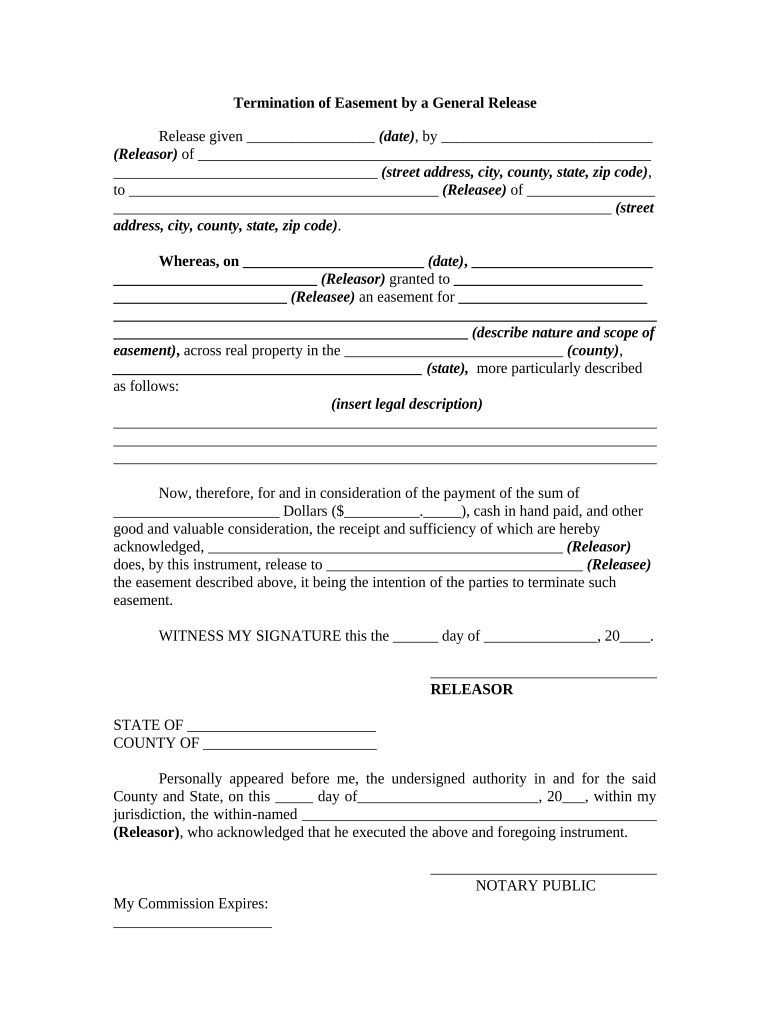
Termination Easement is a written instrument used to end, release, or modify an existing easement or right-of-way affecting real property. It records the parties' agreement that specified easement rights are terminated as of an effective date, and it updates the property title and public record when recorded with the county recorder or land registry. Typical uses include releasing utility corridors, removing access rights, or correcting title after easement satisfaction. The document identifies the grantor and grantee, references the original easement, states consideration if any, and includes signatures and any required notarial acknowledgements for recording.

Why recording a clear termination matters

A properly executed and recorded Termination Easement removes an encumbrance from title, reduces future disputes, and supports sale or refinancing by providing recorded proof that the easement is extinguished or modified under agreed terms.

Why recording a clear termination matters

Who prepares, signs, and records a Termination Easement

Typical users who prepare or sign Termination Easement documents include property owners, title companies, surveyors, and municipal utilities.

  • Property owners or grantors initiating release of an easement; usually the party granting termination.
  • Grantees or utilities relinquishing rights, signing to acknowledge release and updated easement status.
  • Title companies and escrow agents handling recording, title updates, and chain-of-title verification.

Step-by-step: prepare, sign, and record the termination

Follow these steps to prepare, execute, and record a Termination Easement to ensure clear title and proper public notice.

  • 01
    Step 1: Identify original easement instrument and legal description.
  • 02
    Step 2: Draft termination language referencing recorded easement book and page.
  • 03
    Step 3: Have all parties sign and notarize as required for recording.
  • 04
    Step 4: Submit to county recorder with required fees and supporting documents.

Typical online workflow from draft to recorder

This overview shows the typical routing, signing, and recording sequence for a Termination Easement in county systems.

  • Upload Document: Upload the drafted termination document as a PDF for field placement.
  • Assign Signers: Add grantor and grantee with correct email and contact details.
  • Authentication: Choose signer verification: email, SMS code, or stronger identity proofing.
  • Record: After notarization submit to county recorder with applicable fees.

Recommended e-signature workflow settings

Recommended online workflow settings for preparing and distributing a Termination Easement using an e-signature platform.

Field Configuration
Signature Type Electronic signature fields; enable notarization support
Authentication SMS code or email; use KBA for high-risk matters
Notifications Email notifications to parties and title company on completion
Retention Settings Auto-archive signed PDF and keep audit trail indefinitely

Technical considerations for e-submission and cloud workflows

Use platforms that support notarization workflows, PDF compliance, and auditable signature logs when preparing a Termination Easement.

  • File Types: PDF and DOCX accepted for upload
  • Integrations: NetSuite, Salesforce, Box, Procore available
  • Security: TLS 1.2/1.3 in transit; AES-256 at rest

Timing and scheduling considerations

Key timing considerations for preparing, signing, and recording a Termination Easement, including recording windows and lien search timing.

Effective Date Entry:

Use MM/DD/YYYY; effective date controls termination and title search outcomes.

Notary Scheduling:

Schedule before recording; allow time for remote or in-person notarization.

Recorder Processing:

County processing ranges from same day to several weeks depending on jurisdiction.

Title Update:

Allow seven to thirty days for title companies to update chain-of-title after recording.

Tax/Lien Checks:

Complete lien searches before termination to avoid unresolved encumbrances.

Key milestones: drafting through final title update

Milestone timeline for a typical Termination Easement from drafting through public recording and title update.

01

Draft and Review

Prepare draft and obtain legal review before signature circulation.

02

Signatures and Notary

Acquire signatures and required notarization consistent with jurisdictional rules.

03

Record at County

File recorded termination with the county recorder and pay fees.

04

Title Update Completed

Title company confirms release recorded and updates title commitments.

Security and compliance considerations

Encryption: TLS 1.2/1.3 in transit; AES-256 at rest
Compliance: ESIGN, UETA, HIPAA (BAA available)
Audit Trail: Full timestamp, IP, and action log
Access Controls: Role-based permissions and SSO options
Data Residency: EU-U.S. Data Privacy Framework supported
Certifications: SOC 2 Type II; ISO 27001; PCI DSS

Penalties and risks from improper preparation or filing

Recording Rejection: Incorrect notarization will cause rejection
Title Clouding: Unrecorded termination leaves easement on title
Insurance Delay: Title insurance may be delayed
Lien Exposure: Existing liens may survive termination
Penalties: County fines for improper filings possible
Dispute Risk: Ambiguous language invites future litigation

Common mistakes to avoid

  • Failing to reference the original recorded easement instrument or using an imprecise legal description often leads recorders to reject filing and delays title clearance.
  • Skipping a notarized acknowledgement or using an improper notary format for the county results in non-acceptance and may require re-execution in front of a qualified notary.
  • Using vague termination language such as 'rights extinguished' without specifying parcels, prior instrument details, or effective date can leave ambiguity for title examiners.
  • Not checking for subordinate interests, mortgages, or pending liens before recording can expose parties to claims that survive the termination instrument.

Which instrument is appropriate: termination versus alternatives

Compare Termination Easement with other instruments to select the correct document for extinguishing or altering real-property rights.

Document Termination Easement Easement Release Quitclaim Deed
Primary Use end easement release rights convey interest
Recording recorded recorded recorded
Notarization
Affects Title clears easement entry clears rights entry changes ownership

Pricing and capability snapshot for common e-signature vendors

Compare baseline pricing and key capabilities across common e-signature vendors for processing Termination Easement documents.

signNow DocuSign Adobe Sign PandaDoc HelloSign
Starting Price $8/user/mo $15/user/mo $14/user/mo $19/user/mo $15/user/mo
Free Trial 7-day free trial Yes Yes Yes Yes
Bulk Send Yes Yes Yes Yes No
Audit Trail Yes Yes Yes Yes Yes
HIPAA Compliant Yes Yes Yes No No

Real-world examples of recording a Termination Easement

Examples showing typical scenarios where parties record a Termination Easement to clear title or remove obsolete rights.

Martin Properties

Martin Properties needed to remove a redundant access easement to prepare a parcel for sale and refinance.

  • Executed remotely with full audit trail.
  • "I can process and execute all of these documents online with 100% compliance and built-in security. Whether on mobile or working offline, I can get forms back to their necessary parties efficiently."

Case Study 2

A municipal utility terminated a redundant easement after project completion and recorded the release to clear title for redevelopment.

  • Remote execution with audit trail.
  • Recording was accepted by the county; coordination with the title company shortened the timeline and reduced closing friction for the developer.

Who signs and why: two representative profiles

Brian Fitzgibbons — COO

Leverages digital document workflows to accelerate property-related transactions and investor approvals. 'The interface is simple and easy-to-use for our team; more importantly, it is just as easy for our customers.' This approach reduces administrative delays in closing.

Tim Martin — Founder

Processes and executes documents entirely online for property closings. 'I can process and execute all of these documents online with 100% compliance and built-in security. Whether on mobile or working offline, I can get forms back to their necessary parties efficiently.' The result is faster closings.

Practical drafting and recording best practices

Practical tips to reduce recording delays, avoid title issues, and ensure the Termination Easement records cleanly.

Reference the original easement instrument precisely
Include book, page, reception number, and recorded date from the original easement; copy the legal description verbatim. Precise cross-references minimize recorder queries, prevent rejection, and enable title carriers to locate and clear the easement entry efficiently during underwriting.
Confirm signer names and legal capacity
Ensure signatories execute in their legal capacity (individual, officer, trustee, authorized agent). If an entity signs, attach corporate resolution or authority documentation. Mismatched capacity can void the termination for title purposes and delay recording or title endorsement issuance.
Use clear termination language and effective dates
State the exact rights being terminated, identify the parcels affected, reference the original instrument explicitly, and provide an effective date in MM/DD/YYYY format. Avoid blanket or ambiguous phrases that might leave residual claims unresolved.
Coordinate with title insurer and recorder
Circulate the draft to the title company and county recorder for preliminary review where feasible. Confirm county formatting, required exhibits, and correct filer name to prevent processing delays and ensure that title searches reflect the recorded termination promptly.

Frequently asked questions and troubleshooting

Answers to common questions about validity, recording, notarization, and correcting errors in a Termination Easement.


Need help? Contact support

be ready to get more
Join over 28 million airSlate SignNow users