Establishing secure connection…Loading editor…Preparing document…

Testamentary Trust

This template is fully customizable. Edit the text, fill out the fields, and send it for signature. Give it a try!
Testamentary Trust

What a Testamentary Trust Is and how it relates to a will

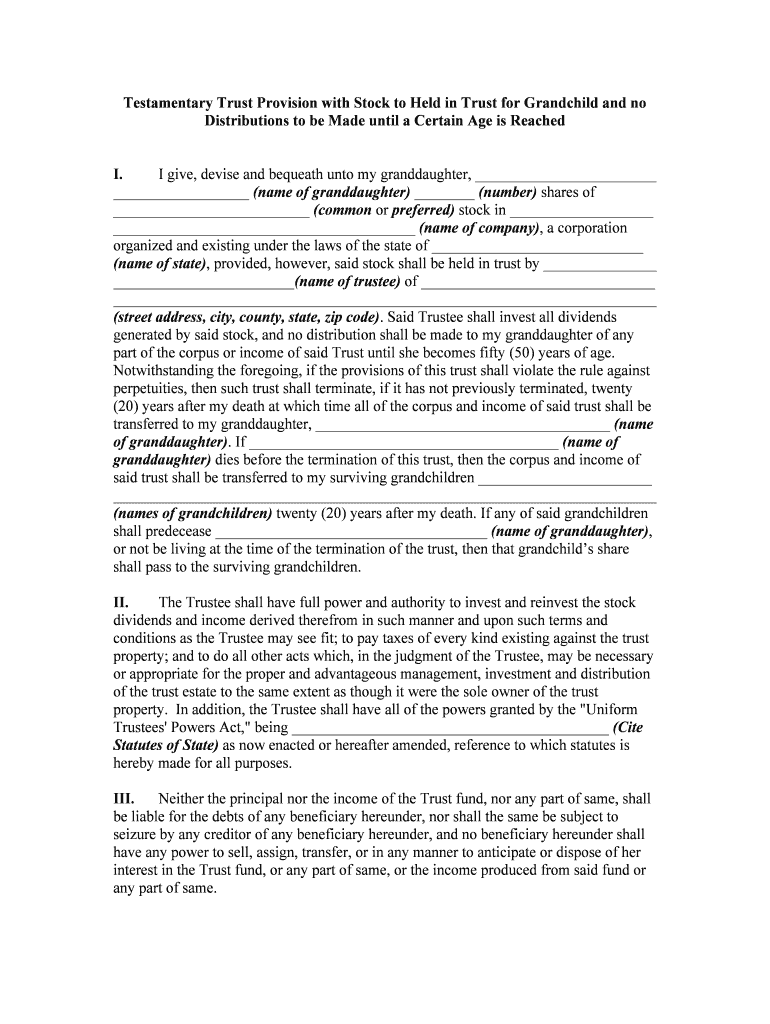
A testamentary trust is a trust created under a decedent's will that takes effect only after the testator's death. It appears as dispositions in the will, directing the probate court to hold and manage assets for named beneficiaries under specified terms. Because a testamentary trust is created by testamentary instrument, many states treat it under the same formalities as wills: witness requirements, possible notarization for self-proving affidavits, and probate filing. Electronic execution may be limited by the ESIGN Act (15 U.S.C. ch. 96) and state law; consult relevant statutes before attempting digital execution.
Why a Testamentary Trust is used in estate planning

Create a Testamentary Trust within a will to control postmortem asset distribution, protect minor or incapacitated beneficiaries, defer distributions, and enable professional trustee oversight. It preserves creditor protection in some cases and supports tax and estate planning, though electronic execution may be restricted by state rules.

Why a Testamentary Trust is used in estate planning

Who commonly prepares and relies on a Testamentary Trust

Estate planners, probate attorneys, fiduciaries, and individuals drafting wills commonly prepare or rely on a Testamentary Trust to manage postmortem distributions.

  • Estate attorneys and trust lawyers who draft terms, advise on compliance, and represent fiduciaries during probate.
  • Individual testators who include trust provisions in their wills to protect beneficiaries and control distribution timing.
  • Financial institutions or professional trustees acting as fiduciaries to manage assets and administer distributions.

Stepwise process to create and integrate a Testamentary Trust

[INTRO] Follow these sequential steps to prepare and integrate a Testamentary Trust within a will and probate process.

  • 01
    Draft Trust Terms: Define beneficiaries, distributions, trustee powers, and conditions.
  • 02
    Select Trustee: Name a trustee and alternates with contact details and acceptance clauses.
  • 03
    Execute Will: Sign witnessed will following state formalities; attach self-proving affidavit if available.
  • 04
    Probate Filing: File will with probate court after death to trigger testamentary trust administration.

Where to file and who receives certified copies

[INTRO] Typical routing and filing destinations for the executed will that creates a Testamentary Trust, shown below.

  • Probate Court: File original will to begin probate and activate the trust.
  • Trustee File: Provide certified copy to trustee for administration and asset management.
  • Beneficiaries: Send notice and summary of trust terms to beneficiaries.
  • Custodial Records: Keep original with estate attorney or safe deposit; store copies securely.

Six essential components of an administrable Testamentary Trust

Core components that make a professional Testamentary Trust enforceable, clear, and administrable by trustees and the probate court after probate.

Trust Purpose

State the trust's objectives plainly (education, support, disability planning). Specify permissible uses of income and principal, and include examples to guide trustee discretion while avoiding ambiguous language that leads to disputes.

Funding Sources

Identify assets that fund the trust (specific bequests, percentages of estate, real property, accounts). Provide clear transfer instructions and contingencies if designated assets are unavailable at probate.

Beneficiary Terms

Name beneficiaries with full identifying details, state distribution conditions, age requirements, and procedures for predeceasing beneficiaries. Address contingent beneficiaries and how per stirpes or per capita distributions apply.

Trustee Powers

List trustee authorities such as investment discretion, distribution standards, delegation, compensation, and bonding. Specify any restricted powers or mandatory reporting to beneficiaries to reduce conflicts.

Distribution Schedule

Provide precise timing and triggers for distributions (ages, milestones, health events). Use objective measurements to limit litigation and include alternate plans if beneficiaries are incapacitated.

Tax Clauses

Specify tax allocation, power to allocate income tax liabilities, and contingency provisions for estate tax apportionment. Include trustee authority to seek professional tax advice and file necessary returns.

Security and compliance considerations for storing and sharing documents

Encryption: TLS 1.2/1.3 in transit; AES-256 at rest
Certifications: SOC 2 Type II, ISO 27001, PCI DSS
Privacy: HIPAA compliant with BAA option
Legal: ESIGN and UETA compliance
Accessibility: WCAG 2.0 Level AA support
Audit Trail: Tamper-evident logs with timestamps

Primary legal risks from incorrect execution or incomplete drafting

Invalid Execution: Will/trust may be void
Probate Delays: Court challenges and added costs
Tax Exposure: IRS reporting mismatches, penalties
Creditor Claims: Unsecured assets subject to claims
Fiduciary Breach: Trustee liability and surcharge risk
Notary/Witness Defects: Voidable due to improper formalities

Common drafting and execution mistakes to avoid

  • Failing to match testator name and ID causes probate verification delays and potential requirement for court-ordered corrections or additional affidavits.
  • Using vague distribution language such as 'support as needed' invites litigation; specify triggers, percentages, ages, or dollar amounts instead to reduce ambiguity.
  • Omitting successor trustees or contingency mechanisms forces court intervention if a trustee predeceases or declines to serve, increasing time and cost.
  • Assuming electronic signatures suffice for testamentary trusts can be incorrect; many jurisdictions require wet signatures and in-person witnesses for wills.

Key deadlines and filing expectations affecting trust activation and tax reporting

[INTRO] Important dates to track from execution through probate, creditor claims, and tax reporting after death.

Will Execution:

Sign per state formalities before death; witnesses present at execution.

Probate Filing:

File will promptly after death per state requirements; timing varies.

Creditor Claims:

Claim periods commonly 3–6 months; check state statute.

Final Return:

File decedent's final Form 1040 by April 15 next year.

Estate Tax:

Estate tax filings often required; check IRS rules for Form 706 timing.

Sequential milestones from drafting to trust closure

Major milestones from drafting through trust administration and closure after the testator's death.

01

Draft & Execute

Prepare will with trust provisions and execute with required witnesses.

02

Death & Probate

File will with probate court to admit it and appoint executor.

03

Trustee Appointment

Court or will appoints trustee; provide certified copies and letters.

04

Administration & Accounting

Trustee manages assets, distributes according to terms, and records accounting.

Typical online workflow settings for drafting and sharing a testamentary will

[INTRO] Common digital workflow settings when preparing an online will that contains a Testamentary Trust clause.

Field Configuration
Signature Block Require signer role, witness signature, and date field.
Witness Fields Add two witness signature fields and printed names.
Notary Block Include notary acknowledgement and date where required.
Conditional Clauses Show trust schedule only if beneficiary selections apply.

Technical capabilities necessary for eSubmission and evidence of signing

Digital signing platforms must support signature fields, witness capture, and secure distribution for documents that create testamentary interests.

  • Formats: PDF and DOCX supported
  • Integrations: Cloud storage and court e-filing systems
  • Authentication: Email, SMS, and advanced signer verification

Sample eSignature vendor comparison for executing supporting estate documents

Comparison of starter pricing, trial availability, bulk send, audit trail, HIPAA support, and envelope limits among common eSignature vendors; signNow is listed first per platform data.

signNow DocuSign Adobe Sign PandaDoc HelloSign
Starting Price $8/user/mo $15/user/mo $14/user/mo $19/user/mo $15/user/mo
Free Trial Yes, 7-day free trial Varies Varies Varies Varies
Bulk Send Yes Yes Yes Yes No
Audit Trail Yes Yes Yes Yes Yes
HIPAA Compliant Yes Yes Yes No No
Envelope Cap No cap 100 envelopes/user/year Varies Varies Varies

Frequently asked questions about Testamentary Trust execution and validity

Answers to common questions about preparing, executing, and validating a Testamentary Trust within U.S. legal frameworks.


Need help? Contact support

be ready to get more
Join over 28 million airSlate SignNow users