Identification
Full legal names of creditor and obligor plus account or lease number to tie the notice to a specific contract or debt and avoid ambiguity.
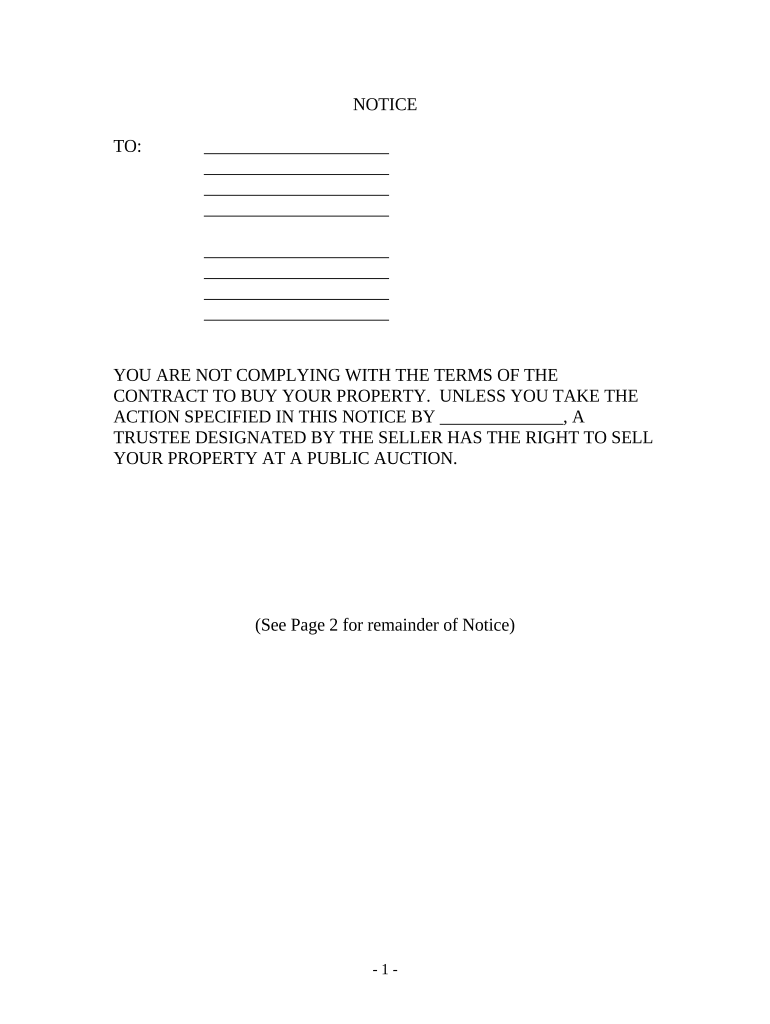
A clear Notice of Default and Right to Cure preserves legal rights, creates a documented opportunity to avoid more costly remedies, and reduces disputes about notice timing or content.

Lenders, servicers, landlords, property managers, and commercial counterparties commonly issue Notices of Default and Right to Cure when contractual performance lapses.
The recipient will usually be the borrower, tenant, guarantor, or contractual counterparty named in the agreement; who has authority to act follows the contract's signature block or power-of-attorney provisions.
Full legal names of creditor and obligor plus account or lease number to tie the notice to a specific contract or debt and avoid ambiguity.
Clear description of the default event(s) with dates and amounts due where applicable, so the recipient knows exactly what conduct or payment is required to cure.
Specific actions required to cure (payment method, documents to deliver, or corrective performance) including precise delivery instructions and acceptable forms of proof.
An explicit cure deadline stated as a calendar date and time, or a fixed number of days measured from receipt, to avoid later disputes about timing.
Plain explanation of remedies that will follow if the default is not cured — acceleration, foreclosure, eviction, lien enforcement, or contract termination.
Name, mailing address, phone number, and email for the party accepting cure or answering questions to facilitate timely resolution.
| Field | Configuration |
|---|---|
| Signature type | Standard electronic signature or authenticated signature |
| Recipient order | Sequential or parallel routing as required |
| Authentication | Email, SMS code, or advanced ID verification |
| Proof of delivery | Audit trail capture and delivery receipt storage |
Determine whether an electronic signature or paper notice is appropriate based on contract language, statutory exceptions, and recipient consent.
Where electronic delivery is used, capture an audit trail and retain records that demonstrate intent, consent, attribution, and retention per electronic signature legal tests.
Prepare notice within business days of identifying default
Commonly 10–30 days unless contract specifies otherwise
Allow a short verification window after receipt of payment or documents
Begin remedies immediately after cure deadline if uncured
Retain notice and delivery proof for the retention period
A mortgage servicer identifies a missed payment and sends a Notice of Default specifying the past due amount and acceptable payment methods.
A landlord documents repeated lease violations and issues a notice outlining corrective actions and a cure timeline.
| signNow | DocuSign | Adobe Sign | PandaDoc | HelloSign | |
|---|---|---|---|---|---|
| Starting Price | $8/user/mo | $15/user/mo | $14/user/mo | $19/user/mo | $15/user/mo |
| Free Trial | 7-day trial | Varies by plan | Varies by plan | Varies by plan | Varies by plan |
| Bulk Send | Yes | Varies by plan | Varies by plan | Varies by plan | Varies by plan |
| Audit Trail | Yes | Yes | Yes | Yes | Yes |
| HIPAA Compliant | Yes | Varies by plan | Varies by plan | Varies by plan | Varies by plan |
| Envelope Cap | No cap | 100 envelopes/user/year | Varies by plan | Varies by plan | Varies by plan |