Establishing secure connection…Loading editor…Preparing document…

Texas Renunciation and Disclaimer of Property

This template is fully customizable. Edit the text, fill out the fields, and send it for signature. Give it a try!
Texas Renunciation and Disclaimer of Property

What the Texas Renunciation and Disclaimer of Property is

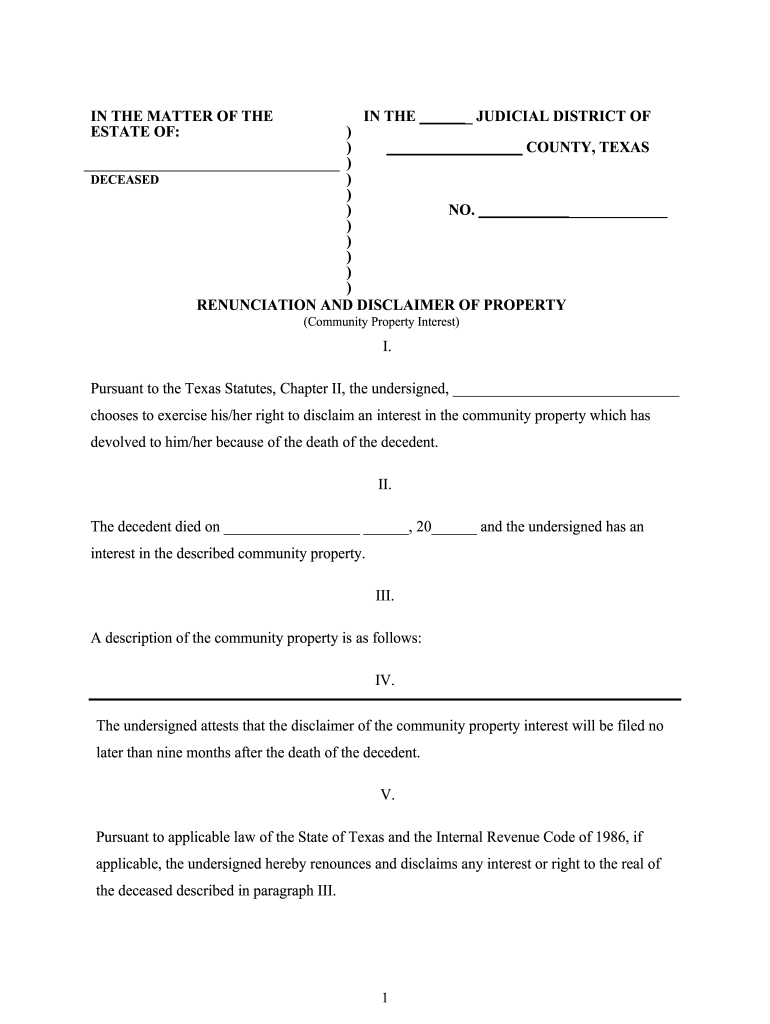
A Texas Renunciation and Disclaimer of Property is a written instrument by which a person formally declines, refuses, or disclaims an interest in specific property or in an estate interest. The document makes clear the disclaimant had the capacity and knowledge to refuse the interest, and it directs that the disclaimed property pass as if the disclaimant predeceased the decedent or transferor. It is used to avoid unintended ownership, tax consequences, or conflicts with estate plans and may affect probate distributions and title records when executed properly.

Why a formal renunciation or disclaimer can matter

A properly executed renunciation clarifies ownership, prevents inadvertent acceptance of liabilities, preserves alternate beneficiary designations, and can simplify probate by removing a party from title or distribution without a costly court proceeding.

Why a formal renunciation or disclaimer can matter

Who typically completes a renunciation or disclaimer

Typical users include individuals notified of an inheritance or interest who choose not to accept it and fiduciaries needing to clear title or distributions.

  • Heirs informed of an inheritance who want to decline an interest to avoid taxes or liabilities.
  • Trust beneficiaries who prefer an alternate remainder beneficiary to receive the asset.
  • Personal representatives or executors who need clear documentation to distribute property per the decedent's plan.

Common signer roles and responsibilities

Heir or Beneficiary

A named heir or beneficiary who elects to disclaim an interest must sign the renunciation knowingly. Signing removes that person's legal claim and causes the asset to pass to the next-designated beneficiary or under intestacy rules.

Personal Representative

An executor, administrator, or trustee may accept a signed renunciation to apply estate or trust terms, to clear title for transfer, and to document that a beneficiary expressly refused the interest.

Essential data points to include

Document Title: Renunciation and Disclaimer
Disclaimant Name: Full legal name
Property Description: Legal description or account ID
Effective Date: MM/DD/YYYY format
Signature Block: Printed name and signature
Notary Acknowledgement: Notary block if required

Step-by-step: completing the renunciation and disclaimer

Follow these sequential steps to prepare a clear, legally effective renunciation and disclaimer.

  • 01
    Identify the asset: Describe property precisely: legal description or account number.
  • 02
    State intent: Explicitly declare refusal or disclaimer of all interest.
  • 03
    Sign and date: Disclaimant signs with full legal name and date.
  • 04
    Authenticate: Add notary/witnesses or eSignature authentication as required.

How to configure an online renunciation workflow

Set up a digital workflow that captures intent, identity, and retention for enforceability and recordkeeping.

Field Configuration
Signer Authentication Email + SMS code or stronger KBA for high assurance
Signature Order Disclaimant signs first, then notary or witness as needed
Auditing Enable full audit trail with IP and timestamps
Retention Store signed PDF/A with audit record for compliance

Typical routing and submission sequence

A clear routing sequence reduces delays and ensures required attestations are captured in the correct order.

  • Prepare Document: Draft with precise descriptions and disclaimant details.
  • Obtain Signatures: Disclaimant signs, then notary or witness completes their section.
  • Record as Needed: File with county recorder or probate file if property is real estate.
  • Distribute Copies: Provide executed copies to fiduciary and title company.

Platform and format considerations for electronic completion

Use platforms that create tamper-evident PDFs, capture audit trails, and support required signer authentication.

  • File Formats: PDF, DOCX supported
  • Integrations: Works with cloud storage
  • Authentication: Email, SMS, or KBA

Key risks and consequences of defective disclaimers

Invalid Disclaimer: May be void for ambiguity
Unintended Acceptance: Treated as acceptance of property
Tax Consequences: Can trigger gift or estate tax issues
Title Delays: Recording errors delay transfers
Probate Disputes: May create contests or litigation
Administrative Fines: Late filings or errors may incur fees

Common errors to avoid when preparing a renunciation

  • Using vague language that fails to unequivocally disclaim all legal and equitable interests in the described property.
  • Failing to match the disclaimant's name to government ID, creating verification problems for title companies or trustees.
  • Omitting necessary notary or witness attestations required by the state or for recording real property instruments.
  • Delaying execution until distributions occur, which may prejudice alternate beneficiaries or produce tax consequences.

Timing considerations and when to act

Act early: a renunciation should be completed before distributions are made or title is transferred to avoid undoing transfers later.

Before Distribution:

Execute prior to asset distribution in probate or trust administration

Prior to Recording:

Complete and deliver before recording real property transfers

Tax-Related Timing:

Meet timeline needed for any tax-qualified disclaimers

Notary Scheduling:

Arrange notary or RON session in advance

Fiduciary Notice:

Provide executed copy to executor or trustee promptly

Practical tips to ensure an enforceable renunciation

Follow a checklist approach to reduce ambiguity and administrative friction when disclaiming property.

Draft Clear Language
Use an explicit, irrevocable statement of refusal naming the property, the effective date in MM/DD/YYYY format, and reference to the instrument or will being affected. Ambiguity invites disputes and can nullify the disclaimer.
Verify Identity
Require government-issued ID verification, match the printed name to the ID, and, when using electronic methods, use multi-factor authentication. Proper attribution of the signature is a legal requirement for enforceability.
Record or Deliver Appropriately
If the property is real estate, follow county recorder procedures for filing. Deliver executed copies to the executor, trustee, and title company to prevent unintended distributions.
Document Reasoning in File
Keep correspondence or legal advice that explains why the disclaimer was executed; contemporaneous records help if later challenged.

Real-world scenarios where a disclaimer is used

Two concise examples illustrate common, practical uses of a renunciation or disclaimer in estate and title contexts.

Heir Declines Burdensome Property

A beneficiary inherits a rental house with deferred maintenance and liabilities

  • The beneficiary signs a disclaimer to avoid assuming obligations
  • The property passes to the alternate beneficiary, preventing the disclaimant from inheriting repair costs or landlord liabilities and simplifying administration for the executor.

Trust Beneficiary Redirects Asset

A beneficiary prefers that an asset pass to a charity or sibling instead of receiving it directly

  • The beneficiary executes a disclaimer to redirect the asset under the trust provisions
  • The trustee records the disclaimer, updates distribution schedules, and transfers the asset to the named alternate without court involvement.

Comparison: eSignature platform pricing and capabilities for executing disclaimers

Typical platform choices differ by price, compliance features, and envelope limits. signNow is listed first per vendor-comparison convention.

signNow DocuSign Adobe Sign PandaDoc HelloSign
Starting Price $8/user/mo $15/user/mo $14/user/mo $19/user/mo $15/user/mo
Free Trial 7-day free trial Varies by vendor Varies by vendor Varies by vendor Varies by vendor
Bulk Send Yes Yes Yes Yes Varies
Audit Trail Yes Yes Yes Yes Yes
HIPAA Compliant Yes Yes Yes No No
Envelope Cap No cap 100 envelopes/user/year Varies Varies Varies

Frequently asked questions and troubleshooting

Clear answers to common questions about validity, notarization, e-signing, and recordkeeping for renunciations and disclaimers.


Need help? Contact support

be ready to get more
Join over 28 million airSlate SignNow users