Heading
Date, addressee, client reference, and property identifier to establish context and intended recipients.
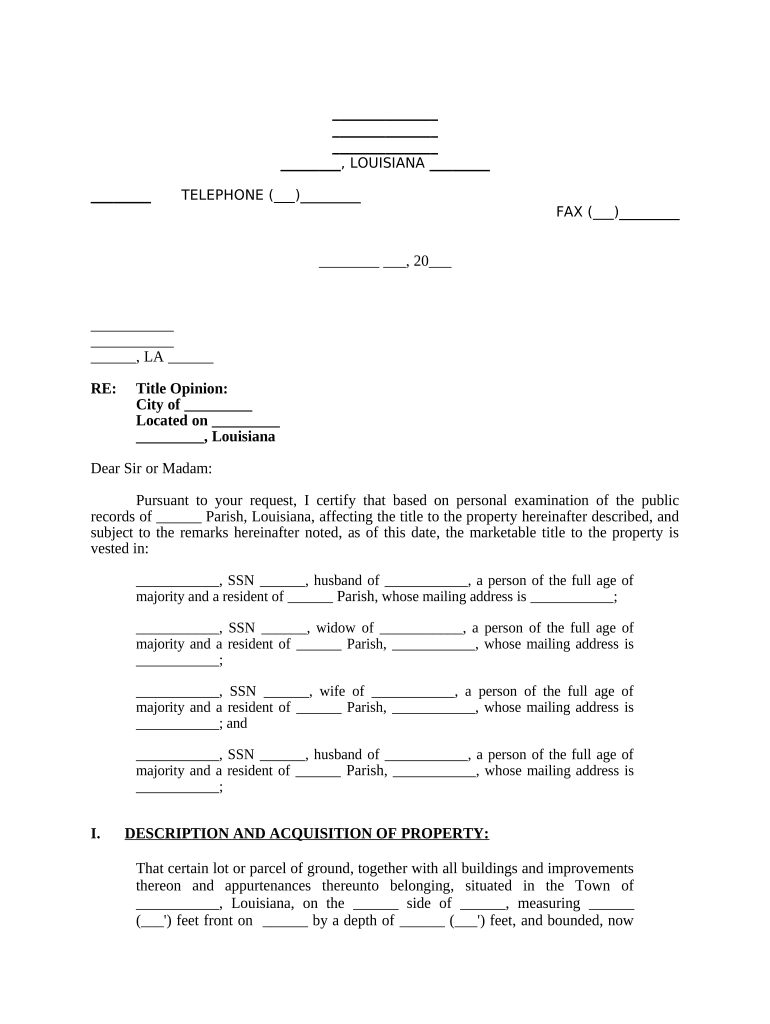
A Title Opinion Letter gives an expert legal view of title issues that can prevent closing delays, reveal defects early, and guide underwriting decisions. It documents the attorney's analysis in a written form that lenders and insurers can rely on, subject to stated exceptions and qualifications under applicable law (ESIGN and UETA govern electronic delivery and signatures).

Common users include lenders, closing agents, buyers, sellers, and title insurers who need a certified legal assessment of ownership, liens, or easements before closing.
Attorneys prepare the opinion; firms that litigate, handle commercial transactions, or specialize in real estate practice commonly issue them as part of closing deliverables.
Date, addressee, client reference, and property identifier to establish context and intended recipients.
Description of records searched (chain of title dates, public records examined, and any exclusions or date cutoffs).
Full metes-and-bounds or recorded plat reference and parcel identifiers to avoid ambiguity about the land.
Summary of ownership transfers and recorded instruments affecting title during the reviewed period.
List recorded liens, easements, covenants, restrictions, and unresolved judgments that qualify the opinion.
Attorney's conclusion on marketability or insurability, any qualifications, signature, and firm contact information.
| Field | Configuration |
|---|---|
| Document Upload | Accept PDF and DOCX; store a master PDF for signature. |
| Signature Fields | Place signer, date, and firm name fields with required status. |
| Authentication | Use email verification or SMS code; consider stronger ID for lender reliance. |
| Audit Trail | Capture timestamps, IPs, and completion certificate for each signer. |
Choose a platform that supports required file formats, robust audit trails, and the authentication level your recipients expect.
Ensure the chosen system can retain tamper-evident signed copies and export audit records to support lender, insurer, or closing agent reliance.
| signNow | DocuSign | Adobe Sign | PandaDoc | HelloSign | |
|---|---|---|---|---|---|
| Starting Price | $8/user/mo | $15/user/mo | $14/user/mo | $19/user/mo | $15/user/mo |
| Free Trial | 7-day free trial | Varies by vendor | Varies by vendor | Varies by vendor | Varies by vendor |
| Bulk Send | Yes | Yes | Yes | Yes | Varies by plan |
| Audit Trail | Yes | Yes | Yes | Yes | Yes |
| HIPAA Compliant | Yes | Yes | Yes | No | No |
| Envelope Cap | No cap | 100 envelopes/user/year | Varies | Varies | Varies |
When Martin Properties needed to close a multi-parcel acquisition, the title opinion identified a dormant lien that required release before funding.
A lender required confirmation of vesting and easements for redevelopment financing on urban property parcels.
An experienced real estate attorney licensed in the state issues and signs the opinion. They state the scope of records examined and provide a professional certification or disclaimer as required by civil practice and lender guidelines.
A firm partner or designated attorney with authority typically signs the letter; for larger firms, an approving partner may add firm-level disclaimers or reliance limitations for lenders and insurers.
3–10 business days for routine searches and drafting.
2–6 weeks or longer when extensive chain issues or litigation checks are required.
Deliver the opinion before funding and closing to allow lender review.
Expedited searches may add fees but shorten delivery timeframes.
Set a clear search cutoff date to define what records were examined.
Place the title search order and confirm parcel identifiers and client instructions.
Examine chain of title, liens, encumbrances, and public filings through the cutoff date.
Compose the opinion, include exhibits, and circulate internally for quality checks.
Sign the final opinion and distribute the signed copy and audit record to stakeholders.