Establishing secure connection…Loading editor…Preparing document…

Trademark Cease and Desist Letter

This template is fully customizable. Edit the text, fill out the fields, and send it for signature. Give it a try!
Trademark Cease and Desist Letter

What a Trademark Cease and Desist Letter Is

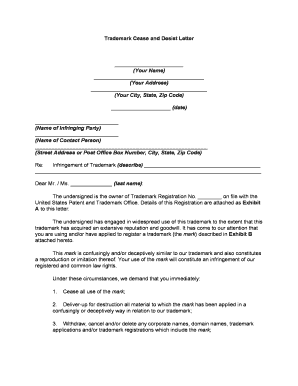
A Trademark Cease and Desist Letter is a formal written demand from a trademark owner or its counsel asserting unauthorized use of a trademark and requesting that the recipient stop specific infringing activity. The letter identifies the trademark, describes the allegedly infringing use with examples, summarizes ownership and registration status where relevant, sets a clear deadline for compliance, and states potential legal remedies if the recipient does not comply. It is commonly used as a pre‑litigation step to preserve rights, encourage voluntary resolution, and create an evidentiary record for later enforcement.

Why Use a Trademark Cease and Desist Letter

A well‑crafted letter can stop infringing activity, document the claim for future enforcement, and encourage settlement without immediate litigation. It helps preserve statutory remedies and supports evidentiary positions while keeping legal costs lower than filing a lawsuit.

Why Use a Trademark Cease and Desist Letter

Who Typically Sends or Receives These Letters

Trademark owners, IP counsel, and in‑house legal teams commonly prepare and send cease and desist letters to address alleged infringements before pursuing litigation.

  • Brand owners and corporations protecting registered trademarks and commercial goodwill.
  • In‑house legal teams and outside IP counsel managing enforcement and dispute resolution.
  • Small businesses and startups asserting common‑law rights or responding to challenges.

Stepwise Process to Prepare and Send the Letter

Follow these steps to prepare, review, and deliver an effective Trademark Cease and Desist Letter while preserving enforcement options and evidentiary records.

  • 01
    Identify Mark: Confirm ownership, registration status, and scope of goods or services.
  • 02
    Gather Evidence: Collect screenshots, sales records, registration certificates, and dates of use.
  • 03
    Draft Letter: State facts, legal basis, demanded actions, and a precise deadline.
  • 04
    Deliver: Serve by certified mail, process server, or counsel delivery; document proof of service.

How Sending and Response Typically Works

This overview shows common points in the sender‑to‑recipient flow for a cease and desist letter and what each party typically does at each stage.

  • Preparation: Sender compiles evidence and drafts the demand.
  • Service: Letter is delivered with proof by mail or process server.
  • Recipient Review: Recipient assesses claims, consults counsel, and decides response.
  • Resolution: Parties may negotiate, comply, or escalate to litigation.

Configuring a Digital Workflow to Send the Letter

Set up a repeatable digital workflow for drafting, approving, and delivering cease and desist letters to ensure evidence capture and consistent handling.

Field Configuration
Authentication Method Email link, SMS code, or higher assurance KBA as required
Signature Fields Add signer, date, and witness fields if notarization is needed
Reminder Schedule Set automatic reminders to recipients and internal approvers
Template Library Create reviewable templates for counsel and business users

Technical and Security Considerations for eDelivery

Choose tools that support secure transmission, audit trails, and optional advanced signer authentication when sending legal demands electronically.

  • Document Formats: PDF and DOCX support
  • Audit Trail: Capture timestamps, IP, and actions
  • Signer Authentication: Email, SMS, or advanced options

Essential Elements of a Professional Letter

A clear structure improves enforceability and reduces ambiguity. Include these six elements to make the recipient and any reviewing court understand the asserted rights and requested actions.

Notice Header

A concise heading that identifies the letter as a demand and alerts the recipient to legal consequences if ignored; sets formal tone.
Trademark ID

Exact trademark text or image plus registration number and filing date if registered to establish the specific right claimed.

Factual Summary

Clear, dated examples of the alleged infringing use with URLs, product listings, or marketing materials attached as exhibits.

Legal Basis

Short statement of the legal theory (e.g., likelihood of confusion, dilution) and references to registration or priority where relevant.

Demand

Precise remedial steps, such as cease use, destroy inventory, remove listings, and retract claims, with a specific compliance deadline.

Reservation of Rights

Explicitly reserve all rights and remedies, including injunctions, statutory damages, and attorney fees if applicable under governing law.

Data and Security Items to Track

Encryption: TLS 1.2/1.3 in transit; AES‑256 at rest
Audit Trail: Timestamps, IP addresses, action log
HIPAA: BAA required if PHI involved
Retention: Exportable records for litigation
Access Controls: Role‑based permissions and SSO
Certification: SOC 2 Type II, ISO 27001 available

Risks and Consequences of Errors

Misidentifying Party: Names wrong — service may be invalid
Overbroad Demand: May expose sender to counterclaims
Insufficient Evidence: Weakens enforcement and damages case
Defamation Risk: False allegations can incur liability
Service Errors: Improper service undermines legal effect
Statute Limits: Delay can reduce remedies

Common Preparation Mistakes to Avoid

  • Sending a vague or overly aggressive letter without documentary support often prompts dispute escalation rather than compliance; attach clear evidence and limit demands to provable acts.
  • Naming the wrong legal entity or an individual instead of the operating company can void service or allow the recipient to evade responsibility if corporate formalities differ.
  • Failing to set a precise deadline or using ambiguous timelines reduces urgency and may complicate calculations of statutory limitation periods and remedies.
  • Not verifying the mark’s registration status, prior licenses, or coexistence agreements can lead to costly counterclaims and diminish the letter’s credibility.

Typical Timelines and Response Expectations

Response windows and follow‑up timing vary by case complexity; clearly set and document deadlines and next steps in the letter.

Initial Deadline:

Commonly 10–30 days for recipient compliance

Evidence Preservation:

Immediately request preservation of relevant records

Follow‑Up Notice:

Send second notice if no response within deadline

Litigation Notice:

Allow reasonable time before escalating to court

Statute Consideration:

Act promptly to preserve equitable and statutory remedies

Key Milestones from Draft to Escalation

Track milestones to document good faith efforts and to create a defensible timeline if litigation becomes necessary.

01

Draft Complete

Letter finalized and reviewed by counsel before sending

02

Proof of Service

Retain certified mail receipt or server affidavit

03

Recipient Deadline

Allow clear calendar days for compliance and reply

04

Escalation Decision

Assess response and decide whether to sue or negotiate

eSignature Cost and Capability Comparison

Comparison of common eSign providers and selected features relevant when sending legal demand letters and tracking proofs of delivery.

signNow DocuSign Adobe Sign PandaDoc HelloSign
Starting Price $8/user/mo $15/user/mo $14/user/mo $19/user/mo $15/user/mo
Free Trial 7‑day free trial Varies by plan Varies by plan Varies by plan Varies by plan
Bulk Send Yes (Business Premium) Yes Yes Yes Varies
Audit Trail Yes Yes Yes Yes Yes
HIPAA Compliant Yes Yes Yes No No
Envelope Cap No cap 100 envelopes/user/year Varies by plan Varies by plan Varies by plan

Representative Use Cases and Outcomes

Two concise examples show how a cease and desist letter can resolve disputes or trigger further action.

Direct Resolution

A small retailer received a letter with dated marketplace listings and promptly removed infringing listings.

  • The seller removed listings within one week.
  • The matter closed with no litigation after the parties executed a limited license and corrective notice.

Escalation After Noncompliance

A mid‑size brand sent notice with evidence of confusion and sales impact.

  • The recipient ignored the deadline.
  • The owner filed suit, used the preserved letter and exhibits at preliminary injunction stage, and obtained a court order to stop use.

Frequently Asked Questions About Trademark Cease and Desist Letters

Answers to common questions on enforceability, service, eSign use, evidentiary value, and next steps when a recipient does not comply.


Need help? Contact support

be ready to get more
Join over 28 million airSlate SignNow users