Establishing secure connection…Loading editor…Preparing document…

Washington Motion to Transfer Case to Superior Court

This template is fully customizable. Edit the text, fill out the fields, and send it for signature. Give it a try!
Washington Motion to Transfer Case to Superior Court

What the Washington Motion to Transfer Case to Superior Court Is

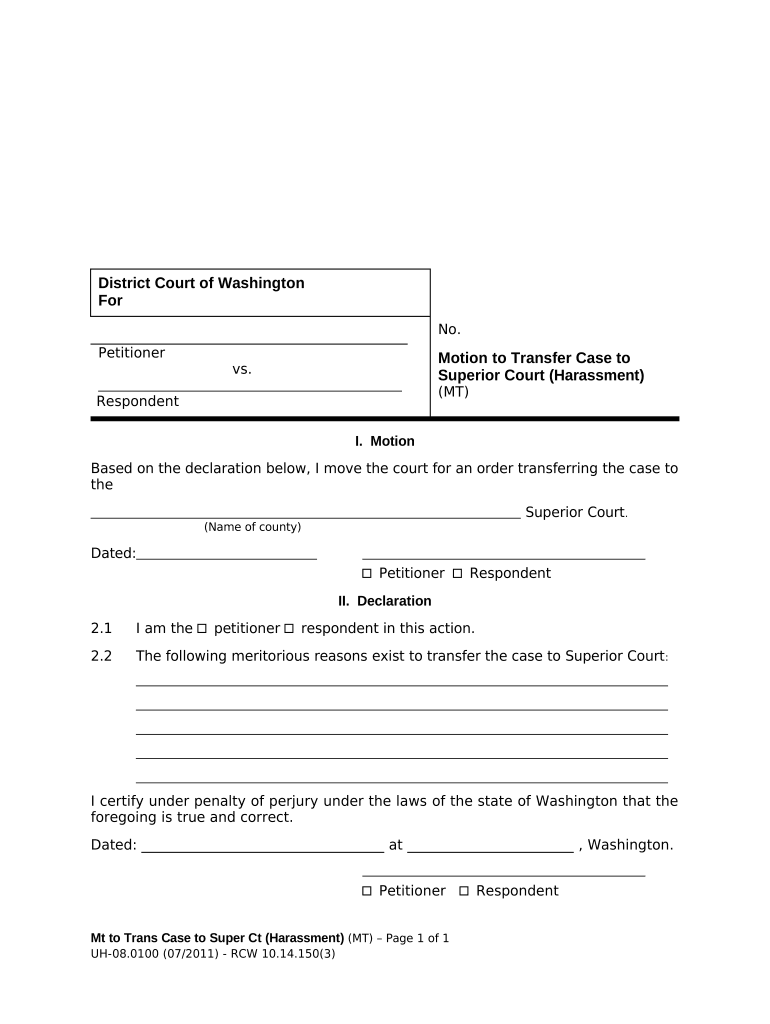
A Washington Motion to Transfer Case to Superior Court is a formal, written request submitted to a court of limited jurisdiction asking that an existing matter be transferred to a Washington Superior Court (the state trial court of general jurisdiction). Typical uses include situations where the relief sought exceeds the lower court's monetary or equitable authority, where a jury trial or broader discovery is needed, or where statutory or venue rules require Superior Court resolution. The motion frames legal grounds, cites supporting facts or law, and asks the judge to issue an order transferring the case to the appropriate Superior Court for further proceedings.

Why filing a transfer motion matters

A properly prepared Motion to Transfer Case to Superior Court preserves parties' rights to broader remedies and procedures available only in Superior Court and ensures the case proceeds in the correct forum for the requested relief.

Why filing a transfer motion matters

Who commonly prepares and files this motion

The motion is used by attorneys and self-represented parties who need transfer to Superior Court for jurisdictional, procedural, or relief-related reasons.

  • Civil plaintiffs or defendants needing jury trial or equitable remedies
  • Attorneys litigating higher-value or complex claims
  • Pro se litigants seeking a different forum for broader remedies

Typical signatories and filing parties

Plaintiff's Attorney

A civil litigator who prepares legal arguments, assembles supporting evidence, and certifies service. The attorney must ensure the motion complies with local Superior Court transfer procedures and any timing requirements.

Pro Se Litigant

An individual representing themselves who drafts and files the motion without counsel. Pro se filers must follow court formatting, filing, and service rules to avoid dismissal or rejection.

Step-by-step: preparing and filing the motion

Follow a structured process: confirm grounds, draft the motion and attachments, file in the originating court, and serve all parties according to local rules.

  • 01
    Confirm Grounds: Verify statutory or procedural reasons for transfer.
  • 02
    Draft Motion: Prepare concise factual and legal support with exhibits.
  • 03
    File & Pay: File in the originating court and pay any applicable fees.
  • 04
    Service: Serve the opposing party and file proof of service.

How the transfer process typically proceeds

The procedural path generally starts in the lower court and, when the judge grants transfer, continues in Superior Court under that court’s docket and scheduling.

  • Prepare Motion: Assemble motion, exhibits, and proposed order.
  • File in Lower Court: Submit to the court that currently has the case.
  • Serve Opposing Party: Provide notice per local rules before hearing.
  • Superior Court Docket: If transferred, case continues under Superior Court procedures.

Typical eFiling and service configuration

Set up filing and service options to match court systems and local rules; verify accepted formats and authentication methods.

Field Configuration
Filing Method eFile portal or paper submission per local clerk
Document Format PDF/A preferred; combine exhibits into single file
Signature Method Wet signature, scanned, or eSignature per court guidance
Proof of Service Certificate of service filed as separate document

Technical considerations for eSubmission and signatures

Confirm the court’s eFiling system accepts electronic documents and whether eSignatures or scanned wet signatures are permitted.

  • File Formats: PDF and PDF/A accepted by most eFiling systems
  • Authentication: Two-factor or account-based eFile authentication often required
  • Integrations: Integrates with cloud storage and court eFile portals

Timing and deadlines to monitor

Deadlines vary by court and motion type; confirm local civil rules and any scheduling orders to ensure timely filing and service.

Filing Timing:

File as soon as grounds for transfer are known to avoid waiver

Service Deadline:

Serve opposing parties according to local rules before hearing

Hearing Scheduling:

Judge may set a hearing after motion is filed and served

Response Window:

Opposing party generally has a short period to respond

Order Entry:

If granted, transfer order is entered and case moves to Superior Court

Key milestones from filing to transfer

Track these sequential milestones to manage the case progression and ensure compliance with procedural steps.

01

Draft and File Motion

Prepare motion and submit to the originating court docket.

02

Serve Opposing Party

Provide proof of service per local civil rule requirements.

03

Attend Hearing

Present arguments at the court hearing if one is scheduled.

04

Entry of Transfer Order

Clerk enters the order and transmits the matter to Superior Court.

How this motion differs from similar filings

Compare the Motion to Transfer with related filings to choose the correct procedural vehicle for your case.

Criteria Motion to Transfer Motion to Dismiss
Primary Purpose change forum challenge legal sufficiency
Typical Outcome case moved case dismissed or not
Timing Sensitivity moderate often immediate
Service Requirement

Common preparation mistakes to avoid

  • Failing to cite specific statutory or rule-based grounds, leaving the judge without a legal basis to grant transfer
  • Using inconsistent party names or incorrect case numbers that cause clerical misfiling or rejection
  • Neglecting to attach required exhibits or declarations that demonstrate the need for Superior Court procedures
  • Missing service requirements or proof of service, which can lead to denial or procedural delay

Consequences of incorrect or late filings

Dismissal: Case delays or dismissal
Sanctions: Court may impose fines
Fee Exposure: Order to pay costs
Waiver: Loss of transfer rights
Delay: Extended litigation timeline
Appeal Limits: Reduced appellate remedies

Key elements a professional motion should include

A complete motion presents a concise statement of facts, legal authority, requested order, and supporting evidence formatted for the court and opposing counsel.

Clear Caption

Case caption and number must match the docket and identify all parties consistently to prevent clerical errors and ensure proper routing.
Statement of Facts

Concise chronological facts showing why transfer is necessary, supported by citations to admissible evidence or sworn declarations.

Legal Authority

Cite applicable statutes or rules that permit transfer and explain how the law supports the requested relief in the specific circumstances.

Supporting Exhibits

Attach key documents, affidavits, or declarations that corroborate factual assertions and help the court evaluate transfer necessity.

Proposed Order

Include a proposed order the judge can sign, specifying the Superior Court to receive the case and any interim directions.

Proof of Service

Certificate of service showing how and when opposing parties were notified, filed as a separate docket entry as required.

Supporting documents you should attach

Include immediate evidence and administrative items that substantiate your request and facilitate the transfer without supplemental requests.

Affidavit or Declaration

Sworn statement by a party or witness summarizing key facts and authentication of exhibits for the court’s consideration.

Relevant Contracts or Invoices

Documents showing the amount in controversy, contractual disputes, or other reasons supporting Superior Court jurisdiction.

Proposed Order

Draft order tailored to the court’s required language to expedite entry if the judge grants transfer.

Proof of Service

Completed certificate of service demonstrating timely notice to all parties in the manner prescribed by local rules.

Practical tips for accurate and efficient completion

Adopt standardized templates and checklist-driven reviews to reduce errors and speed court processing.

Use a Template and Checklist
Start from a jurisdiction‑specific template that includes required sections, exhibits, and a proof-of-service form; checklists catch missing items before filing.
Verify Local Rules
Confirm format, page, and eFiling requirements with the county clerk; local rules often control timing, service, and acceptable electronic signatures.
Include a Proposed Order
Provide a clearly worded proposed order to expedite entry if the judge grants the motion; mirror local form language where available.
Maintain an Audit Trail
Keep copies of filed documents, filing receipts, service confirmations, and any eSignature audit records for the case file and appeals.

Representative scenarios where a transfer motion is used

Two common, practical examples show when transfer is appropriate and how it affects case handling.

High-Value Contract Dispute

Plaintiff obtains relief exceeding lower-court limits and files to transfer

  • Transfer sought to access broader damages and jury trial
  • Superior Court handles complex discovery and expert testimony, enabling full remedies and extended procedural tools.

Claim Requiring Injunctive Relief

Defendant’s ongoing conduct risks irreparable harm, not remediable in limited court

  • Motion seeks transfer for equitable relief
  • Superior Court can provide injunctive remedies, longer hearings, and enforceable orders suited to the emergency relief requested.

Frequently asked questions and troubleshooting

Answers to common procedural and technical questions about preparing and filing a Motion to Transfer Case to Superior Court in Washington.


Need help? Contact support

eSignature vendor pricing snapshot for filing and signing needs

Compare starting prices and key features relevant to signing and managing court documents. Confirm vendor plan details and court acceptance of eSignatures before use.

signNow DocuSign Adobe Sign PandaDoc HelloSign
Starting Price $8/user/mo $15/user/mo $14/user/mo $19/user/mo $15/user/mo
Free Trial 7-day free trial Varies Varies Varies Varies
Bulk Send Yes (Business Premium) Varies Varies Varies Varies
Audit Trail Yes Yes Yes Yes Yes
HIPAA Compliant Yes Varies Varies Varies Varies
Envelope Cap No cap 100 envelopes/user/year Varies Varies Varies
be ready to get more
Join over 28 million airSlate SignNow users