Establishing secure connection…Loading editor…Preparing document…

Resolution Authorizing Corporate Credit Account

This template is fully customizable. Edit the text, fill out the fields, and send it for signature. Give it a try!
Resolution Authorizing Corporate Credit Account

What the Resolution Authorizing Corporate Credit Account Is

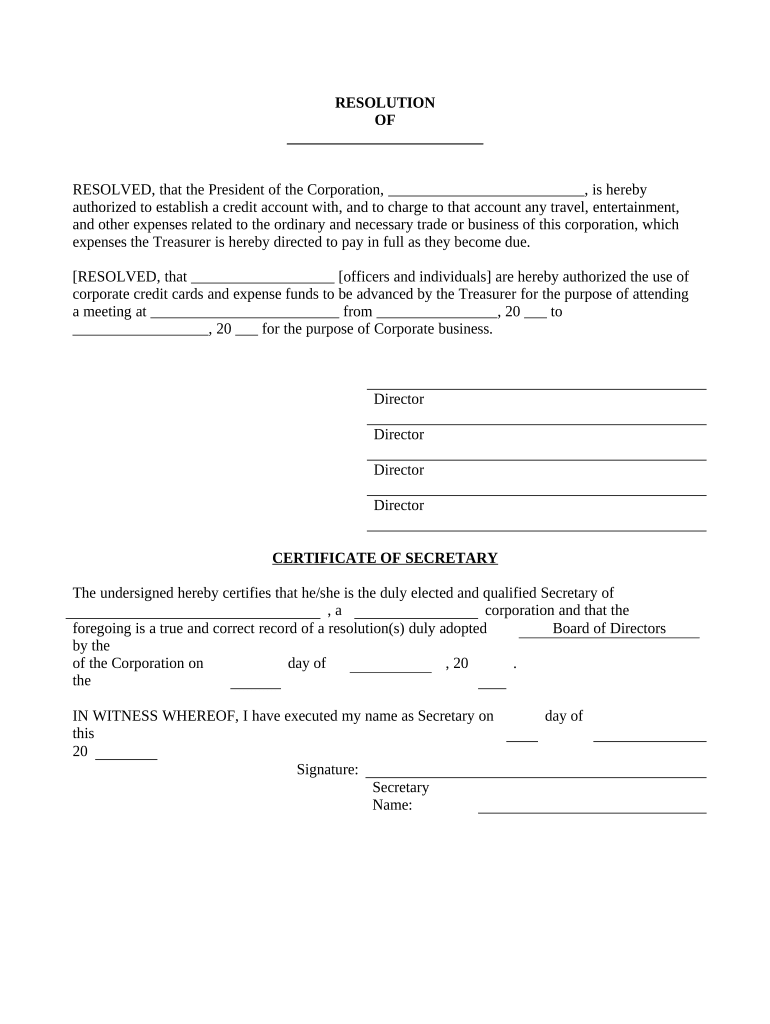
A Resolution Authorizing Corporate Credit Account is a formal corporate record, typically adopted by a board of directors or authorized committee, that grants one or more officers or agents the authority to open, manage, and use a credit account on behalf of the company. The resolution identifies the legal entity, specifies the bank or lender, describes the permitted account activities and spending limits, names authorized signatories, and sets any conditions for use. It is preserved in corporate minutes and provided to financial institutions as proof of corporate authority to bind the entity to credit arrangements.

Why a Clear Corporate Credit Resolution Matters

A precise resolution reduces onboarding friction with banks, clarifies internal authority, and limits personal liability by documenting delegated powers.

Why a Clear Corporate Credit Resolution Matters

Who Prepares and Signs This Resolution

Corporations typically prepare this resolution through corporate counsel, the corporate secretary, or the finance department before presenting it to the board for adoption.

  • Board of Directors — Adopts and ratifies authority delegations and records the resolution in minutes.
  • Corporate Secretary — Drafts, certifies, and preserves the resolution as an official record.
  • Chief Financial Officer — Often designated as an authorized signatory or responsible officer for account oversight.

After adoption, certified copies are delivered to banks, lenders, and internal stakeholders to operationalize the credit account and enforce controls.

Step-by-Step: Adopting and Using the Resolution

Follow these sequential steps to authorize and activate a corporate credit account with minimal delay.

  • 01
    Draft: Prepare resolution text listing entity, authority, and limits.
  • 02
    Board Approval: Present at a meeting; adopt by recorded vote.
  • 03
    Certification: Corporate secretary signs a certified copy.
  • 04
    Deliver: Provide certified copy to the bank or lender.

Frequently Asked Questions

Common questions and practical answers about preparing, signing, and using a corporate credit resolution.


Need help? Contact support

Key Security and Compliance Details to Record

Data Encryption: TLS 1.2/1.3 in transit; AES-256 at rest.
HIPAA Considerations: Include BAA if PHI is present.
Audit Trail: Record timestamps, IP, and signer identity.
Access Controls: Limit electronic access to authorized roles.
Retention Policy: Preserve certified copies per retention rules.
Authentication: Use multi-factor for high-value authorizations.

Consequences of an Incorrect or Missing Resolution

Bank Refusal: Account opening denied.
Unauthorized Liability: Personal liability exposure possible.
Regulatory Fines: Penalties for noncompliance.
Contract Voidance: Credit agreements may be unenforceable.
Operational Delay: Funds access delayed.
Reputational Risk: Trust with lenders harmed.

Common Preparation Pitfalls to Avoid

  • Using an informal template that omits corporate identifiers, leading banks to reject the document for lack of proof of authority.
  • Failing to specify dollar thresholds and joint-signature requirements, which can permit unintended single-person commitments above safe limits.
  • Delivering an uncertified copy instead of a certified copy signed by the corporate secretary, resulting in repeated requests or account delays.
  • Not updating the resolution after officer changes, which leaves parties unable to transact or exposed to unauthorized activity.

What a Professional Resolution Should Include

A complete resolution balances legal precision with operational clarity so banks and internal teams can rely on it without further inquiry.

Resolution Header

Corporate name, state of incorporation, and a clear title identifying the document as a board resolution authorizing a corporate credit account; ensures formal recognition.
Authority Clause

Explicit language delegating authority to open and manage the specified credit account; include any spending limits and conditions for execution.

Account Details

Name of bank or lender, permitted account types, and permitted transactions so the institution can match the resolution to its records.

Authorized Signatories

Full names, corporate titles, specimen signature blocks, and any joint-signature rules for value thresholds to control access and liability.

Certification Statement

Signed statement by the corporate secretary certifying the vote, date of adoption, and that the resolution remains in effect unless superseded.

Effective and Review Dates

Start date, optional expiration or review interval, and procedures for amendment or revocation to maintain governance oversight.

How to Set Up an Electronic Approval Workflow

Configure a secure, auditable workflow that mirrors the board approval and certification process before delivering the resolution to the bank.

Field Configuration
Document Template Create reusable resolution template with fixed and variable fields.
Signing Order Board members sign first, then corporate secretary certifies.
Authentication Use email + SMS or stronger MFA for officers.
Storage Archive certified copy in corporate records system.

Digital Delivery and Platform Considerations

Choose a platform that supports secure e-signatures, audit trails, and the integrations your treasury and legal teams use.

  • Integrations: Salesforce, NetSuite, and Microsoft 365 commonly integrate with document workflows.
  • Formats: Support for PDF and Word (DOCX) is essential for bank acceptance.
  • Authentication: Options for SMS, email, and advanced signer authentication.

Preserve a certified copy in your records system and deliver an authenticated copy to the financial institution per its submission requirements.

Typical Submission Flow to a Financial Institution

This sequence describes the practical steps from drafting to account activation at the bank.

  • Draft Resolution: Prepare resolution and circulate for board approval.
  • Board Vote: Record minutes and adopt the resolution formally.
  • Certify Copy: Corporate secretary signs and certifies the adopted resolution.
  • Deliver to Bank: Provide certified copy and any required officer IDs to the financial institution.

Typical Timelines and Processing Expectations

Account opening and activation times vary by institution; plan ahead and allow time for certification and bank underwriting.

Board Meeting:

Schedule and adopt resolution; allow typical notice periods per bylaws.

Certification:

Corporate secretary certification usually completed same business day after adoption.

Bank Review:

Underwriting and KYC checks commonly take 3–10 business days.

Account Activation:

Activation may follow once bank verifies documents and IDs.

Ongoing Review:

Banks may request updated resolutions after material corporate changes.

eSignature Vendor Pricing Snapshot for Executing the Resolution

Comparison of typical starting prices and feature availability for common eSignature vendors useful when collecting authorizing signatures on corporate resolutions.

signNow DocuSign Adobe Sign PandaDoc HelloSign
Starting Price $8/user/mo $15/user/mo $14/user/mo $19/user/mo $15/user/mo
Free Trial 7-day free trial Varies by plan Varies by plan Varies by plan Varies by plan
Bulk Send Yes Yes Yes Yes No
Audit Trail Yes Yes Yes Yes Yes
HIPAA Compliant Yes Yes Yes No No
Envelope Cap No cap 100 envelopes/user/year Varies by plan Varies by plan Varies by plan

Practical Examples of Using the Resolution

Two concise scenarios showing how a resolution is adopted and relied upon by banks and internal teams.

Corporate Treasury Activation

A mid-size corporation drafts a resolution to authorize its CFO to open an operating line with a named bank.

  • The board records the vote in minutes.
  • The certified resolution and officer IDs are delivered to the bank, which completes KYC and activates the account within a week.

Changing Signatories

After a senior finance officer departs, the board adopts a replacement resolution naming new authorized signatories.

  • The corporate secretary certifies and distributes the updated certified copy.
  • The bank updates signing privileges and revokes the prior officer's authority to prevent unauthorized transactions.

Typical Signatories and Their Roles

Chief Financial Officer

As primary financial officer, the CFO is often named as an authorized signer with delegated limits; responsibilities include account oversight, reconciliation, and reporting to the board.

Corporate Secretary

The corporate secretary certifies that the resolution was duly adopted, maintains the official copy in corporate records, and provides certified copies to banks and external parties when required.

Practical Tips for Accurate and Efficient Completion

Follow consistent practices to reduce bank inquiries and internal compliance risk.

Use a Standard Template
Adopt a firm-approved template that includes required corporate identifiers, authority language, and a certification block to minimize drafting errors and speed bank acceptance.
Specify Limits and Conditions
Include clear dollar thresholds, single vs joint signing rules, and reporting obligations to enforce internal controls and reduce unauthorized commitments.
Certify and Archive
Have the corporate secretary certify the adopted resolution immediately and store certified copies in both physical and secure electronic records for audit readiness.
Confirm Bank Requirements
Ask the receiving financial institution whether it requires notarization, witness, or a wet-ink signature to avoid unexpected delays.
be ready to get more
Join over 28 million airSlate SignNow users