Identifying information
Full legal names, dates of birth, addresses, and government ID references to tie the affidavit to the declarants accurately.
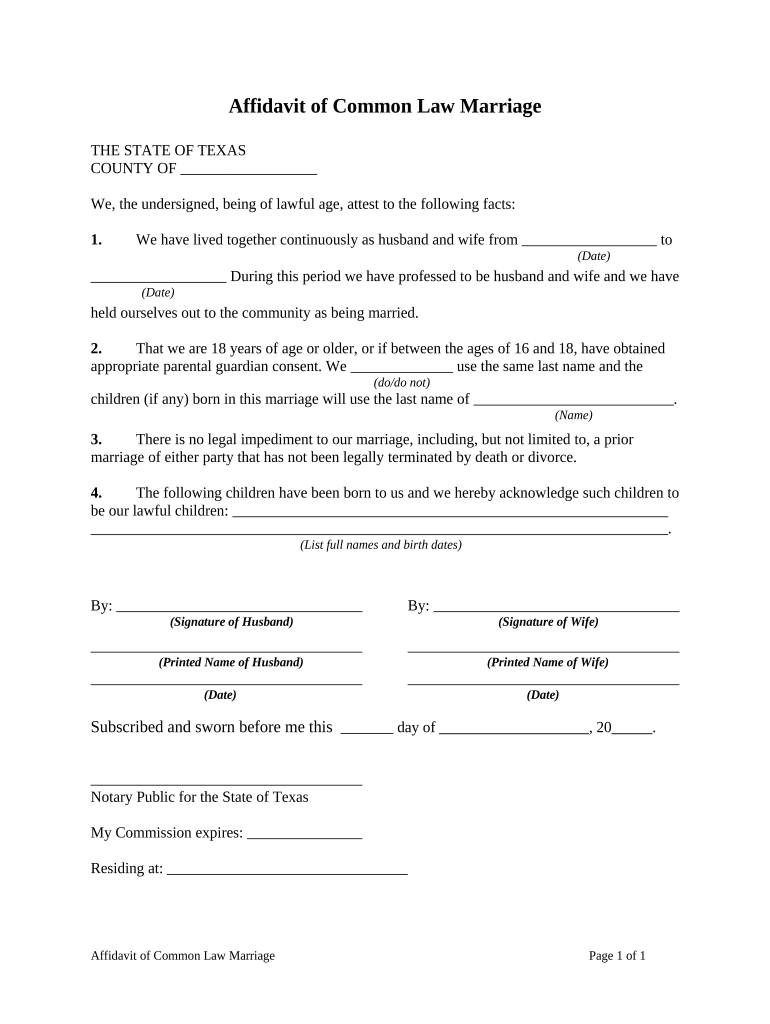
A completed affidavit provides a clear, signed statement that can simplify access to spousal benefits, probate administration, insurance claims, and tax filings when informal marriage is in dispute.

Practical users range from individuals to legal and administrative professionals seeking evidence of marital status.
The affidavit is useful wherever a signed, sworn declaration of informal marriage clarifies legal status for third parties.
The person asserting the relationship; signs under oath and provides identifying information, relevant dates, and factual statements about cohabitation and public representation. Their sworn statement is central to proving an informal marriage.
County clerks, benefits administrators, or attorneys who review the affidavit and accompanying evidence to determine eligibility for benefits, probate rights, or recognition of marital status.
| Field | Configuration | Field name | Action required |
|---|---|
| Upload PDF | Use a clean scanned document | High resolution |
| Add signature | Signature and date fields | Required for each party |
| Authentication | Email or SMS code | Confirm signer identity |
| Notary step | In-person or RON session | Capture acknowledgment |
Digital completion works with common file types and many eSignature platforms when notarization is not required.
Where notarization is required, coordinate with a notary service that supports remote online notarization (RON) or schedule an in-person session; check state rules.
File when needed for benefits or probate
Submit affidavit early to avoid administration delays
Provide proof to insurers within policy claim windows
Amend returns promptly if filing status changes
Book notary or RON session before deadline-driven submissions
Assemble joint documents and witness statements.
Prepare the affidavit and verify accuracy.
Execute before a notary or RON provider.
Provide copies to courts, insurers, or HR offices.
| Criteria | Texas Affidavit | Declaration/Registry |
|---|---|---|
| Notarization | ||
| Filed with county | optional | often filed |
| Used for benefits | ||
| Standard form |
Full legal names, dates of birth, addresses, and government ID references to tie the affidavit to the declarants accurately.
A clearly stated MM/DD/YYYY date when the parties agreed to be married or began holding themselves out as spouses.
The date cohabitation began supports continuity and duration elements often considered by third parties and courts.
A short, direct sworn sentence that both parties mutually agreed to be married and presented themselves publicly as spouses.
Attach joint tax returns, leases, insurance policies, affidavits from acquaintances, or other documentary proof that corroborates the sworn statements.
Notary acknowledgment, official seal, and dated signatures are essential for many administrative and legal uses of the affidavit.
A surviving partner submits an affidavit to establish spousal status
An insurer requests proof of spousal status for a dependent claim