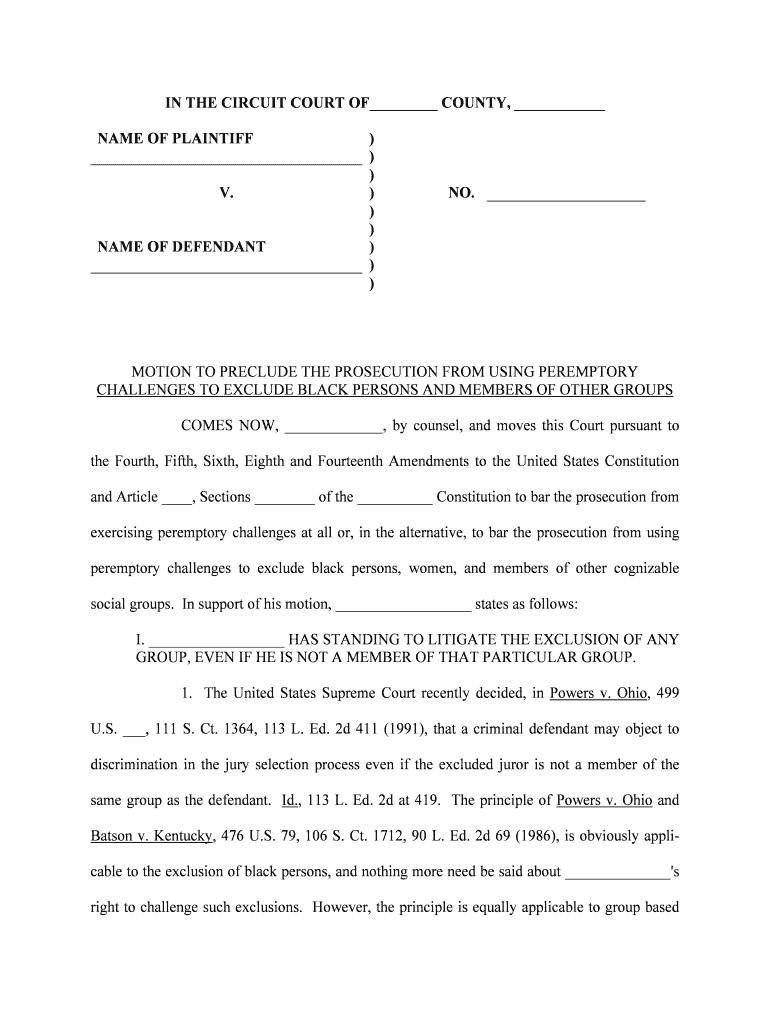
IN THE CIRCUIT COURT OF_________ COUNTY, ____________ NAME OF PLAINTIFF) )) V. )NO.))NAME OF DEFENDANT) )) MOTION TO PRECLUDE THE PROSECUTION FROM USING PEREMPTORY CHALLENGES TO EXCLUDE BLACK PERSONS AND MEMBERS OF OTHER GROUPSCOMES NOW, _____________, by counsel, and moves this Court pursuant to
the Fourth, Fifth, Sixth, Eighth and Fourteenth Amendments to the United States Constitution
and Article ____, Sections ________ of the __________ Constitution to bar the prosecution from
exercising peremptory challenges at all or, in the alternative, to bar the prosecution from using
peremptory challenges to exclude black persons, women, and members of other cognizable
social groups. In support of his motion, __________________ states as follows:I. __________________ HAS STANDING TO LITI GATE THE EXCLUSION OF ANY
GROUP, EVEN IF HE IS NOT A MEMBER OF THAT PARTICULAR GROUP.1. The United States Supreme Court recently decided, in Powers v. Ohio, 499
U.S. ___, 111 S. Ct. 1364, 113 L. Ed. 2d 411 (1991), that a criminal defendant may object to
discrimination in the jury selection process even if the excluded juror is not a member of the
same group as the defendant. Id., 113 L. Ed. 2d at 419. The principle of Powers v. Ohio and
Batson v. Kentucky , 476 U.S. 79, 106 S. Ct. 1712, 90 L. Ed. 2d 69 (1986), is obvi ously appli -
cable to the exclusion of black persons, and nothing more need be said about ______________'s
right to challenge such exclusions. However, the principle is equally applicable to group based
-2- strikes that are predicated on groups other than racial ones. Set forth below are just a few of the
various permutations on this theme.A. Gender-based strikes.2. For example, while ________________ is male, it is well established that
gender-based classifications used by the state are subject to constitutional scrutiny. Craig v.
Boren, 429 U.S. 190, 97 S. Ct. 451, 50 L. Ed. 2d 397 (1976); City of Cleburne v. Cleburne
Living Center, 473 U.S. 432, 105 S. Ct. 3249, 87 L. Ed. 2d 313 (1985). In United States v.
DeGross, 913 F.2d 1417 (9th Cir. 1990), the court considered whether the principles established
in Batson compelled the prohibition of peremptory challenges on the basis of the venireperson's
gender. Id. at 1421. The DeGross court first found that gender-based challenges, like racial
challenges, are based:
[E]ither on the false assumption that mem bers of a certain group
are unqualified to serve as jurors, or on the false assumption that
members of certain groups are unable impartially to consider the
case against a member or a non-member of their group.Id., 913 F.2d at 1422 (citations omitted). The court then found that
gender discrimination during jury selection, again like racial
discrimination, "harms the excluded venirepersons, undermines
public confidence in the judicial system, and stimulates community
prejudice." Id. at 1422. Based on these findings, the court
concluded that "equal protection principles prohibit peremptory
challenges exercised on the basis of a venireperson's gender." Id. at
1423; see also People v. Blunt, 561 N.Y.S.2d 90 (App.Div. 1990);
-3- People v. Irizarry, 560 N.Y.S.2d 279 (App.Div. 1990);
Commonwealth v. Samuel , 495 N.E.2d 499 (Mass.App. 1979).
B. Witherspoon-Violative Strikes.3. In this trial, the State will seek to death qualify
the jury by conducting a voir dire to question members of the jury
pool about their views toward capital punishment and to remove
for cause those venire persons who are so opposed to the death
penalty that they could never vote to impose it. Because potential
jurors are excluded based solely on their views, a death qualified
jury is not representative of the commu nity and may not be truly
impartial. See generally Ballew v. Georgia, 435 U.S. 223 (1978)
(defendant's right to representative jury violated when jury was
limited to five members; recognizing that right is secured only
when various predispositions and biases of the community at large
are present on jury); Fay v. New York, 332 U.S. 261 (1947)
(examining conviction ratios of special juries to determine whether
defendant's right to impartial jury was violat ed). In Witherspoon
v. Illinois , 391 U.S. 510, 88 S. Ct. 1770, 20 L. Ed. 2d 776 (1968),
the Supreme Court carved out a limited exception to the capital
defendant's right to a truly representative jury by permitting the
prosecution to exclude only those jurors who refused to follow the
law or those jurors who were, "[i]rrevoc ably committed, before the
trial has begun, to vote against the penalty of death regardless of
-4- the facts and circumstances that might emerge in the course of the
proceedings." Id. at 522 n.21.4. The Court held that a defendant's fundamental
right to a fair and impartial jury would be violated if the
prosecution were permitted to exclude jurors who were opposed to
the death penalty, but who could otherwise vote to impose the
State's death penalty statute under certain circumstances. The
Court found that when the State "[s]wept from the jury all who
expressed conscientious or religious scruples against capital
punishment and all who opposed it in principle, the State crossed
the line of neutrali ty" by creating a jury which was "[u]ncommonly
willing to condemn a man to die" --i.e., a jury unrepresentative of
the community from which it was drawn. Id. at 520; see also
Fuselier v. State , 468 So.2d 45 (Miss. 1985); Billiot v. State , 454
So.2d 445 (Miss. 1984), cert. denied , 469 U.S. 1230 (1985)
(quoting Armstrong v. State, 214 So.2d 589, 593 (Miss. 1968),
cert. denied , 395 U.S. 965 (1969)).
5. The exclusion of even one potential juror who
could otherwise serve under the Witherspoon and Fuse lier
standards, the sentence imposed by such an unconstitutional jury
would be vacat ed. For example, in Gray v. Mississippi , 481 U.S.
648, 107 S. Ct. 2045, 95 L. Ed. 2d 622 (1987), the Supreme Court
found that the improper exclusion of a single prospective juror
-5- during the death qualification phase of voir dire was, in and of
itself, reversible constitutional error. See also Fuselier v. State,
468 So.2d at 54 (finding that trial court committed reversible error
in excusing jurors for cause who could implement death penalty
statute but who were "hesitant" to do so).
1. If the prosecution may not exclude these jurors
for cause because to do so would violate _______________'s right
to a fair and representative jury, surely the prosecution cannot be
permitted to achieve the same impermissible goal by abusing its
peremptory challenges. 2. Neither may the prosecution illegitimately
exclude such groups as Hispanics, United States v. Chinchilla , 874
F.2d 695 (9th Cir. 1989), Mexican-Americans, United States v.
Romero-Reyna, 867 F.2d 834 (5th Cir. 1989), Native Americans,
United States v. Roan Eagle, 867 F.2d 436 (8th Cir. 1989), or even
males just because they are males. See Baine v. State, 354 S.E.2d
177, 180-81 (Ga. App. 1987).
II. THE HISTORY OF DISCRIMINATION IN THE
TWENTIETH JUDICIAL DISTRICT AND ACROSS
THE STATE OF MISSISSIPPI MUST RESULT IN THE
PRECLUSION OF THE EXERCISE OF
PROSECUTORIAL PEREMPTORY CHALLENGES
ALTOGETHER.
-6- 3. There has been a history of discrimination in the
selection of juries in this Judicial District and across this State. As
set forth below, this on-going pattern of discrimination must result
in the prohibi tion of the use of peremptory challenges by the
prosecution altogether.A. An Introduction to Racial Discrimination in the
Twentieth Judicial District.4. The history of discrimination and abuse in the
exercise of peremptory challenges continues unabated today, five
years after the Supreme Court's decision in Batson v. Kentucky.
For example, in the case of State of Mississippi v. Kevin Bryant,
No. 115-91 (Lauderdale Co.), allegations of racial discrimination
were made against the Office of this District Attorney:
1. The District Attorney and his staff in the past have
systematically excluded members of the black race from being
allowed to serve on juries.2. It is logically anticipated that the District Attorney will
continue his pattern of racial discrimination in the exercise of his
peremptory challenges. * * * 5. The District Attorney in the past has consistently chosen
to use his peremptory challenges to eliminate from jury service
those members of the age group from 21 to 30 years of age.Motion to Restrict Prosecution Strikes (filed June 13, 1991). The
interesting fact to note in these statements was that they were made
by a person--Charles W. Wright--who formerly worked in the
-7- same office, and indeed was responsible for what is apparent ly the
pattern of racial discrimination. 5. However, he is not the only local attorney who
has noted that the prosecution likes to "use[] its peremptory chal -
lenges to exclude members of the Negroid race, the female sex and
young adults under age thirty (30) from the jury where the prose -
cution is seeking the death penalty. . . ." Motion to Prohibit the
State from Using Peremptory Challenges to exclude all blacks,
females and young adults from the Jury , State of Mississippi v.
Michael McDade, No. 1607 (Lauderdale Co., filed May 19, 1986);
see also State of Mississippi v. Thomas Franklin Sherrell, No. 315-
88 (Lauderdale Co.) (Motion to Preclude the Prosecution from
using peremptory challenges to exclude potential jurors who
express reservations about the death penalty but who cannot be
excused for cause, and to require the exercise of peremptory
strikes prior to the death qualification portion of voir dire (filed
Feb. 9, 1990)).
6. Habitually, black persons, women, and young
people are struck from the juries in this District. It is next to
impossible for the defense to ascertain the race of all jurors struck,
since race is generally not reflected in the records kept at the Court
house. It is for this reason that discovery is demanded of the
prosecution below. Nevertheless, to give but a few examples
-8- where the evidence was available, in State of Mississippi v.
Michael Anthony Blanks, No. 1614-C (Lauderdale Co.), the state
used 6 of 12 strikes to eliminate all the black persons from the jury.
While the defense used 11 strikes to eliminate black persons, this
still left an all-white jury. In State of Mississippi v. Clarence
Johnson a/k/a/ "Pot" Johnson, No. 2019-C (Lauderdale Co.), the
state used 5 of 8 strikes on black persons. In State of Mississippi
v. Houston Johnson , No. 1862-C (Lauderdale Co.), the state used 6
of 7 strikes against black persons. In the case of State of Missis-
sippi v. Prentiss Dubose, No. 1949-C (Lauderdale Co.), the jury
was comprised of 11 whites and 1 black person.
7. Neither is discrimination always limited to those
groups identified by former-District Attorney Wright. Especially
in capital cases, where blind adherence to stereotype is often still
more rife, other groups are also singled out for exclusion. For
example, in the case of State of Mississippi v. Billy Wade Smith,
No. 1979-C (Lauderdale Co.), the prosecution used three strikes to
remove Catho lics from the case. This discrimination against
Catholics is presumably predicated on such stereotypes as the
perception that Catholics are against the death penalty because the
Pope says they should be.
8. Similarly, the prosecution seeks to exclude
those who are not opposed to the death penalty to the extent
-9- required for exclusion under Witherspoon v. Illinois , 391 U.S. 510,
88 S. Ct. 1770, 20 L. Ed. 2d 776 (1968), and Fuselier v. State, 468
So.2d 45 (Miss. 1985), but who nevertheless would not apply the
death penalty without very careful consideration. These people
obviously have the right to serve on juries and, but dint of the
attitude which describes their group, are legally cognizable, as
discussed below. Indeed, there are various groups which are
routinely excluded by the prosecution in this Judicial District, none
of whom should be thus barred from serving on juries.
9. While Batson v. Kentucky, 476 U.S. 79, 106 S.
Ct. 1712, 90 L. Ed. 2d 69 (1986), made it absolutely clear that
racial and other discrimination will not be tolerated, pretextual
reasons continue to be given for the disproportionate exclusion of
minority per sons from the juries in this District. See, e.g. , Wheeler
v. State, 536 So.2d 1347, 1351 (Miss. 1988) (prosecution from this
District gets away again with using 4 of 6 strikes to elimi nate black
persons); Johnson v. State , 529 So.2d 577, 582-83 (Miss. 1988)
(prosecution gets away with using 5 of 7 strikes on black per sons).
B. There historically was, and clearly still is, dis-
crimination going on in the selection of juries across
this State.10. One hundred years ago, Plessy v. Ferguson,
163 U.S. 537, 16 S. Ct. 1138, 41 L. Ed. 256 (1896), was the law.
Under the law of Plessy , the prosecutors of this state could validly
-10- get away with removing any black person who might have
appeared on the jury: Upon the other hand if he be a colored man and be so assigned,
he has been deprived of no property, since he is not lawfully
entitled to the reputation of being a white man. Id., 163 U.S. at 549. A century ago, the belief that black citizens
"had no rights which the white man was bound to accept" was
"universal . . . and men in every grade and position in society daily
acted upon it in their private pursuits, as well as in matters of
public concern." Scott v. Sanford , 60 U.S. (19 How.) 393, 407
(1857) (The Dred Scott Decision). If they were lucky enough to be
represented at all, black slaves were represented by their owners
when they were tried for capital crimes. See , e.g., Alfred v. State,
6 Ga. 483 (1849) (failure of white owner to use any peremptory
strikes on behalf of his slave in capital trial not error).
11. At that time, State courts placed enormous
obstacles in the path of the few black defendants who tried to
assert their new Fourteenth Amendment rights. See, e.g. , Neal v.
Delaware, 103 U.S. 370, 397 (1880) (state court presumed that
none of the 26,000 blacks in Delaware had the "intelligence" or
"moral integrity" to sit on a jury); Ex Parte Murray , 66 Fed. 297
(E.D. La. 1985) (state trial judge refused to sign defendant's
subpoena for jury lists and denied relief for lack of proof); Smith
-11- v. State, 45 Tex. Crim. 405, 77 S.W. 453 (1903) (name of dead
black man placed on grand jury to feign compliance with Supreme
Court decision); Fugett v. State, 45 Tex. Crim. 313, 77 S.W. 461
(1903) (to defeat jury challenge, prosecutor called black physician
to testify that no blacks were intelligent enough to serve); cf.
Strauder v. West Virginia , 100 U.S. 303 (1880). Although the
history books prove that blacks were inten tionally excluded from
juries in almost every county in the southern states, the belief that
blacks were "in mind and morals, inferior to the Caucasian" was
so well entrenched that it was regarded as a judicially noticeable
fact. Wolfe v. Georgia Ry. & Electric Co., 2 Ga. App. 499, 58 S.E.
899, 901-02 (1907). The courts believed that "no human law"
could prevent juries from acting upon their bias against blacks. Id.,
58 S.E. at 902.
12. That was a century ago, however. In theory,
Plessy was over ruled in Brown v. Board of Education, 347 U.S.
483, 74 S. Ct. 686, 98 L. Ed. 873 (1954). In practice, only recently
did this State see appointment of its first black district attor ney, far
away from this Judicial District. Every single one of them is male.
These white males make two decisions, inter alia, in every capital
case which can mean the difference between life and death, and
between first class citizen ship and no citizenship at all.
-12- 13. First, the District Attorney in this Judicial
District, and his compadres in other Districts, decide whether
someone should live or die. If he decides to take the power of God
into his hands, the District Attorney -- along with his almost
exclusively white male colleagues -- then decides whether he will
permit any black persons to sit on the juries which make the final
life-or-death decision. Any District Attorney -- be he or she black
or white --ought rightfully to make the first decision equitably, if at
all. Rich and poor, black and white, killers of victims from all
walks of society -- all should fear the execution er equally.
Similarly, any District Attorney should respect the Sixth
Amendment right to a fair cross-section on the jury, and the
Fourteenth Amendment right to equal protection, and permit all
citizens, of every race, sex, creed or color, to share in the most
momentous decision Society can make: Whether to take a human
life. Despite these self-evident truths, there are many District
Attorneys in this state who flagrantly violate the rights of women,
black people, and the poor on a routine basis in capital prosecu -
tions, as well as in other trials. This judicial district has witnessed
such discrimination in the same manner that all the others have. 13. _______________ has tried to gather all the
information on all the cases tried in this judicial district over recent
years. As set forth above, this is a very difficult process since the
-13- court records do not reflect the race of peremptory challenges in
most cases. However, a pattern of abuse of peremptory challenges
has appeared from those cases where the history is available.14. Neither is the pattern in this Judicial District
unique. Day after day, in case after case, prosecutors across this
State continue to strike black persons for no real reason other than
their skin color, and then give pretextual reasons for the continu -
ation of this sorry history of discrimination. For example, in
Goggins v. State , 529 So.2d 649 (Miss. 1988), the State struck two
black jurors, and the prosecutor said he was striking the black
jurors just like the defense had struck white jurors. Id. at 651. See
also, e.g., Chisolm v. State, 529 So.2d 635, 637 (Miss. 1988);
Conerly v. State , 544 So.2d 1370, 1372 (Miss. 1989); Lockett v.
State, 517 So.2d 1346, 1349 (Miss. 1987); Baskins v. State , 528
So.2d 1120, 1122 (Miss. 1988); Dedeaux v. State, 519 So.2d 886,
888 (Miss. 1988); Joseph v. State, 516 So.2d 505 (Miss. 1987);
Caldwell v. State , 517 So.2d 1360 (Miss. 1987); Sudduth v. State ,
562 So.2d 67 (Miss. 1990); Jones v. State, 517 So.2d 1295 (Miss.
1987); Thomas v. State , 517 So.2d 1285 (Miss. 1987); Gallion v.
State, 517 So.2d 1364 (Miss. 1987); Booker v. State, 449 So.2d
209 (Miss. 1984); Gaines v. State, 404 So.2d 557 (Miss. 1981). In
the case of Edwards v. Thigpen , 595 F. Supp. 1271 (N.D. Miss.
1984), Edward J. Peters, District Attorney for the Seventh Judicial
-14- District, announced that his "philosophy" for picking juries in
capital cases was to get rid of as many black persons as possible.
His ideal juror, he said, was a middle aged white male with a crew
cut and white socks who welds for a living. Peters is one leopard
who apparently still has not changed his spots. This kind of
intolerable discrimination does immense damage to the criminal
justice system.C. Where an on-going pattern illustrates the desire
among District Attorneys across the State to elimi-
nate black persons and other minorities from juries
with their peremptory challenges, this Court must
bar the use of peremptory challenges altogether.15. The main conceptual difference between a
claim predi cated on Swain v. Alabama, 380 U.S. 202, 85 S. Ct.
824, 13 L. Ed. 2d 759 (1965)--alleging that the prosecution is
systematically excluding black persons in all capital cases or, in
this district, in all cases--and the case-specific claim predicated on
Batson v. Kentucky, 476 U.S. 79, 106 S. Ct. 1712, 90 L. Ed. 2d 69
(1986), is that the prosecution cannot rebut a Swain claim. The
only remedy is to preclude the prosecution from using peremptory
challenges altogether. This is why the issue must be litigated pre-
trial, unlike the Batson claim.
16. In various cases where there have been all-
white juries in this District, the prosecution has eliminated all the
black persons. The probability of all black venirepersons all being
-15- eliminated by chance by the prosecution is, of course, infinites-
imal. Even where the prosecution uses 62% or 85% of the
challenges used to eliminate black persons, this is still radically
disproportionate when compared to the black population of the
county concerned. Under these circumstances, it appears that the
words in Plessy ring sadly true. Where the prosecutor's over-
whelming instinct is to remove all black persons from the jury
pool, both judicial pronouncements and
[l]egislation [seem] powerless to eradicate racial instincts or to
abolish distinctions based upon physical differences, and the at-
tempt to do so can only result in accentuating the difficulties of the
present situation.Plessy v. Ferguson , 163 U.S. at 551. Looking to the facts sur-
rounding the manner in which juries are still selected in this State,
it would seem that the fears expressed by Justice Marshall in
Batson v. Kentucky, 476 U.S. at 102-08, have come home to roost.
As Justice Marshall said, any machiavellian but half-way intelli-
gent "prosecutor can easily assert facially neutral reasons for
striking a juror, and trial courts are ill-equipped to second-guess
those reasons." Id. at 106. "A prosecutor's own conscious or
unconscious racism may lead him easily to the conclusion that a
prospective black juror [should be struck] . . . ." Id. at 106. Justice
Sullivan has expressed his agreement with this, in another of
-16- Edward Peters' cases out of the Seventh Judicial District, in
arguing that the time had come to eliminate prosecutorial
peremptory challenges altogether, in light of the intransigence of
those who continue to bar blacks and other minorities from jury
service. See Davis v. State, 551 So.2d 165 (Miss. 1989) (Sullivan,
J., concurring). For these, and other, reasons, some commentators
have joined Justice Sullivan's and Justice Marshall's suggestion
that a total ban on the use of peremptory challenges by the
prosecution is the only manner in which they may be effectively
controlled. See , e.g., Brown, McGuire & Winters, The Peremptory
Challenge as a Manipulative Device in Criminal Trials:
Traditional Use or Abuse, 14 New Eng. L. Rev. 192 (1978); Van
Dyke, Jury Selection Procedures: Our Uncertain Commitment to
Representative Panels, at 167 (1977).
17. Any suspicion of racial discrimination in the
criminal justice system is particularly damaging. As the Court
held in Batson v. Kentucky :
The harm from discriminatory jury selection extends beyond that
inflicted on the defendant and the excluded juror to touch the entire
community. Selection procedures that purposefully exclude black
persons from juries undermine public confidence in the fairness of
our system of justice.
-17- Id., 476 U.S. at 87. Indeed, "discrimination on the basis of race
[is] odious in all respects." Rose v. Mitchell, 443 U.S. 545, 555
(1979).
18. The principles set forth above found their roots
in American jurisprudence long before Batson, and the analysis in
this case must begin with Swain v. Alabama, 380 U.S. 202, 85 S.
Ct. 824, 13 L. Ed. 2d 759 (1965). The basic premise of Swain
was that systematic abuse of peremptory challenges, in case after
case, raises a threat to the criminal justice system which is intolera-
ble:
His argument is that not only were the Negroes removed by the
prosecutor in this case, but that there never has been a Negro on a
petit jury in . . . Talladega County and that in criminal cases
prosecutors have consistently and systematically exercised their
strikes to prevent any and all Negroes on petit jury venires from
serving on the petit jury itself. This systematic practice . . . is
invidious discrimination for which the [rationale supporting the]
peremptory system is insufficient justification.
Swain v. Alabama , 380 U.S. at 222-23 (emphasis supplied).
Where a showing is made that such systematic abuse has occurred,
it does not matter that the prosecution did "not eliminate 100
percent of minority jurors to achieve an impermissible purpose."
Commonwealth v. Soares, 377 Mass. 461, 387 N.E.2d 499, n. 32
(1979); see also United States v. Pearson, 448 F.2d 1207, 1217
(5th Cir. 1971). Furthermore, the proof offered by the defendant
-18- may be either statistical in nature, or historical observations of
attorneys who have practiced law against the prosecutor in ques-
tion. See Jones v. Davis, 835 F.2d 835, 840 (11th Cir. 1988)
(where defendant offered evidence that local lawyers noted routine
exclusion of black potential jurors, evidentiary hearing required);
Willis v. Zant, 720 F.2d 1212 (11th Cir. 1983), cert. denied, 467
U.S. 1256, 104 S. Ct. 3546, 82 L. Ed. 2d 849 (1984).
19. Finally, under the Swain v. Alabama analysis,
unlike Batson v. Kentucky, once the standard is met there can be
no rebuttal proffered by the prosecution. State v. Washington , 375
So. 2d 1162 (La. 1979); State v. Brown, 371 So. 2d 751 (La.
1979). The prosecution must simply be precluded from exercising
peremptory challenges to exclude members of the cognizable
social groups. As the intransigent racial discrimination in this and
other circuits amply demonstrates, there is no other manner in
which _______________ constitutional rights may be adequately
protected.
IV. SINCE THE EVIDENCE IS NOT READILY
AVAILABLE FROM ANY OTHER SOURCE BUT THE
OFFICE OF THE DISTRICT ATTORNEY, THE
DISTRICT ATTORNEY MUST PROVIDE DISCOVERY
TO THE DEFENSE.20. In assembling the data, __________________
has made a good faith effort to secure the information without
troubling the prosecution. However, for various reasons it appears
-19- that the prosecution has exclusive access to the information
required, given the reasonable efforts made by the defense. The
prosecution doubtless retains information relating to the juries
picked in trials in this district, which party struck whom, and race,
sex, age and other data concerning these challenges.21. To make his position clear,
________________ specifically requests that the prosecution
produce all notes, lists, memoranda or other records of the jury
selection in all cases tried in this district in the past ten years. If
the prosecution has no ready way in which to ascertain which cases
were tried and which were not, _______________ will provide the
prosecution with a list of the cases which have been tried in that
time, according to court records. If the prosecution considers this
request too burden some, ______________ or his representative
will go through the files and pull the required information under
whatever rules this Court may establish.22. ___________________ makes this request
both under the provi sions of the Mississip pi Open Records Act and
under the United States constitution. Discovery of matters such as
this must be allowed where "production of those facts is essential
to the preparation of [the defendant's] case." Hickman v. Taylor,
329 U.S. 495, 511 (1947). The Mississippi Public Records Act of
1983 states in rele vant part:
-20- [A]ll public records are . . . public property, and any person shall
have the right to inspect . . . any public record. . . .Miss. Code Ann. 25-61-1 to 17 (Supp. 1988). Because of the
public policy considerations which militate on the side of doing
business in the open, any effort to restrict public access to
documents in the possession of public officials is looked upon with
disfavor. Parker v. Lee , 259 Ga. 195, 378 S.E. 2d 677, 679 (1989).
If the prosecution has been involved in racial discrimination, it
would be odious to claim that some governmental interest is being
served by suppressing disclosures. In Amadeo v. Zant, 486 U.S.
214, 108 S. Ct. 1771, 100 L. Ed. 2d 249 (1988), the prosecution
sought to "rig" the jury to exclude blacks and women. They then
sought to cover up their nefarious scheme. The Eleventh Circuit
initially ordered that a hearing be held on the prosecutor's
involvement in what amounts to a federal crime. Amadeo v.
Kemp, 773 F.2d 1141 (11th Cir. 1985) (remand for eviden tiary
hearing on whether state actors contributed to concealment of
issue). After the hearing, the United States Supreme Court
reversed the conviction, holding that the prosecution cannot try to
hide evidence of discrimina tion and then blame the defendant for
failing to prove his case. Accord Murray v. Carrier, 477 U.S. 478,
106 S. Ct. 2639, 2646, 91 L. Ed. 2d 397 (1986) (state cannot claim
-21- default where "some objective factor external to the defense
impeded counsel's efforts" to raise the issue); Godfrey v. Kemp,
836 F.2d 1557, 1569 (11th Cir. 1988); Lewis v. Lane, 832 F.2d
1446, 1457 (7th Cir. 1987).
WHEREFORE, __________________ moves that this Court grant
the following relief:1. Setting his motion down for an evidentiary
hearing where he may prove the allegations set forth
therein; and,2. Requiring the prosecution to disclose any notes,
memoranda or other records of jury selection in cases aris-
ing in this District over the past 15 years;3. Enjoining the State from excluding jurors who
are members of particular groups, such as black citizens,
women, young peo ple, Catholics, and those who express
reservations concerning the death penalty but are other wise
qualified to serve and require the exercise of peremptory
challenges prior to the death qualification portion of voir
dire; and,4. Such other relief as may seem equitable and just. Respectfully submitted,
-22- ______________________________________ CERTIFICATE OF SERVICE I, _____________________, attorney for ____________, do
hereby certify that I have on this day delivered, by hand, a true and
correct copy of the foregoing Motion to _____________________.This the ____ day of ________. Respectfully submitted,____________________________________