Establishing secure connection…Loading editor…Preparing document…

Utah Request for Return of Property

This template is fully customizable. Edit the text, fill out the fields, and send it for signature. Give it a try!
Utah Request for Return of Property

What the Utah Request for Return of Property Is

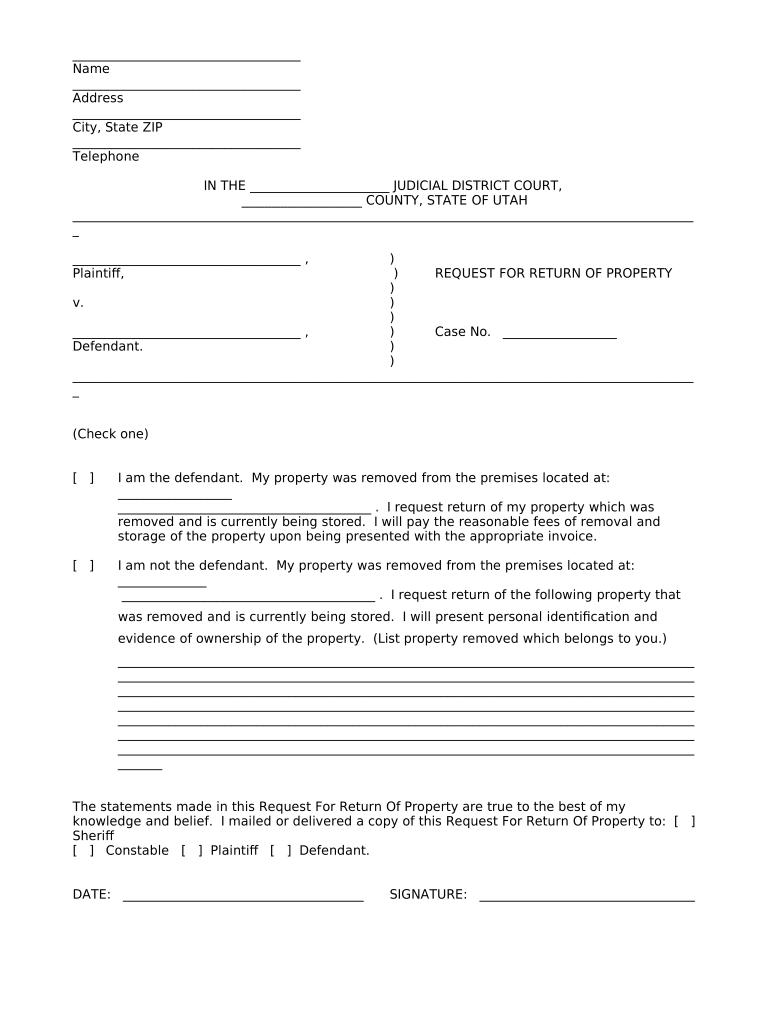
The Utah Request for Return of Property is a formal written request used to ask a custodian—typically a law enforcement agency, prosecutor, or private holder—to return personal property that was seized, retained, or placed in custody. The form documents the requester, describes the property, identifies the case or seizure event, and states the basis for return. It can start an administrative review, support a court motion, or document an agreed release. Electronic completion and transmission are generally permitted consistent with ESIGN (15 U.S.C. §7001) and UETA where applicable.

Why a Clear Request Matters

A well-prepared request preserves legal rights, creates a record of the demand, speeds agency processing, and reduces the risk of denial or misdelivery. It also documents chain-of-custody and establishes proof of ownership or lawful interest.

Why a Clear Request Matters

Who Typically Prepares and Receives This Request

Individuals, attorneys, property owners, and authorized representatives commonly prepare and submit requests in Utah.

  • Individual owners requesting personal items after an investigation or arrest
  • Attorneys submitting formal claims on behalf of clients
  • Authorized representatives (power of attorney, estate representatives) seeking release

Step-by-Step: Submitting a Request in Utah

Follow these steps to assemble, submit, and track a Request for Return of Property efficiently.

  • 01
    Confirm Custody: Verify which agency or holder has the property before preparing the request.
  • 02
    Complete Form: Fill all required fields, attach proof of ownership, and sign the document.
  • 03
    Submit Request: Send to the named agency contact via accepted delivery method.
  • 04
    Track Response: Record submission date and follow up on status within agency timelines.

Typical Routing and Review Process

Requests usually move from intake through administrative review to custody release or legal disposition. Know each step to set expectations.

  • Prepare Package: Assemble request, ownership evidence, identification, and any case references.
  • Deliver to Custodian: Hand-deliver, mail, or e-submit to the agency’s property/evidence unit.
  • Agency Review: Agency verifies ownership, checks holds/forfeiture, and schedules release or hearing.
  • Release or Appeal: If approved, agency arranges return; if denied, next steps may include court motion.

Configuring an Online Workflow for the Request

When preparing an electronic form, configure authentication, required fields, and evidence attachments so the receiving agency can process without manual follow-up.

Field Configuration
Authentication Email or SMS code; stronger options include ID verification or KBA
Required Fields Make name, property description, case number, and signature mandatory
Attachments Allow PDF, JPG, and DOCX; limit size per agency rules
Audit Trail Enable timestamps, IP logging, and download certificates for evidence

Technical Options for Distribution and Signing

Choose a platform that supports secure upload, strong signer authentication, and an audit trail for legal admissibility.

  • File Formats: PDF, DOCX, JPG supported
  • Integrations: Works with Google Workspace and Microsoft 365
  • Security: TLS in transit; AES-256 at rest

Essential Data Elements for the Form

Requester Name: Full legal name
Property Description: Detailed items and identifiers
Seizure Date: MM/DD/YYYY
Case Number: Agency file ID
Custody Agency: Agency name and unit
Contact Info: Phone, email, mailing address

Core Components of a Professional Request

A complete Request for Return of Property clearly identifies parties, property, legal basis, and the relief sought while providing verifiable supporting documentation.

Identification

Full legal names and current contact information for requester and any representative, enabling agency verification and lawful release.
Property Details

Clear description with serial numbers, photos, receipts, or other identifiers to prevent misidentification and ensure accurate return.

Custody Information

Name of the holding agency, case or incident number, and storage location to expedite retrieval during agency review.

Legal Basis

Brief statement explaining ownership or right to possession and referencing any relevant court orders, release conditions, or statutory authority.

Evidence Attachments

Uploads such as purchase receipts, title documents, ID, or police reports that substantiate the ownership claim.

Signature and Date

Signed declaration by the requester or authorized representative; electronic signatures permitted under ESIGN/UETA when accepted.

Timing and Typical Processing Expectations

Processing varies by agency and case complexity; submit promptly and include proof to shorten review times and avoid administrative holds.

Immediate Submission:

Submit as soon as custody status is known to preserve rights

Agency Review:

Often completed within 30–90 days depending on holds

Forfeiture Holds:

Items subject to forfeiture may be retained pending legal resolution

Hearing Scheduling:

Court hearings follow agency decisions when contested

No Universal Deadline:

State law does not prescribe a single submission deadline

Key Milestones from Submission to Return

A typical milestone path helps you track progress and understand where delays are likely to occur.

01

Submission Filed

Form received and timestamped by agency for intake

02

Verification Stage

Agency checks ownership, case holds, and supporting documents

03

Decision or Hearing

Agency sets release or schedules a contested hearing

04

Release or Appeal

Property returned or next-step appeal begins

Common Preparation Mistakes to Avoid

  • Incomplete property descriptions that force the agency to request more information and delay release.
  • Submitting without proof of ownership, such as receipts or title documents, which often causes immediate denial.
  • Using an incorrect recipient or unit name, leading to misrouting within large agencies and longer processing times.
  • Failing to sign, date, or provide authority documentation when acting as a representative, prompting rejection.

Risks and Consequences of an Improper Request

Delay or Denial: Incomplete requests may be rejected
Loss of Rights: Missed timing can affect legal claims
Forfeiture Risk: Items under legal hold may be forfeited
Privacy Exposure: Unsecured submissions risk sensitive data disclosure
Authentication Failure: Unverified signatures may be invalidated
Additional Costs: Appeals or legal counsel increase expense

Comparison: eSignature Pricing and Capabilities

Cost and feature trade-offs matter when choosing a signing platform for formal requests. signNow is listed first for comparison with common market alternatives.

signNow DocuSign Adobe Sign PandaDoc HelloSign
Starting Price $8/user/mo $15/user/mo $14/user/mo $19/user/mo $15/user/mo
Free Trial 7-day free trial Free trial available Free trial available Free trial available Free trial available
Bulk Send Yes Yes Yes Yes No
Audit Trail Yes Yes Yes Yes Yes
HIPAA Compliant Yes Yes Yes No No

Frequently Asked Questions About the Request Process

Answers to common questions about completion, authentication, timelines, and next steps for contested returns.


Need help? Contact support

be ready to get more
Join over 28 million airSlate SignNow users