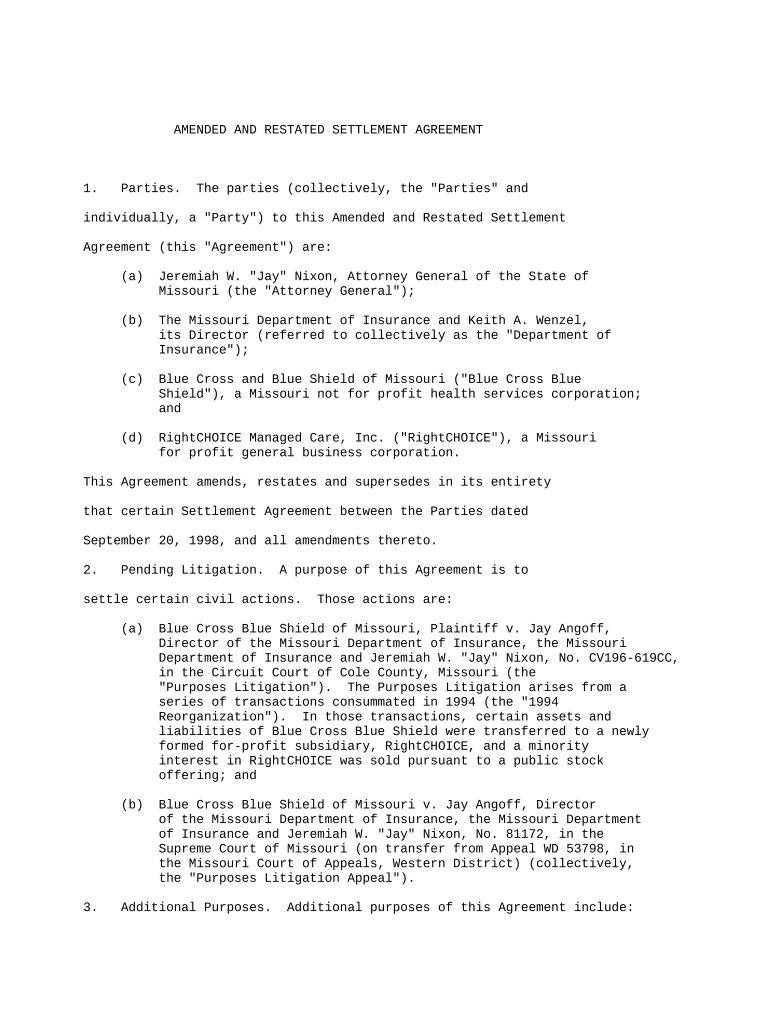
Amended Agreement
What an Amended Agreement Is and when it’s used
Why use an Amended Agreement instead of drafting a new contract
An Amended Agreement updates obligations while keeping the original contract’s context, limiting disputes and clarifying intent. It creates a legally enforceable record of changes, helps meet regulatory or filing requirements, and reduces operational disruption when rights or duties must be adjusted.
Who prepares and benefits from Amended Agreements
Typical users preparing or relying on an Amended Agreement include in-house counsel, contract managers, procurement officers, and external counterparties.
- In-house legal teams updating contract terms and tracking amendment history across agreements.
- Procurement and vendor managers executing scope changes, deliverable adjustments, or pricing amendments.
- Finance staff documenting payment schedule revisions or accounting impacts for tax and audit purposes.
Primary signatories and reviewers
Contracting Officer
A contracting officer or authorized signatory who has explicit delegation to modify contracts should execute the amendment. The text should reference the original agreement by date and section and confirm any limits on authority or required internal approvals.
Corporate Counsel
Legal counsel reviews amendment language for consistency with governing law and corporate bylaws, confirms consideration suffices, and advises on filing or notarization requirements when amendments affect property interests or statutory filings.
Short list of legal risks and penalties
Common mistakes to avoid when preparing an amendment
- Failing to reference the original agreement precisely can create confusion over which provisions remain in effect and may invalidate the intended change.
- Using ambiguous language like 'reasonable' consideration or 'market rate' without quantification invites disputes and complicates accounting or tax reporting.
- Allowing an unauthorized signatory or neglecting corporate approval processes risks ratification disputes and may render the amendment voidable.
- Not updating related records, filings, or internal systems (e.g., payroll, vendor master, property records) causes operational errors and regulatory noncompliance.
Step-by-step: preparing and executing an Amended Agreement
-
01Identify Clause: Reference original agreement and specific clause being changed.
-
02Draft Wording: Use precise language and show deletion or insertion clearly.
-
03Review & Approve: Obtain legal and authorized signatory approvals per corporate policy.
-
04Sign & Distribute: Have all required signers sign and circulate final executed copy.
How to set up an online amendment workflow
| Workflow field and configuration settings | Field name | Example configuration settings |
|---|---|
| Signature field placement and requirements | Add signature field, require date, assign signer role. |
| Conditional field rules and visibility | Show fields only when checkbox or role condition met. |
| Signer authentication and verification options | Use email or SMS codes; enable KBA for high-risk. |
| Template saving, version control, and retention | Save template, lock prior versions, and set retention. |
Where to send executed amendments and common routes
-
Internal Records: Store executed copy in contract repository and accounting systems.
-
Counterparty: Provide counterparty a fully executed PDF with amendment dated.
-
Filing Authority: File with county recorder or agency if real property affected.
-
Tax Reporting: Update any tax forms (e.g., 1099) before applicable deadline.
Digital signing and technical requirements
Digital completion supports PDF and DOCX files, audit trails, and integrations with common business systems for secure distribution.
- Supported Formats: PDF, DOCX, and Excel supported.
- Authentication Options: Email, SMS code, and two-factor authentication.
- Integrations: Salesforce, Google Workspace, NetSuite, and others.
Typical timelines, notice periods, and filing expectations
Selecting the effective date precisely:
Enter as MM/DD/YYYY; this date governs performance start.
Providing notice to affected parties:
Comply with any contract-specified notice windows to avoid default claims.
Recording amendments with public registries:
Record with county recorder when amendment affects real property.
Assess tax reporting consequences promptly:
Update 1099 reporting or other tax forms before statutory deadlines.
Update internal systems and controls:
Adjust accounting, payroll, and contract management records immediately after execution.
Practical scenarios showing the Amended Agreement in use
Lease Extension Example
A landlord and tenant agree to extend a commercial lease term for an additional twelve months, preserving the original lease terms except for rent adjustments.
- Rent increased by 3% annually.
- They executed a single Amended Agreement referencing the original lease date and section, signed by authorized representatives, filed a copy with the property manager, and avoided recreating the full lease, saving administrative time and preserving tenant relationship continuity.
Service Contract Change
A software vendor and client amended their services agreement to add new deliverables and revised acceptance criteria without terminating the existing contract.
- Acceptance tests and delivery dates added.
- Parties attached a concise amendment specifying added deliverables, delivery schedule, and acceptance test procedures; both signed electronically with audit trails, reducing negotiation friction and enabling prompt billing changes tied to the new milestones.
Practical best practices to keep amendments enforceable
Comparing signNow pricing and compliance features versus common vendors
| signNow | DocuSign | Adobe Sign | PandaDoc | HelloSign | |
|---|---|---|---|---|---|
| Starting Price | $8/user/mo | $15/user/mo | $14/user/mo | $19/user/mo | $15/user/mo |
| Free Trial | Yes, 7-day | Varies | Varies | Varies | Varies |
| Bulk Send | Yes | Yes | Yes | Yes | No |
| Audit Trail | Yes | Yes | Yes | Yes | Yes |
| HIPAA Compliant | Yes | Yes | Yes | No | No |
| Envelope Cap | No cap | 100 envelopes/user/year | Varies | Varies | Varies |
FAQs: common questions about Amended Agreements
-
When is an amendment legally binding?
An amendment is binding if parties demonstrate intent to sign, consent to electronic records when required, attribution to signers, and retention/reproduction capability per ESIGN (15 U.S.C. §7001) and UETA. Certain exclusions like wills and court orders still apply.
-
Do I need notarization or witnesses for amendments?
Most commercial amendments do not require notarization or witnesses; exceptions exist when the amendment affects real property, deeds, wills, or power of attorney. Check state rules and the original contract; some jurisdictions require recording with the county recorder.
-
Can an amendment be signed electronically?
Yes. Electronic signatures are legally valid under ESIGN (15 U.S.C. ch. 96) and UETA in most states when the four-prong test is met: intent, consent, attribution, and reproducible record. Confirm any industry or state-specific exceptions before relying on e-signature alone.
-
Are e-signatures acceptable for healthcare amendments?
Healthcare amendments involving protected health information must comply with HIPAA; use a HIPAA-compliant platform and execute a Business Associate Agreement (BAA) where required. Ensure audit trails and access controls meet HIPAA standards (45 CFR §164.530(j)).
-
How long must amended agreements be retained?
Retention depends on record type: follow federal minima such as IRS three-year rules (IRC §6501(a)) and HIPAA six-year retention for PHI. For high-risk or property-related amendments retain records longer and consult state-specific requirements or legal counsel.
-
What happens if a signer lacked authority?
An unauthorized signature can render the amendment voidable; counterparties may seek ratification, rescission, or damages. Verify signatory authority via corporate resolutions or powers of attorney before execution to avoid costly disputes and potential contract unenforceability.