Parties
Names and addresses of trustor (borrower), trustee, and beneficiary. Use full legal names and current addresses; discrepancies can impede recording and cloud title searches during due diligence.
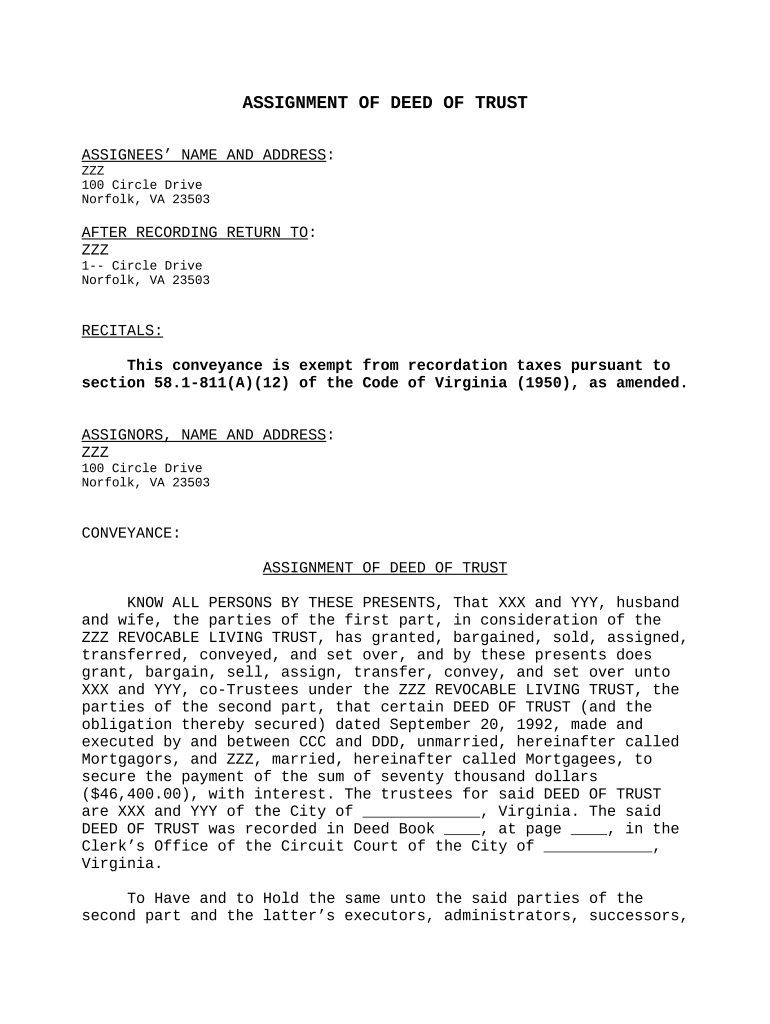
A Virginia Deed of Trust secures lender rights while clarifying obligations and remedies, supports clear public notice through recordation, and enables streamlined nonjudicial foreclosure when permitted by the instrument. It reduces title uncertainty and documents priority among liens.

Typical parties who prepare, sign, or record Virginia Deeds of Trust include lenders, title companies, trustee agents, and private borrowers.
A financial institution or private lender that provides the loan secured by the property. The beneficiary sets loan terms, enforces remedies under the deed of trust, and typically instructs the trustee for foreclosure actions; accurate beneficiary identification is essential for enforceability and title searches.
The person or entity granting legal title to a trustee as security for the loan. The trustor remains responsible for repayment; name consistency and accurate property description are critical for valid recording, reconveyance, and avoiding title defects.
Names and addresses of trustor (borrower), trustee, and beneficiary. Use full legal names and current addresses; discrepancies can impede recording and cloud title searches during due diligence.
Complete metes and bounds or recorded plat citation identifying the encumbered property. A street address alone is insufficient for recordation and may result in an invalid lien.
Principal amount, interest rate, payment schedule, maturity date, and acceleration clauses. Clearly specify optional prepayment penalties or escrow requirements to avoid later disputes.
Language conveying legal title to the trustee 'to secure' repayment. Must be explicit about the interest conveyed and any powers granted to the trustee.
Enumerated powers for sale, notice, substitution, and reconveyance. Define remedies, cure periods, and procedures for nonjudicial foreclosure when applicable under Virginia law.
Notary acknowledgement and any required witness signatures for the county. The acknowledgement must conform to Virginia statutory language for recordation.
| Field | Configuration |
|---|---|
| Signature Field | Place signature, date; compatible with PDF/A |
| Authentication | Email link by default; SMS or KBA where required |
| Templates | Save deed template with merge fields for parties |
| Notifications | Notify beneficiary, trustee, and recording agent on completion |
Choose a platform that supports notarization workflows, PDF/A output, and a verifiable audit trail for recording and title purposes.
Ensure legal description and parties are correct.
Coordinate signor, notary, and trustee availability.
Trustor signs in presence of commissioned notary.
Notary completes statutory acknowledgement and seal.
Provide two witnesses where state law mandates.
Use RON only if accepted by recorder.
File with county clerk and pay fees.
Get recorded deed copies and update loan file.
A lender closing a fixed-rate mortgage used a standardized Virginia Deed of Trust template to secure the residential loan and record priority.
A commercial borrower refinanced a multi-tenant building using a Virginia Deed of Trust to secure a new construction loan with modified maturity and escrow terms.
| signNow | DocuSign | Adobe Sign | PandaDoc | HelloSign | |
|---|---|---|---|---|---|
| Starting Price | $8/user/mo | $15/user/mo | $14/user/mo | $19/user/mo | $15/user/mo |
| Free Trial | 7-day free trial | Varies by vendor | Varies by vendor | Varies by vendor | Varies by vendor |
| Bulk Send | Yes | Yes | Yes | Yes | No |
| Audit Trail | Yes | Yes | Yes | Yes | Yes |
| HIPAA Compliant | Yes | Yes | Yes | No | No |