Trustee Authority
Define trustee powers clearly, including discretionary distribution authority, investment powers, and limits on loans or advances to preserve public benefits.
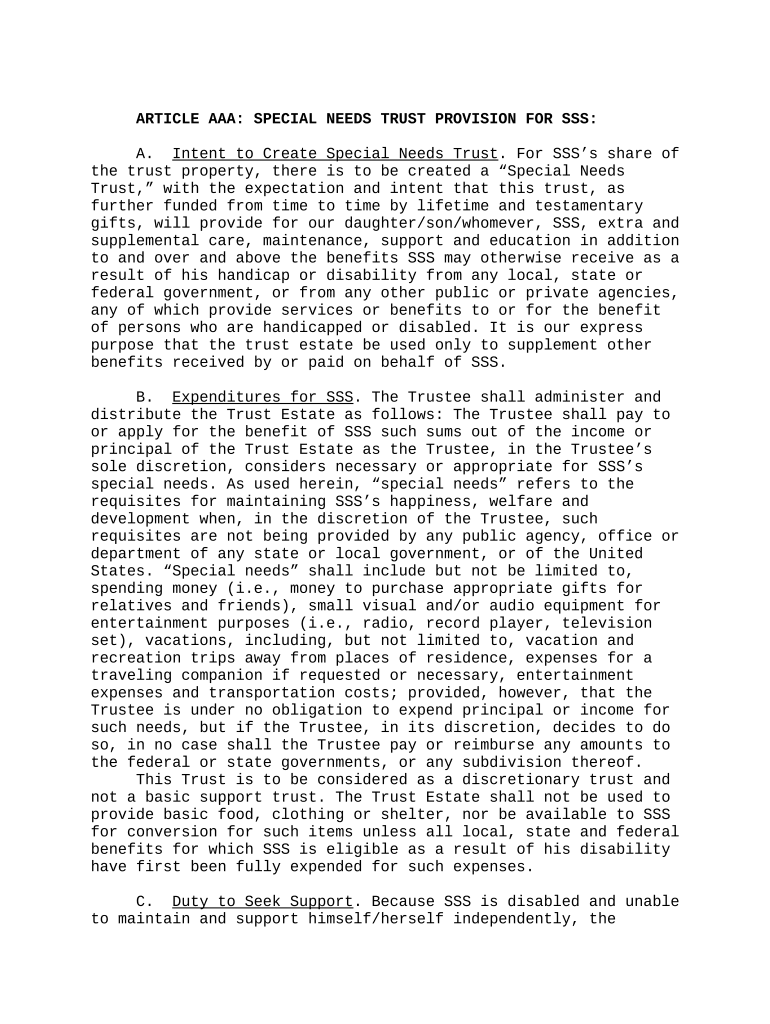
A well‑drafted Special Needs Trust Provision protects benefits eligibility, clarifies trustee discretion, and reduces future disputes over distributions. It provides a legal structure to pay for supplemental needs without being counted as available income or resources under federal and state benefit rules.

The provision is most often prepared by estate attorneys and used by families, trustees, and financial professionals involved in long‑term care planning.
Coordination among legal counsel, benefits counselors, and financial institutions ensures the provision functions as intended and minimizes risk to public benefits eligibility.
Define trustee powers clearly, including discretionary distribution authority, investment powers, and limits on loans or advances to preserve public benefits.
List permissible supplemental items (medical, therapy, education, transportation, recreation) while excluding items counted as income for benefits when necessary.
If required (first‑party trusts), include Medicaid payback language specifying repayment from remaining assets at termination.
Name orderly successor trustees and alternates, and describe removal and replacement mechanics to avoid administration gaps.
Specify how the trust will be funded (pour‑over will, life insurance, direct transfer, settlement proceeds) and timing for each method.
Address EIN assignment, annual Form 1041 filing responsibility, beneficiary reporting, and coordination with payer institutions.
| Field | Configuration |
|---|---|
| Template | Create reusable provision template with locked legal text |
| Signer Roles | Assign trustee, settlor, and witness signature fields |
| Authentication | Use email, SMS code, or higher assurance where required |
| Audit Trail | Enable full event history and attachments |
Choose a signing platform that supports secure audit trails, required authentication levels, and the file formats you use.
Ensure the platform can retain signed originals, provide tamper‑evident certificates, and export records for trustee and counsel review.
Sign and date when ready; effective date governs administration
Fund trust shortly after execution to align assets with planning goals
Trust returns (Form 1041) typically due April 15 annually
Review trustee decisions and beneficiary status at least yearly
Notify benefit agencies as required when circumstances materially change
Legal language finalized and internal review completed
Signatures, witnesses, and notarization (if required) are obtained
Assets transferred into the trust and documented
Annual accounting, tax filings, and benefits coordination
A parent includes a provision in a will to create a third‑party SNT upon death
An individual funds a first‑party (d4A) trust using settlement proceeds
| signNow | DocuSign | Adobe Sign | PandaDoc | HelloSign | |
|---|---|---|---|---|---|
| Starting Price | $8/user/mo | $15/user/mo | $14/user/mo | $19/user/mo | $15/user/mo |
| Free Trial | 7‑day free trial | Varies by plan | Varies by plan | Varies by plan | Varies by plan |
| Bulk Send | Yes | Yes | Yes | Yes | Varies |
| Audit Trail | Yes | Yes | Yes | Yes | Yes |
| HIPAA Compliant | Yes | Yes | Yes | No | No |