Establishing secure connection…Loading editor…Preparing document…

Virginia Codicil

This template is fully customizable. Edit the text, fill out the fields, and send it for signature. Give it a try!
Virginia Codicil

What a Virginia Codicil Is and When It’s Used

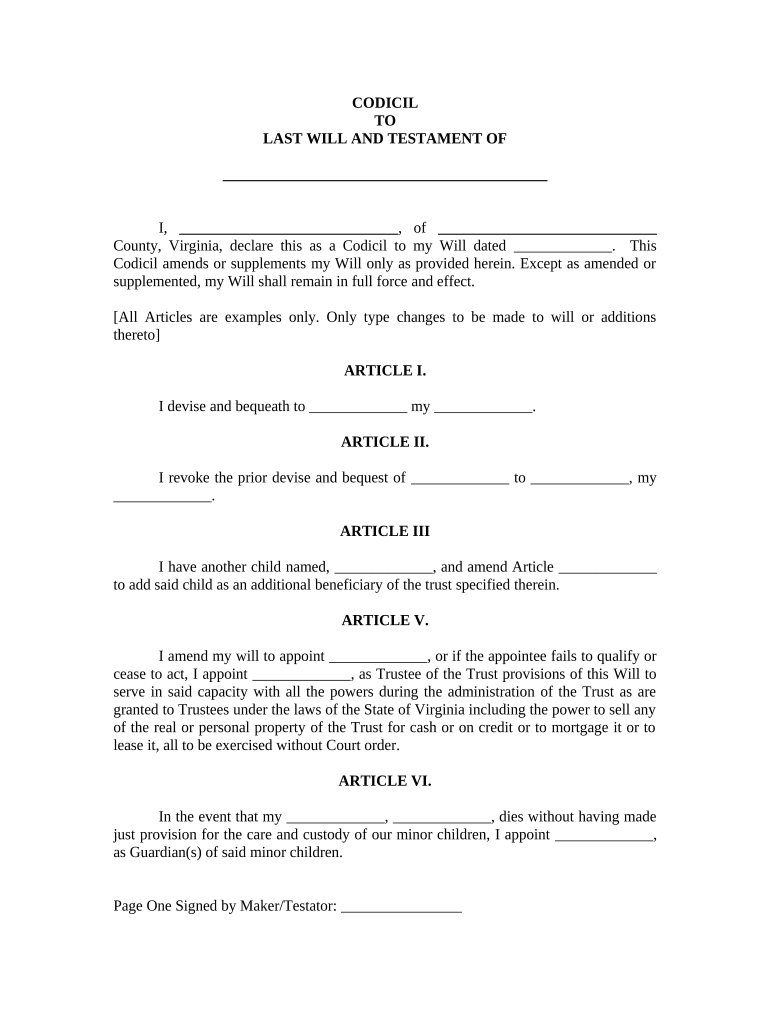
A Virginia codicil is a legal instrument that amends, supplements, or revokes provisions of an existing will without replacing the entire document. It must be executed with the same formalities as a will in Virginia to be effective at probate. Codicils are typically used to make targeted changes — for example, adding or changing beneficiaries, correcting wording, or altering executors — while preserving the original will’s structure. Proper execution, witness acknowledgement, and clear cross-references to the original will are essential to avoid disputes in probate court.

Why a Codicil Can Be Preferable to Rewriting a Will

A codicil lets you make a focused change quickly and at lower cost than drafting a new will, while keeping the original will intact for continuity and clarity.

Why a Codicil Can Be Preferable to Rewriting a Will

Who Typically Prepares or Signs a Virginia Codicil

The following parties are most commonly involved when creating a codicil in Virginia.

  • Testator: The person who owns the will and must sign the codicil with testamentary intent, typically in the presence of required witnesses.
  • Attorneys: Estate planning attorneys draft clear codicil language and confirm compliance with Virginia formalities to reduce probate challenges.
  • Witnesses and Notary: Witnesses attest to the testator’s signature; a notary may be used for a self-proving affidavit to ease probate.

Primary Elements to Include in a Professional Virginia Codicil

A well-drafted codicil references the original will, states the amendment clearly, and captures the execution formalities required under Virginia law to ensure admission to probate.

Title

Identify the document explicitly as a codicil and cite the date of the original will to avoid ambiguity during probate proceedings.
Recital

State that the codicil amends the named will; include the testator’s full legal name and original will date for clear linkage.

Amendment Text

Provide precise language describing the addition, deletion, or substitution of clauses, beneficiaries, or executor designations.

Execution Clause

Include a statement that the testator intentionally executes the codicil as an amendment to the referenced will.

Signatures

The testator plus the required number of witnesses must sign and date; consider including signature blocks for clarity.

Self-Proving Affidavit

Optional notarized affidavit can reduce or eliminate witness testimony at probate; include if you seek faster administration.

Step-by-Step: How to Execute a Valid Virginia Codicil

Follow these sequential steps to execute a codicil that aligns with Virginia probate requirements and reduces the likelihood of contest.

  • 01
    Draft Amendment: Write precise amendment language referencing the original will.
  • 02
    Review with Counsel: Have an estate attorney confirm legal effect and clarity.
  • 03
    Arrange Witnesses: Secure the required number of competent witnesses.
  • 04
    Sign and Date: Testator signs in witness presence; notarize self-proving affidavit if desired.

Where to File and How a Codicil Enters Probate

A codicil is typically kept with the original will and offered to the probate court after the testator’s death; the following routing steps are common.

  • Keep with Will: Store the codicil physically or digitally with the original will to ensure discovery after death.
  • Provide to Executor: Give the executor the original codicil and will for estate administration.
  • File in Probate: Executor files will and codicil with the local probate or circuit court when opening probate.
  • Admit to Probate: Court reviews execution formalities and admits documents to probate if valid.

Digital Signing and Technology Considerations

Electronic options can simplify execution logistics, but wills and codicils are often treated differently under U.S. law.

  • Security Standards: Use TLS 1.2/1.3 and AES-256 for document transmission and storage.
  • Audit Trails: Capture timestamps, IP addresses, and signer actions for attribution.
  • Platform Compliance: Prefer providers with ESIGN and UETA compliance and available BAA for HIPAA needs.

Timing and Key Deadlines to Keep in Mind

A codicil itself is not filed immediately; timing issues concern execution, probate initiation, and related filings after death.

No Filing on Creation:

There is no routine state filing requirement when you sign a codicil during your lifetime.

Probate Filing:

Executor should file will and codicil with probate court promptly after death to begin administration.

Self-Proving Affidavit:

A notarized self-proving affidavit expedites probate by avoiding live witness testimony.

Record Retention:

Keep originals indefinitely or per counsel guidance to ensure availability at probate.

Update Intervals:

Review estate documents after major life events such as marriage, divorce, birth, or significant asset changes.

Execution Checklist: Witness and Notarization Flow

Follow this authentication flow to ensure a codicil meets formal will requirements and eases probate admission.

01

Prepare Document

Ensure clear reference to original will and precise amendment language.

02

Arrange Witnesses

Select two competent, disinterested adult witnesses where state law requires.

03

Testator Signs

Testator signs in the presence of the witnesses per statutory formalities.

04

Witness Signatures

Witnesses sign, print names, and provide addresses and dates.

05

Notary Option

Obtain notarization for a self-proving affidavit if desired to streamline probate.

06

Make Originals

Keep the signed original codicil with the original will; distribute copies as needed.

07

Store Securely

Use secure physical storage or a compliant digital vault for originals.

08

Notify Executor

Inform the executor of the codicil’s existence and location.

Common Mistakes to Avoid When Preparing a Codicil

  • Vague cross-references: Failing to precisely identify the original will or the specific clause being amended invites probate disputes and court interpretation.
  • Insufficient witnesses: Using the wrong number or interested witnesses can render the codicil invalid under state testamentary formalities.
  • Improper signing order: Having witnesses sign before the testator or signing in separate locations may fail statutory presence requirements.
  • Failing to record originals: Losing the original codicil or keeping it separate from the will can delay probate and create authenticity issues.

Consequences of an Incorrect or Invalid Codicil

Invalid Amendment: Codicil may be declared void
Probate Delays: Estate administration can be prolonged
Increased Costs: Attorney and court fees may rise
Family Disputes: Contested probate litigation risk
Tax Implications: Unintended tax consequences possible
Revocation Risk: Subsequent wills may unintentionally revoke it

eSignature Vendor Snapshot for Executing Estate Documents

Compare starting price, trial policy, bulk send capability, audit trail, and HIPAA compliance across common eSignature providers; signNow appears first by design.

signNow DocuSign Adobe Sign PandaDoc HelloSign
Starting Price $8/user/mo $15/user/mo $14/user/mo $19/user/mo $15/user/mo
Free Trial 7-day free trial Varies by plan Varies by plan Varies by plan Varies by plan
Bulk Send Yes Yes Yes Yes No
Audit Trail Yes Yes Yes Yes Yes
HIPAA Compliant Yes Yes Yes No No

Practical Examples: When a Codicil Made Sense

Real-world scenarios where a codicil provided a focused, cost-effective correction or update to an existing will.

Change of Executor

An elderly testator needed to replace an executor due to relocation

  • The codicil named the new executor and updated contact details
  • Probate proceeded smoothly because witnesses followed statutory signing steps and a self-proving affidavit was included to speed administration.

Asset Addition

A homeowner acquired a small rental property after the will was drafted

  • The codicil specifically bequeathed the rental to a named beneficiary
  • The targeted amendment avoided drafting a new will while clearly allocating the new asset for probate distribution.

Practical Tips for Accurate and Efficient Codicil Preparation

Adopt these practical habits to reduce errors, improve clarity, and streamline probate.

Be Specific and Concise
Use exact cross-references to the original will and quote the clause or paragraph being changed; vague language increases risk of misinterpretation and disputes during probate.
Use Independent Witnesses
Choose witnesses without a direct financial interest in the estate to reduce grounds for contest and to satisfy statutory impartiality requirements in most jurisdictions.
Consider a Self-Proving Affidavit
Have the testator and witnesses execute a notarized self-proving affidavit at signing; this often removes the need for live witness testimony at probate.
Maintain Originals Together
Keep the original codicil with the original will in a secure location and inform the executor; clearly stored originals prevent delays and authenticity disputes.

Frequently Asked Questions About Virginia Codicils

Answers to common questions about validity, witnesses, electronic options, storage, revocation, and probate practice for codicils in Virginia.


Need help? Contact support

be ready to get more
Join over 28 million airSlate SignNow users