Establishing secure connection…Loading editor…Preparing document…

Washington Findings of Fact and Conclusions of Law (Nonparental Custody)

This template is fully customizable. Edit the text, fill out the fields, and send it for signature. Give it a try!
Washington Findings of Fact and Conclusions of Law (Nonparental Custody)

What this Washington Findings of Fact and Conclusions of Law (Nonparental Custody) document is

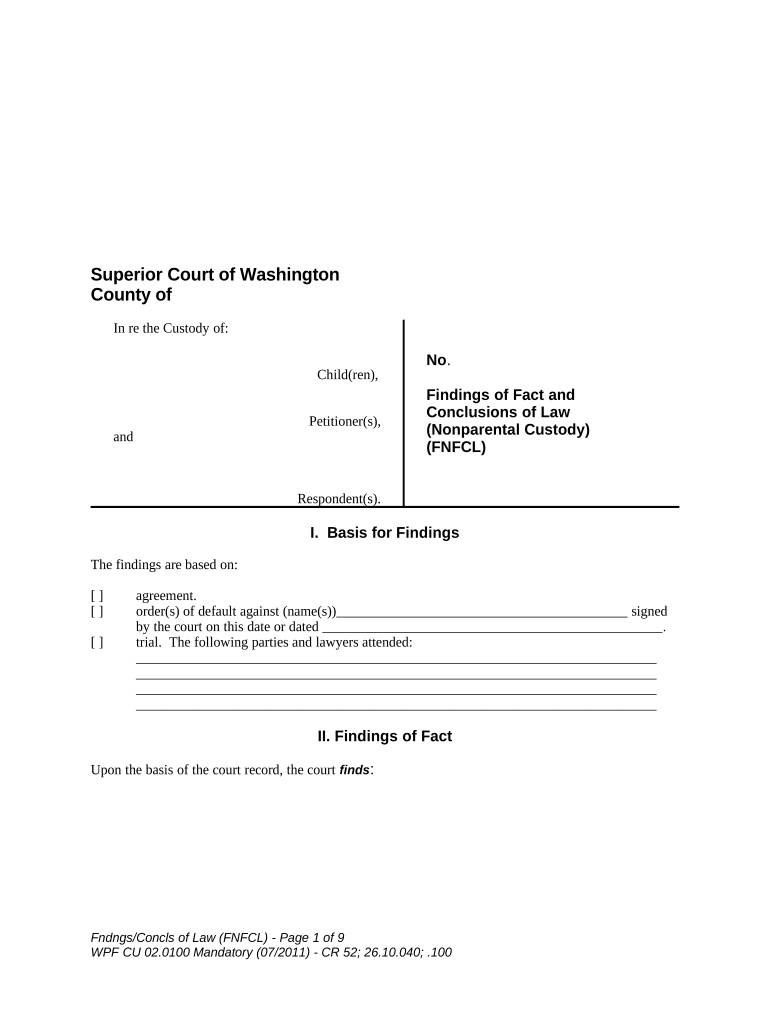
The Washington Findings of Fact and Conclusions of Law (Nonparental Custody) is a written court document used in Washington family courts when a nonparent seeks custodial rights or when the court must explain the factual basis and legal reasoning supporting a custody decision. It combines numbered factual findings about the child and parties with legal conclusions applying Washington statutes and case law. Proposed findings may be submitted by parties; the judge issues the final signed findings and conclusions as part of the court record. Note that court orders and official filings often follow specific filing and signature rules distinct from commercial e-signature law.

Why precise, court-ready findings and conclusions matter

Clear written findings and conclusions create a record the judge can rely on for entry of order, appeal review, and enforcement. Properly structured findings reduce delays, support enforceability, and clarify custody standards that affect the child's welfare.

Why precise, court-ready findings and conclusions matter

Who typically prepares or files these findings and conclusions

Several stakeholders prepare, review, or receive the document during nonparental custody proceedings.

  • Nonparent petitioners and guardians seeking custody rights and clarity on legal standards in their case.
  • Family law attorneys who draft proposed findings, tailor legal conclusions, and serve filings on all parties.
  • Court staff and judges who review submissions, adopt findings into a signed order, and docket the entry.

Step-by-step: preparing proposed findings and conclusions

Follow a concise procedural order when preparing proposed findings to improve clarity and reduce court editing.

  • 01
    Gather case record: Collect pleadings, affidavits, orders, and exhibits for factual support.
  • 02
    Draft findings: Number discrete facts with references to evidence and dates.
  • 03
    Write conclusions: Cite statutory or caselaw standards that apply to each finding.
  • 04
    File and serve: Submit proposed findings per court e-filing and service rules.

Technical requirements for electronic preparation and submission

Courts and clerks expect documents in standard formats and may impose e-filing rules; check local court procedures before submission.

  • File format: Submit PDF/A or PDF per court e-file specifications.
  • e-Filing portal: Use the county or state e-file system required by the court.
  • Integrations: Common integrations: Salesforce, NetSuite, Google Workspace for internal workflow.

Typical workflow from drafting to signed court entry

The court filing sequence moves from draft to service to judicial acceptance and docketing.

  • Draft proposed order: Prepare findings with citations and exhibits attached.
  • File with clerk: E-file or deliver per local practice and pay any filing fees.
  • Serve parties: Serve all parties with the proposal and proof of service.
  • Judge signs: Judge reviews, may edit, and signs the final findings and order.

Setting up an electronic workflow for proposed findings

Map fields and routing before you start to reduce rework and maintain an evidentiary trail.

Field Configuration
Document format PDF/A preferred for long-term preservation
Signature method Judge original signature or court-approved e-signature
Attachments Include certified exhibits as separate PDF attachments
Service method E-service or certified mail per local rules

Common timing considerations and response deadlines

Timing varies by local rules and the court's calendar; confirm deadlines at the clerk's office and in court orders.

Initial Filing Deadline:

Meet the statute of limitations and local filing requirements for custody petitions.

Response Period:

Opposing parties typically have a set time to respond; check local rules for exact days.

Hearing Scheduling:

Hearings are set by the court calendar and may take weeks to months to secure.

Final Order Entry:

Judge issues signed findings and conclusions after hearing or submission.

Service Requirements:

Proof of service must be filed in accordance with local civil procedure rules.

Key milestones from filing to entry

A compact milestone view helps parties track progress and required actions at each stage.

01

Petition Filed

Clerk accepts filing and sets a case number and tentative calendar.

02

Response Period

Respondent files an answer or motion within the court's prescribed timeframe.

03

Pretrial/Hearing

Court schedules evidentiary hearing or briefing schedule for proposed findings.

04

Order Entered

Judge signs the findings and conclusions and the clerk dockets the order.

Common preparation pitfalls to avoid

  • Submitting unsigned or incomplete findings that omit required party names, case numbers, or dates can lead to rejection or delay by the clerk.
  • Relying solely on generalized statements rather than tying findings to specific exhibits, testimony, or hearing dates weakens the record on appeal.
  • Failing to serve all parties with the proposed findings and proof of service risks setting aside the order for improper notice.
  • Attempting to use a vendor e-signature for a judge's required original signature when the court mandates an original may invalidate the filing.

Security and legal frameworks relevant to electronic documents and signatures

Encryption transit: TLS 1.2/1.3
Encryption rest: AES-256
Audit trail: Tamper-evident timestamps
HIPAA support: BAA available where required
Legal basis: ESIGN and UETA recognized
Access control: Role-based permissions

Consequences of defective findings or improper filing

Order voidable: Court may vacate a defective order
Appeal risk: Weak factual record harms appellate review
Service defect: May require reservice and redo of proceedings
Rejection delay: Clerk may reject for formatting errors
Sanctions risk: Possible court sanctions for misrepresentation
Custody confusion: Improper parties listed can misassign rights

How electronic signatures compare with original judge-signed orders

Different instruments carry different evidentiary and procedural weight; courts may require originals for official orders.

Criteria Electronic Signature Judge-signed Original
Acceptable for filing sometimes
Audit trail present limited
Ease of verification high requires physical custody
State exceptions varies generally required for official entry

Core sections to include in professional findings and conclusions

A well-built document separates facts from legal conclusions and provides clear cross-references to evidence and law.

Case Caption

Full court and party caption at the top, including case number and county to ensure correct docketing and clerical handling.
Findings of Fact

Numbered factual statements supported by specific exhibits, testimony citations, or hearing dates to provide an evidentiary foundation.

Conclusions of Law

Legal conclusions that reference statutes or binding case law and explain how the facts meet each legal element.

Child Details

Names, birthdates, and pertinent information about the child's needs and welfare that inform custody considerations.

Exhibit List

A clear index of attached exhibits with labels or Bates numbers to allow the court to verify sources.

Signature and Entry

Judge's signature line, date of entry, and clerk's docket notation for enforceability and future reference.

Representative examples of use in nonparental custody matters

These anonymized scenarios illustrate how findings and conclusions function in practice.

Child in Care — Proposed Findings

A petitioner compiles hearing transcripts and social-work reports to support discrete factual findings about parenting capacity

  • The points link each finding to a hearing exhibit and witness statement
  • The judge adopts the proposed findings in part, edits specific conclusions, and enters a signed order that becomes enforceable and appealable.

Agreed Settlement — Joint Findings

Parties negotiate custody terms and draft joint factual recitals reflecting agreement on parenting and visitation

  • Mediator and counsel sign off on the factual statements for accuracy
  • The court reviews the joint recitals, incorporates them into conclusions, and issues an order reflecting the negotiated custody arrangement.

Practical tips to produce defensible findings and conclusions

Adopt a disciplined drafting approach to reduce clerical edits and appellate vulnerability.

Tie facts to evidence
Reference specific exhibits, transcript pages, or witness testimony for each factual finding to make the record auditable and to support legal conclusions on appeal.
Be concise and specific
Avoid argumentative phrasing; state observable facts, dates, and actions so the judge and any reviewing court can clearly trace the rationale.
Follow local formatting
Use the court's preferred margins, caption format, and e-filing PDF settings to avoid clerical rejection or reformatting.
Confirm signature requirements
Verify whether the court requires a judge's original signature, accepts scanned signatures, or has a distinct e-signature process for orders.

FAQs and troubleshooting for common questions

Answers to frequent practical and procedural questions about preparing, filing, and preserving findings and conclusions in nonparental custody cases.


Need help? Contact support

eSignature vendor comparison for preparing and sharing court-ready documents

Overview of common vendor features and starting prices relevant to document preparation and secure distribution; signNow is listed first per vendor comparison conventions.

signNow DocuSign Adobe Sign PandaDoc HelloSign
Starting Price $8/user/mo $15/user/mo $14/user/mo $19/user/mo $15/user/mo
Free Trial 7-day free trial Varies by vendor Varies by vendor Varies by vendor Varies by vendor
Bulk Send Yes (Premium) Yes Yes Yes Yes
Audit Trail Yes Yes Yes Yes Yes
HIPAA Compliant Yes (BAA) Yes Yes No No
Envelope Cap No cap 100 envelopes/user/year Varies Varies Varies
be ready to get more
Join over 28 million airSlate SignNow users