Establishing secure connection…Loading editor…Preparing document…

Warrant Purchase Agreement

This template is fully customizable. Edit the text, fill out the fields, and send it for signature. Give it a try!
Warrant Purchase Agreement

What a Warrant Purchase Agreement Is and When It’s Used

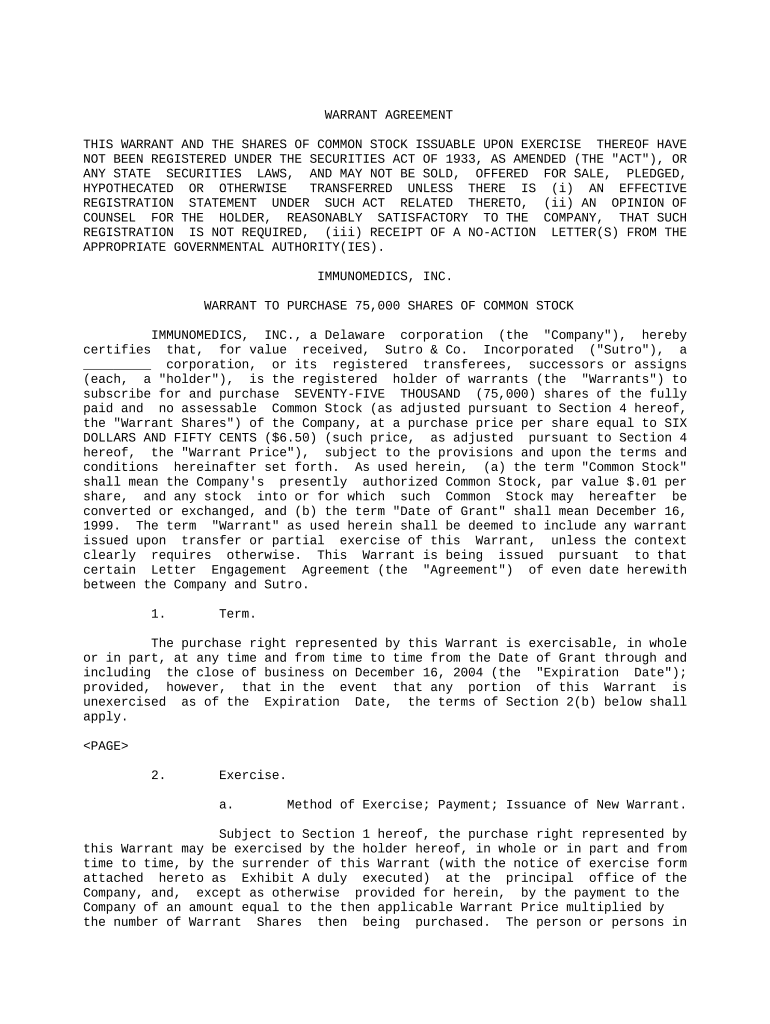
A Warrant Purchase Agreement is a contract under which a purchaser acquires warrants—rights to buy equity in the issuer at a specified exercise price and within a defined term. The agreement sets purchase price, number of warrants, vesting or exercise conditions, transfer restrictions, registration or resale rights, representations and warranties, indemnities, and closing mechanics. It governs rights between an issuer and investor and often coordinates with a stock purchase agreement, investor rights agreement, and corporate charter amendments. Parties commonly document wire instructions, tax identifiers, and conditions precedent to closing.

Why a Clear Warrant Purchase Agreement Matters

A precise agreement reduces ambiguity about exercise mechanics, tax consequences, transferability, and investor protections. It protects issuer and purchaser expectations and helps avoid costly disputes or securities compliance problems.

Why a Clear Warrant Purchase Agreement Matters

Typical Parties and Advisors Involved

Each participant should confirm signing authority and, where relevant, securities law compliance before executing the agreement.

  • Issuers and management teams preparing corporate documents and board approvals for grant or sale of warrants.
  • Individual and institutional investors acquiring warrants as part of financing, compensation, or strategic investment.
  • Corporate counsel, securities counsel, and accountants who review compliance, tax, and disclosure implications.

Who Typically Signs and Why

Company Representative

CEO, CFO, or authorized officer signs for the issuer; they confirm board authorization and corporate power to issue warrants and accept purchase proceeds.

Purchaser or Authorized Agent

Investor or an authorized signing agent signs to accept the terms; accredited investor status and tax identification are commonly verified at signing.

Essential Sections to Include in a Professional Agreement

A complete Warrant Purchase Agreement combines financial terms, investor protections, and operational mechanics so warrants function as intended across time and transfers.

Purchase Terms

Number of warrants, purchase price paid at signing, and any escrow instructions; state whether the purchase is by subscription, payment on closing, or another mechanism.
Warrant Characteristics

Exercise price, measurement (per share), term and expiration, vesting schedule if any, and adjustments for stock splits or recapitalizations.

Transfer Restrictions

Lockups, right of first refusal, legend requirements, and conditions for secondary sales to ensure compliance with resale rules.

Representations

Issuer and purchaser representations regarding authority, organization, noncontravention, accreditation, absence of undisclosed liabilities, and tax status.

Conditions and Closings

Conditions precedent for closing, required deliverables, opinions, board resolutions, and mechanics for funds transfer and warrant delivery.

Governing Law & Remedies

Choice of law, dispute resolution forum, injunctive relief provisions, limitation of liability, and indemnification terms.

Step-by-Step: Completing the Agreement

Follow these sequential steps to prepare, review, sign, and record the Warrant Purchase Agreement accurately.

  • 01
    Prepare Draft: Populate issuer, purchaser, financial, and warrant-specific terms.
  • 02
    Legal Review: Have securities counsel review transfer restrictions and disclosure language.
  • 03
    Confirm Closing Conditions: Verify board approvals, funds availability, and ancillary documents.
  • 04
    Execute & Deliver: Sign all copies, exchange consideration, and retain executed originals.

How Execution and Post-Closing Processes Typically Flow

Execution triggers delivery of warrants, entry in stock ledger, and any required regulatory filings; be clear on who performs each step.

  • Signing: Parties sign and date the agreement; signatures may be electronic where permitted.
  • Payment: Purchaser transfers purchase funds per wiring instructions or escrow terms.
  • Warrant Issuance: Issuer issues warrant certificates or electronic records and updates cap table.
  • Post-Closing Filing: Issuer files any required securities notices and updates internal records.

Customizing an Online Workflow for the Agreement

Configure a digital workflow to collect signatures, attach exhibits, and store an audit trail in a repeatable manner.

Field Configuration
Signature Field Require signer name and date on signature fields
Initials Add initial fields on key pages for purchaser acknowledgment
Attachments Allow upload for board resolutions and investor accreditation proof
Authentication Use email link or SMS code for signer verification

Digital Signing, File Types, and Integrations

Verify the platform preserves an audit trail, supports conditional fields, and can retain signed copies for compliance.

  • File Formats: PDF, Word DOCX supported
  • Integrations: CRM and cloud storage integrations
  • Authentication: Email, SMS, or advanced KBA

Common Timing Elements and Deadlines to Track

Track dates that affect rights and obligations: effective date, exercise period, closing date, and any notice windows for transfers or registration.

Effective Date:

Date when agreement obligations commence; use MM/DD/YYYY format.

Closing Date:

When funds and warrants exchange; coordinate wiring and escrow timing.

Exercise Window:

Start and end dates for exercising warrants; often measured in years from effective date.

Notice Periods:

Timeframes for transfer notices, ROFR exercises, or conversion notices.

SEC/State Filings:

Any required filings must follow applicable securities notice deadlines; consult counsel.

Key Milestones from Offer to Post-Closing

A typical warrant transaction passes predictable milestones—track each to avoid missed conditions or reporting obligations.

01

Term Sheet Agreed

Parties agree principal economic terms and issue summary paperwork.

02

Board Approval

Issuer secures corporate approvals and authorizations required to issue warrants.

03

Closing and Funding

Purchaser delivers funds; issuer issues warrants and updates records.

04

Post-Closing Compliance

Issuer completes any required filings and updates cap table and transfer restrictions.

Common Preparation and Execution Mistakes

  • Using informal or ambiguous exercise price language that later causes disputes over share valuation or rounding.
  • Failing to verify purchaser accreditation or tax identifiers, which can trigger withholding or compliance problems.
  • Neglecting transfer restrictions or legends, allowing unintended secondary sales that violate resale rules.
  • Not confirming board authorization or filing requirements, which can invalidate the issuance or expose the issuer to liability.

Short-Form Risk Summary and Potential Consequences

Securities Violations: Civil penalties and rescission risk
Tax Misreporting: Withholding or penalty exposure
Invalid Issuance: Corporate actions may be voided
Transfer Breach: Shares subject to clawback
Reputational Harm: Investor relations damage
Execution Errors: Signatures challenged or delayed

High-level eSignature Pricing and Feature Comparison (signNow first)

This high-level table compares starting pricing and common capabilities across popular eSignature providers; signNow is presented first for parity and clarity.

signNow DocuSign Adobe Sign PandaDoc HelloSign
Starting Price $8/user/mo $15/user/mo $14/user/mo $19/user/mo $15/user/mo
Free Trial 7-day free trial Varies by plan Varies by plan Varies by plan Varies by plan
Bulk Send Yes Yes Yes Yes No
Audit Trail Yes Yes Yes Yes Yes
HIPAA Compliant Yes Yes Yes No No
Envelope Cap No envelope cap 100 envelopes/user/year limit Varies by plan Varies by plan Varies by plan

Frequently Asked Questions About Warrant Purchase Agreements

Answers to common execution, enforceability, and operational questions that arise when preparing or eSigning a Warrant Purchase Agreement.


Need help? Contact support

be ready to get more
Join over 28 million airSlate SignNow users