Establishing secure connection…Loading editor…Preparing document…

Washington Declaration of Service

This template is fully customizable. Edit the text, fill out the fields, and send it for signature. Give it a try!
Washington Declaration of Service

What the Washington Declaration of Service Is and When it Applies

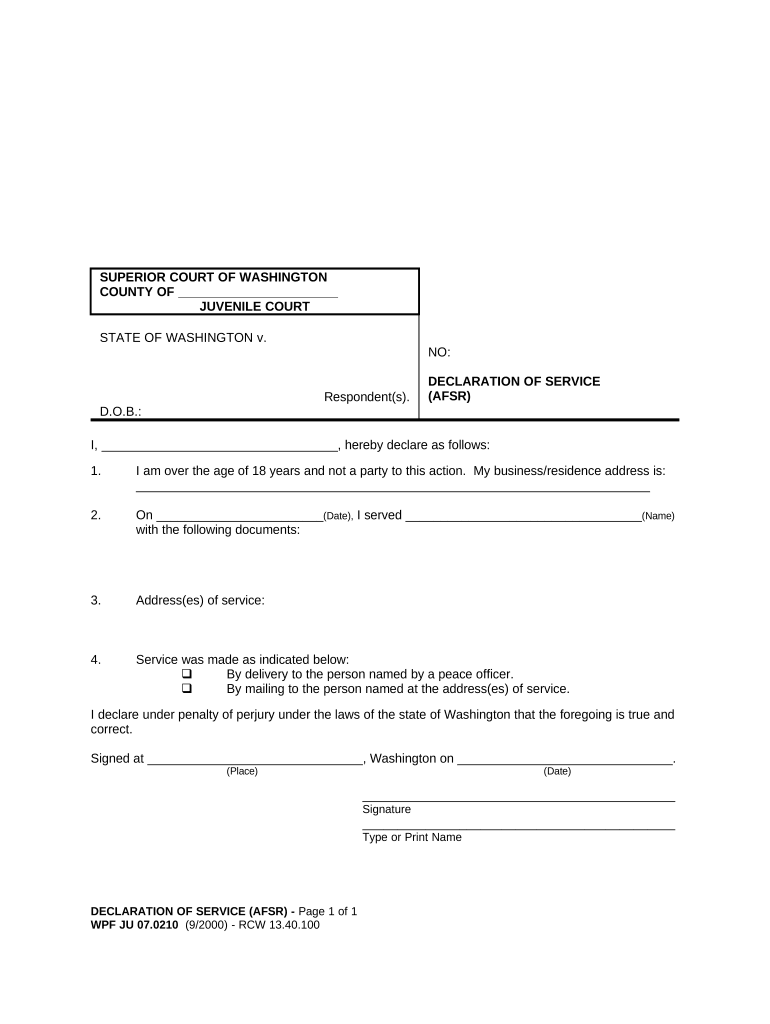
The Washington Declaration of Service is a sworn statement used to record how and when legal documents were delivered to a respondent or party in matters governed by Washington practice. It records the method of service, date and time, recipient identity, and the server's declaration under penalty of perjury. Courts, agencies, or opposing parties rely on the declaration as proof that statutory notice or service requirements were met. When required by local rules, the declaration may be notarized, accompanied by certified mail receipts, photographs, or electronic delivery logs.

Why a Clear Declaration of Service Matters

The Washington Declaration of Service provides an evidentiary record accepted by many courts and agencies to prove service was completed according to procedural rules, reducing disputes about timing and method and protecting response rights tied to statutory deadlines.

Why a Clear Declaration of Service Matters

Step-by-Step: Completing a Washington Declaration of Service

Follow these sequential actions to complete the declaration accurately and in compliance with court or agency filing expectations.

  • 01
    Prepare Details: Gather case caption, docket number, recipient contact information, and evidence of delivery.
  • 02
    Select Method: Indicate personal, mail, substitute, or electronic service method and provide carrier or platform specifics.
  • 03
    Attach Evidence: Include delivery receipts, photographs, mail tracking records, or audit logs that corroborate the server's account.
  • 04
    Sign & Date: Signer declares truth under penalty of perjury, signs, prints name, and dates the declaration.

Who Typically Prepares and Uses This Declaration

Process servers, attorneys, claims administrators, and individual litigants use the Washington Declaration of Service to document and prove delivery of legal notices and filings.

  • Private process servers — provide sworn statements confirming personal delivery and recipient identity at time of service.
  • Attorneys and law firms — file declarations to support motions and to meet court proof-of-service requirements.
  • Government agencies — document service of administrative orders, licensing notices, and regulatory correspondence.

Primary Roles Involved in Service Documentation

Process Server

A licensed or registered server who completes personal or substitute service and signs the declaration under penalty of perjury; typically records time, location, recipient details, and method. Accurate entries and attached evidence reduce the risk of service-related disputes and support admissibility.

Attorney (Filing Party)

The filing attorney reviews the declaration for procedural compliance, ensures supporting evidence is attached, and files or serves the declaration per court rules. Errors can delay proceedings or lead to rejected filings, so attorneys verify format and signatures.

Key Elements of a Professional Declaration of Service

A professional Washington Declaration of Service is precise, includes verifiable metadata, and adheres to the receiving court or agency format so it functions as reliable proof of delivery.

Case Caption

Include the full case caption and docket number in the header to associate the declaration unambiguously with the underlying matter; mismatches can require corrective filings.
Service Details

State the exact date, time, physical location, and observable description of how service was performed; record facts rather than opinions to bolster credibility.

Recipient ID

Provide the recipient's full legal name, relationship, business name, or badge number as appropriate to confirm the correct party received the documents.

Attached Proof

Attach certified mail receipts, tracking details, photographs of served documents, or electronic delivery logs to corroborate the server's statement and reduce challenges.

Declaration Language

Use precise declaration text attesting to truth under penalty of perjury and include the server's printed name, signature, and contact details for verification.

Notarization Note

If the receiving body requires notarization or remote online notarization, obtain it per local notary rules to maintain admissibility.

Essential Fields to Include on the Form

Case Caption: Plaintiff v. Defendant as shown.
Court and Docket: Court name and docket number.
Service Method: Personal, mail, substitute, or electronic.
Date and Time: MM/DD/YYYY and time of day.
Recipient Name: Full legal name of recipient.
Server Declaration: Signature, printed name, and date.

Where to File, Send, or Submit a Completed Declaration

Destination depends on whether the declaration supports a court filing, administrative proceeding, or internal record; follow the receiving body's submission rules to ensure acceptance.

  • Court Clerk: File or lodge with the court record per local e-filing or paper rules.
  • Opposing Counsel: Serve opposing parties with a copy per applicable service rules.
  • Agency Records: Submit to a licensing or administrative agency according to their process.
  • Internal Retention: Keep original for the case file and compliance audits.

Timelines, Deadlines, and How Service Affects Response Periods

Timeframes vary by case type and service method; a valid service date typically starts the clock for statutory response periods, so accuracy in the declaration is consequential.

Service effective date and response clock:

Date service completed triggers the recipient's deadline to respond.

Mail service calculation and mailbox rule:

Mail may add statutory days depending on jurisdiction.

Electronic service and confirmation requirements:

E-service often requires an audit trail and consent.

Evidence retention periods for service documentation:

Keep proof for the longer of statutory periods or local rules.

Court-specific filing and response deadlines:

Local rules may impose shorter filing or response times.

Penalties and Risks from an Inaccurate or Incomplete Declaration

Perjury Exposure: False statements risk criminal penalty.
Missed Deadlines: Response periods may default.
Filing Rejection: Noncompliant form may be rejected.
Sanctions Risk: Court sanctions or fee awards.
Evidence Gap: Insufficient proof undermines case.
Privacy Concerns: Sensitive data must be protected.

Common Mistakes to Avoid When Preparing a Declaration

  • Omitting recipient details such as full legal name, address, or relationship to the case, which can invalidate proof of service or invite challenges.
  • Using an incorrect service method designation (for example marking personal service when mailed) leading to procedural objections or delayed deadlines.
  • Failing to attach supporting evidence such as certified mail receipts, delivery confirmations, or photographs when the chosen method typically requires them.
  • Signing without verifying local court requirements for notarization, witness attestations, or electronic filing protocols, which vary by jurisdiction and court.

eSignature Pricing and Feature Snapshot for Declarations and Proof-of-Service Workflows

Comparison of starting prices and key capabilities for common eSignature vendors to inform selection for electronic declarations and proof-of-service processes.

signNow DocuSign Adobe Sign PandaDoc HelloSign
Starting Price $8/user/mo $15/user/mo $14/user/mo $19/user/mo $15/user/mo
Free Trial 7-day free trial Varies by plan Varies by plan Varies by plan Varies by plan
Bulk Send Yes Yes Yes Yes Yes
Audit Trail Yes Yes Yes Yes Yes
HIPAA Compliant Yes Yes Yes No No

How Declarations of Service Are Used in Practice

Representative examples show how declarations of service resolve disputes, support filings, and fit into court and administrative workflows.

County Court Filing

A plaintiff's counsel filed a Declaration of Service after the process server confirmed personal delivery to the defendant at home.

  • The court accepted the filing without challenge.
  • The declaration included time, address, recipient description, and a photograph of the documents left with the defendant; attached certified mail receipt provided alternate proof, preventing later dispute over service timing and preserving the filing party's ability to proceed.

Administrative Hearing

A licensing board accepted an electronically generated declaration accompanied by an audit trail showing delivery confirmation to the respondent's business email.

  • The agency accepted audited electronic delivery as proof.
  • The submission followed the agency's e-filing rules and included a signed affidavit from the server; clear audit metadata and retained logs satisfied procedural requirements and avoided needs for in-person notarization.

Practical Tips to Reduce Errors and Speed Acceptance

Standardize templates, confirm recipient identity, attach corroborating proof, and verify local filing rules before submission to reduce rejections and delays.

Use a standardized, court-ready template
Maintain a template matching local court formatting with mandatory declaration wording and placeholders for attachments; templates reduce review time and ensure completeness before filing.
Verify recipient identity before service
Confirm the recipient's full legal name and capacity; at businesses, note employee name and title to avoid misidentification that can invalidate service.
Keep timestamped evidence and activity logs
Preserve timestamps, photos, tracking numbers, and electronic delivery receipts in accessible formats and link them to the declaration for easy verification.
Confirm notarization, witness, and e-filing rules
Check whether the receiving court or agency requires notarization, witness attestations, or specific e-filing formats to prevent rejections.

FAQs and Troubleshooting for Common Service Issues

Answers to frequent practical questions about preparing, signing, notarizing, and submitting a Washington Declaration of Service to courts and agencies.


Need help? Contact support

be ready to get more
Join over 28 million airSlate SignNow users