Establishing secure connection…Loading editor…Preparing document…

Washington Default Judgment

This template is fully customizable. Edit the text, fill out the fields, and send it for signature. Give it a try!
Washington Default Judgment

What the Washington Default Judgment Is and When It Applies

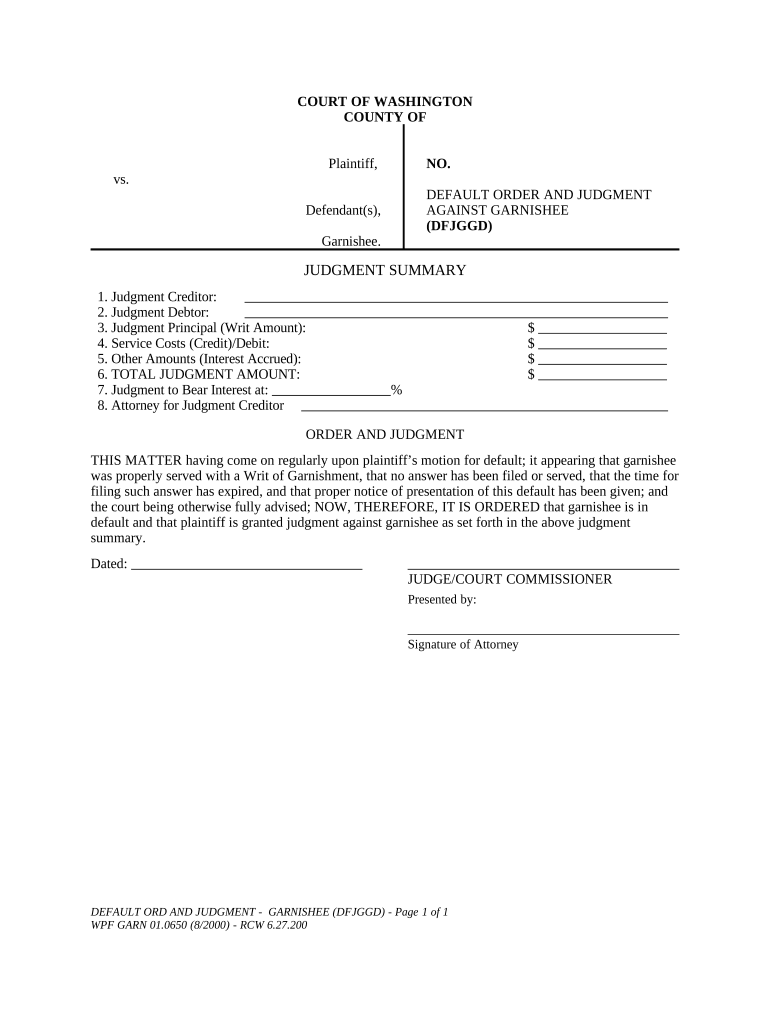
A Washington Default Judgment is a court order entered against a defendant who fails to respond or appear in a civil case filed in a Washington court. It formalizes the plaintiff's claims as a judgment without trial, typically awarding money, declaring rights, or granting other relief requested in the complaint. Default judgments follow statutory and court-rule procedures and often require filing a motion or affidavit showing service, notice, and entitlement. Remedies can include monetary award, interest, costs, and post-judgment collection measures such as liens or garnishments.

Why a Clear Default Judgment Document Matters

A correctly prepared default judgment ensures the court has the necessary facts, proof of service, and legal basis to enter judgment and reduces the chance of vacatur or delay. Precise drafting protects enforceability and simplifies collection.

Why a Clear Default Judgment Document Matters

Who Typically Prepares or Files a Default Judgment in Washington

Parties and counsel who pursue civil claims routinely prepare default judgment paperwork when a defendant fails to answer or appear.

  • Plaintiffs and their attorneys preparing an entry of judgment and supporting affidavits to prove service and damages.
  • Court clerks and judicial officers who review filings for compliance with Washington civil rules and statutory requirements.
  • Collections professionals and judgment creditors who use the final judgment to initiate enforcement steps such as liens or garnishments.

Step-by-Step: Preparing and Filing a Default Judgment in Washington

Follow this sequential checklist to prepare supporting materials, file with the correct court, and preserve enforceability; verify local county rules and judge-specific practices before filing.

  • 01
    Confirm Service: Verify proof of service or affidavit that meets Washington court rules.
  • 02
    Calculate Damages: Prepare an itemized statement of damages, interest, and costs.
  • 03
    Draft Motion/Affidavit: File a motion or proposed judgment with factual affidavits and supporting exhibits.
  • 04
    Submit to Clerk: File documents with the court clerk and obtain a signed judgment or order.

How Electronic Preparation and Filing Typically Flows

Digital workflows can streamline drafting, reviewer approvals, e-signature capture, and court e-filing; confirm the court’s e-filing requirements before e-submission.

  • Prepare Document: Draft judgment and attach proof-of-service exhibits.
  • Internal Review: Have counsel or paralegal verify facts and calculations.
  • Sign and Authenticate: Capture signatures and any necessary notarizations.
  • File with Court: Submit via the court’s e-filing portal or clerk’s office as required.

Suggested eFiling and eSignature Workflow Settings

Use consistent, auditable settings for authentication, templates, and retention when preparing default judgment packets for electronic workflows.

Field Configuration
Template Naming Include court, case number, and 'Default Judgment' for easy retrieval.
Authentication Use email plus SMS or government ID for signer verification where required.
Document Types PDF/A for filings; attach proof-of-service as separate exhibits.
Retention Policy Retain signed packet per court and regulatory retention timelines.

Technical Requirements for Digital Signing and Court E-Filing

Confirm the court accepts electronic submissions and the eSignature method meets court authentication expectations before filing.

  • File Formats: PDF/A and standard PDF
  • Integrations: Court e-filers, case management
  • Signer Authentication: Email, SMS, or ID verification

Key Risks and Consequences of Errors in a Default Judgment

Vacatur Risk: Defects in service or notice can lead to vacating the judgment
Enforcement Delay: Missing calculation details delays collection and liens
Sanctions Exposure: False statements may trigger sanctions or fee awards
Appeal Limitations: Improper entry can narrow grounds to appeal
Costs Increase: Rectifying errors increases attorney and filing costs
Collection Obstacles: Incomplete judgment language may impede garnishments or liens

Common Preparation Mistakes to Avoid

  • Failing to attach a valid proof of service or stating an incorrect service date often leads to immediate challenges and possible vacatur.
  • Listing incorrect party names or omitting a defendant’s alias creates enforceability issues and can require amended filings.
  • Calculating interest or costs without showing method and statutory basis invites judicial recalculation and delays enforcement.
  • Submitting unsigned or undated affidavits, or failing to obtain a required jurat, can cause the clerk to refuse filing.

Time-Sensitive Deadlines and Typical Processing Steps

Deadlines vary by court and service method; follow federal baselines where applicable and confirm the local civil rules for exact timeframes.

Federal Answer Deadline:

21 days after service under FRCP 12(a) for most defendants.

Motion to Vacate:

Time to move to vacate varies by rule; act promptly upon learning of default.

Judgment Entry:

Clerk processes entry after proper documentation and judge’s signature.

Enforcement Start:

Post-judgment collection steps may begin immediately after entry.

Appeal Window:

Appeal deadlines differ; verify applicable appellate rules for timelines.

Essential Elements to Include in a Professional Default Judgment

Ensure the judgment contains explicit findings, clear awards, and enforcement language so clerks and collectors can implement remedies without further clarifying submissions.

Case Caption

Complete court name, county, case number, and party designations; this anchors the judgment to the underlying file and must match the complaint precisely to avoid confusion or administrative rejection.
Findings of Fact

Short factual findings demonstrating defendant’s lack of response and service; courts rely on these to determine whether default judgment entry is appropriate and supported by record evidence.

Judgment Amount

Clear breakdown of principal, interest, statutory costs, and attorney fees with calculations and dates; specificity is required for accurate enforcement and to avoid later recalculation disputes.

Interest and Costs

State statutory interest rate or contract rate citation, plus taxable costs; specifying computation method reduces later disputes over accrual or post-judgment interest.

Enforcement Language

Directives regarding liens, garnishment, or levy procedures and clerk authority to issue writs; provide creditor contact info for enforcement coordination and clerical processing.

Signature and Date

Judge’s signature or clerk’s certificate of entry, with date; include certificate of service attesting to delivery of the judgment to parties or counsel.

Practical Tips to Improve Accuracy and Speed

Adopt consistent templates, verify all dates and names, and document service carefully to minimize motion practice and delays.

Use a Standard Template
Maintain a court-specific default judgment template that includes required headings, a findings section, detailed damage calculations, and a clear enforcement clause to ensure consistent, court-ready filings.
Attach Proofs and Exhibits
Include redacted billing records, service affidavits, and any contract excerpts relied upon; exhibit labeling and a short exhibit index reduce clerk and judicial review time.
Check Local Rules
Review county and judge-specific filing instructions, e-filing formats, and any mandatory forms required for default judgments to avoid rejections or procedural delays.
Preserve Audit Trails
When using electronic tools, keep the signing audit trail, timestamps, and exportable certificates to demonstrate authenticity and support enforcement or challenges.

Comparative eSignature Provider Overview for Default Judgment Workflows

Choose an eSignature provider that supports required authentication, audit trails, and PDF output compatible with court e-filing; signNow appears first for comparison of core commercial options.

signNow DocuSign Adobe Sign PandaDoc HelloSign
Starting Price $8/user/mo $15/user/mo $14/user/mo $19/user/mo $15/user/mo
Free Trial 7-day free trial Varies by vendor Varies by vendor Varies by vendor Varies by vendor
Bulk Send Yes (Premium) Yes Yes Yes Yes
Audit Trail Yes Yes Yes Yes Yes
Envelope Cap No cap 100 envelopes/user/year Varies Varies Varies

Frequently Asked Questions About Washington Default Judgments

Answers address common procedural and technical questions about entry, enforcement, e-signing, and how to correct or contest a default judgment.


Need help? Contact support

be ready to get more
Join over 28 million airSlate SignNow users