Establishing secure connection…Loading editor…Preparing document…

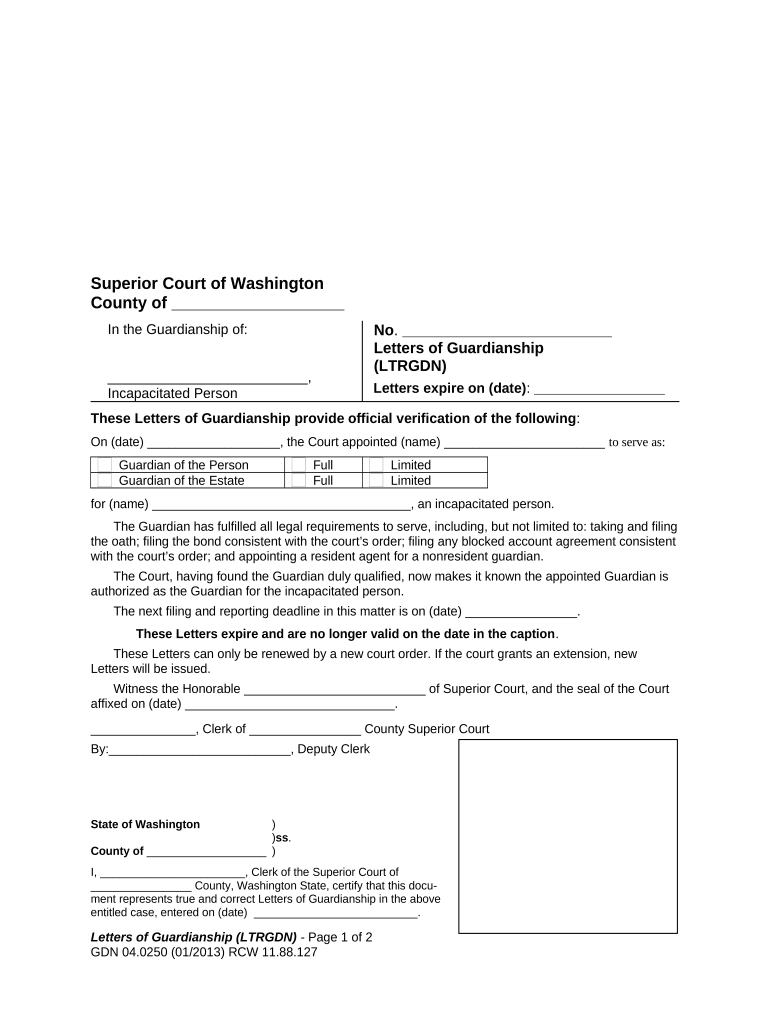
Washington Guardianship

This template is fully customizable. Edit the text, fill out the fields, and send it for signature. Give it a try!
Washington Guardianship

What the Washington Guardianship document is and when it applies

A Washington Guardianship is a court-filed petition that asks a probate or superior court to appoint a guardian to make personal care or financial decisions for an adult who lacks capacity. The petition initiates a judicial process that includes notice to interested persons, medical or psychological evidence, a hearing, and an order that defines the guardian's powers and reporting duties. Guardianship may be temporary or full, and the court tailors authority to the ward's needs while protecting statutory due process and the ward's rights.

Why preparing a clear Washington Guardianship petition matters

Accurate, complete petitions reduce delays, limit contested hearings, and help the court assess capacity and need for intervention. Clear documentation of incapacity, proposed scope of authority, and proposed alternatives (conservatorship, supported decision-making) supports narrower, less intrusive orders and better long‑term outcomes for the proposed ward.

Why preparing a clear Washington Guardianship petition matters

Who commonly prepares and files a guardianship in Washington

Typical filers include family members, public guardianship programs, and private attorneys representing interested parties.

  • Family members seeking decision-making authority when an adult cannot manage personal or financial affairs.
  • Public or court-appointed guardians serving wards with no available family or insufficient resources.
  • Attorneys representing petitioners or proposed guardians to satisfy court-formal and evidentiary requirements.

Professional involvement—attorney review or counsel from a public guardian—can reduce procedural errors and ensure compliance with local court rules.

Step-by-step: complete and file a Washington Guardianship petition

Follow these steps in order; local superior court rules may add procedural requirements such as specific forms or filing locations.

  • 01
    Gather evidence: Collect medical reports and capacity evaluations.
  • 02
    Complete petition: Fill required fields and attach supporting documents.
  • 03
    File petition: Submit to the county superior court clerk.
  • 04
    Serve notice: Provide notice to interested persons per court rules.

Overview of the court workflow for guardianship petitions

Typical processing moves from petition to investigation to hearing and then to a final order; timing and intermediate steps vary by county and caseload.

  • Petition Filed: Clerk assigns case number and schedules initial events.
  • Investigation: Court investigator or social worker may assess facts.
  • Hearing: Judge hears evidence, testimony, and objections.
  • Order Issued: Court issues guardianship order and reporting requirements.

Digital workflow settings to prepare guardianship forms for e‑submission

Configure a consistent workflow to collect signatures, attach medical reports, and track service of process steps before filing.

Field Configuration
Authentication Email or SMS code for petition signer
Document Attachments Require PDF medical reports before finalizing
Signing Order Petitioner signs first; proposed guardian signs if required
Audit Trail Retain timestamps, IPs, and signer events

Technical delivery options for completing and sharing the petition

Use a platform that supports PDF, DOCX, secure storage, and audit trails to preserve evidentiary integrity.

  • File formats: PDF, DOCX accepted
  • Integrations: Works with Google Workspace
  • Security: AES-256 at rest

Ensure your chosen workflow also supports multi-factor signer authentication and provides a tamper-evident final PDF for court filing.

Core components every Washington Guardianship petition should include

A complete petition organizes petitioner identity, ward facts, factual basis for incapacity, proposed guardian details, evidence, and a clear request for authority.

Petitioner Information

Full legal name, contact details, and relationship to the proposed ward; required for service and court contact.
Ward Identification

Full name, DOB, current address, and any known aliases to avoid misidentification in court records.

Factual Basis

Concise statements of observed incapacity, dates, and supporting incidents that justify the guardianship petition.

Medical Evidence

Attach recent capacity evaluations, physician letters, or psychological assessments supporting the claim of incapacity.

Proposed Guardian

Name, address, relationship, and a summary of the proposed guardian’s suitability and proposed duties.

Relief Requested

Specify the exact powers you request (care, medical, financial) and any limitations or reporting intervals sought.

Essential data fields to complete on the petition

Petitioner Details: Full contact info
Ward Details: Name and DOB
Capacity Claim: Specific facts
Medical Attachments: Exam dates
Guardian Nominee: Name and relation
Requested Powers: Scope described

Common legal risks and consequences of incomplete or incorrect petitions

Delays in Appointment: Hearing postponement
Dismissal Risk: Case dismissal
Fiduciary Liability: Civil penalties possible
Service Defects: Invalid service harms case
Evidence Gaps: Insufficient proof
Reporting Violations: Court sanctions possible

Timing considerations and scheduling expectations

Exact deadlines vary by county court docketing and local rules; start early to allow for service, investigation, and any required competency evaluations.

Filing Promptly:

File when incapacity is first identified to secure timely protection

Notice Periods:

Provide notice to interested persons per local court rules

Investigation Time:

Court investigators may require several weeks

Hearing Timing:

Hearing dates depend on court calendar and urgency

Reporting Deadlines:

Guardian accountings and reports follow court-specified schedules

Practical tips to prepare an accurate guardianship petition

Small preparation steps reduce court follow-up, contested hearings, and administrative burden for the guardian and the ward.

Start with local forms
Use the superior or probate court's official petition form for your county to avoid missing required statements or attachments; local forms often specify necessary exhibits and formatting.
Attach clear medical reports
Include dated, signed evaluations that directly address capacity for specific decisions; vague letters often prompt investigator follow-up and hearing delays.
Identify interested persons
List immediate family, prior agents under powers of attorney, and potential heirs to ensure proper service and reduce objections based on missing notice.
Keep an audit trail
When using electronic tools, retain timestamps, signer authentication logs, and final tamper-evident PDFs to support filing and evidentiary needs.

FAQs and troubleshooting for Washington Guardianship filings

Answers to common questions about signatures, e-submissions, required evidence, and next steps when the court requests more information.


Need help? Contact support

be ready to get more
Join over 28 million airSlate SignNow users