Establishing secure connection…Loading editor…Preparing document…

Washington Petition

This template is fully customizable. Edit the text, fill out the fields, and send it for signature. Give it a try!
Washington Petition

What the Washington Petition Is and When It’s Used

A Washington Petition is a formal written request submitted to a Washington state court or administrative body asking the tribunal to grant specific relief, such as a name change, guardianship, probate matter, civil claim, or administrative review. The form collects party names, jurisdictional facts, the precise remedy requested, and attachments that support jurisdiction and standing. Although procedures vary by court and petition type, the core purpose is to frame the legal issue for the clerk and presiding judge and to trigger official docketing, service, and a judge’s review.

Why a Correctly Prepared Petition Matters

A clear, complete petition ensures the court can accept, docket, and serve the matter without delay. Properly completed petitions reduce the risk of administrative rejection, missed deadlines, or unnecessary hearings and provide a reliable record for parties and counsel.

Why a Correctly Prepared Petition Matters

Who Typically Files and Reviews Washington Petitions

Filers include private individuals, attorneys, guardians, probate representatives, government agencies, and nonprofits initiating administrative appeals or court remedies.

Accurate petitions help all these users avoid procedural defects, conserve time, and create a clear record for subsequent steps such as service, hearings, or appeals.

Who Signs and Who Reviews

Primary Signer

The petitioner — an individual or authorized representative — must sign under penalty of perjury or affirmation, confirming the truthfulness of factual statements and the accuracy of attachments.

Court Reviewer

Court clerks and judges review petitions for jurisdiction, serviceability, and statutory sufficiency; clerks may reject or request corrections if filing requirements are unmet.

Step-by-Step: Preparing and Filing a Washington Petition

Follow these core steps to prepare, execute, and submit a petition to a Washington state court or agency.

  • 01
    Gather Documents: Collect IDs, prior orders, and exhibits supporting your claim.
  • 02
    Draft Petition: Complete required fields, state relief sought, and attach exhibits.
  • 03
    Sign and Notarize: Sign under penalty of perjury and obtain notarization if required.
  • 04
    File and Serve: File with the correct clerk’s office and serve opposing parties per court rules.

Digital Workflow Checklist for eSubmission

Set up a reliable digital workflow that captures signatures, attachments, and service records before filing or mailing paper copies.

Document Format Required PDF/A — searchable, flattened where needed for exhibits
Signatory Authentication Use email and phone verification or stronger multifactor methods
Notarization Method RON if allowed, otherwise physical notarization and scanned copy
Service Tracking Record proof of service (certified mail tracking or e-service confirmation)
Audit Trail Retain timestamped logs of signing and file transfers

Technical Considerations for eFiling and eSignatures

Confirm the file types, authentication level, and integrations required by the court or agency before electronic submission.

  • File Types: PDF, DOCX accepted by many portals
  • Authentication: Email/SMS is common; KBA or MFA may be required
  • Integration Options: Connectors for cloud storage and case management systems

Ensure your chosen platform supports secure TLS encryption, audit trails, and the export formats required by the receiving court or administrative portal.

Typical eSubmission Flow for a Washington Petition

A consistent sequence helps ensure admissibility and a clear record when filing electronically.

  • Prepare Package: Assemble petition, exhibits, and signature blocks
  • Apply Signatures: Place signature and date fields, then authenticate signer
  • Obtain Notary: If required, perform RON or in-person notarization
  • File and Record: Submit to clerk and retain filing receipt and audit trail

Security and Compliance Notes for Electronic Petitions

Encryption: TLS 1.2/1.3 and AES-256
Audit Trail: Signed timestamps and action history
Authentication: Email, SMS, or stronger MFA
HIPAA: BAA available for protected health information
ESIGN / UETA: Compliant with U.S. e-signature laws
SOC 2: SOC 2 Type II available

Consequences of an Incorrect or Incomplete Petition

Administrative Rejection: Filing may be returned or rejected
Service Defect: Improper service can void proceedings
Delay: Hearings and relief may be postponed
Sanctions: Court fines or sanctions possible
Perjury Risk: False statements carry legal penalties
Appeals Impact: Procedural errors can weaken appellate positions

Common Pitfalls to Avoid When Preparing a Petition

  • Missing jurisdictional facts or wrong venue entries that cause clerk rejection or transfer delays.
  • Unsigned or incorrectly notarized signature blocks that lead to administrative returns or requests for re-execution.
  • Incomplete service details or failure to serve respondents within statutory timeframes, which may abate the petition.
  • Poorly labeled exhibits and unclear references to attachments that force the court to request clarification.

Essential Sections Every Professional Washington Petition Should Include

Organize your petition into clear sections so clerks and judges can quickly identify jurisdiction, parties, relief, and supporting facts.

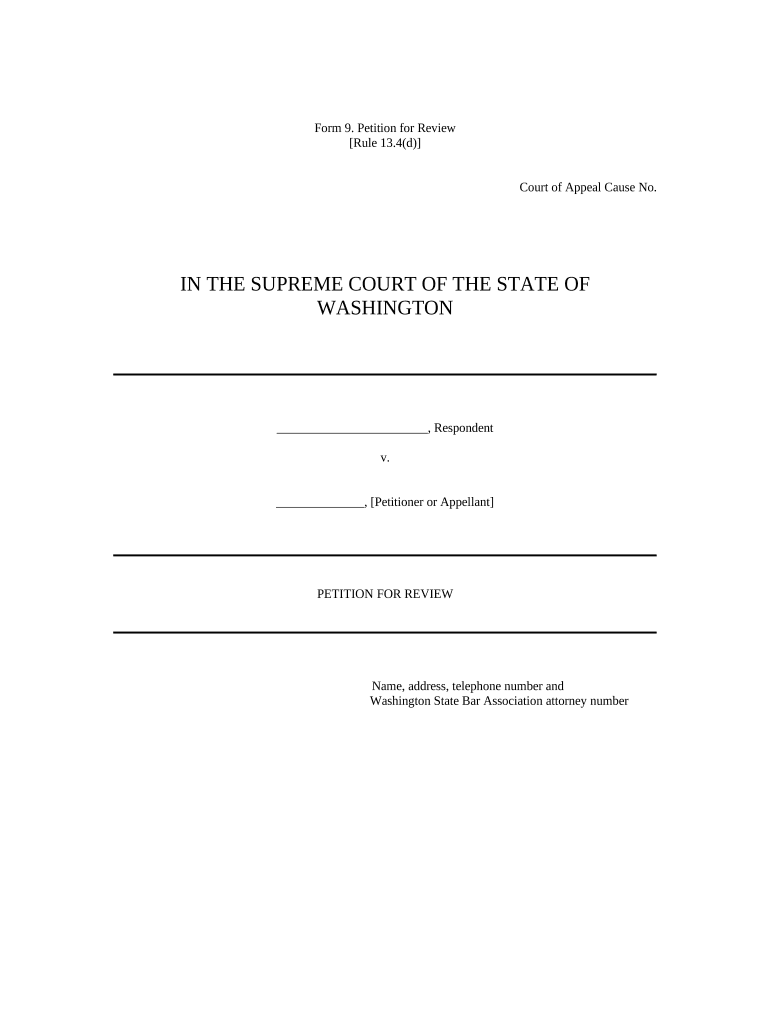
Caption

Court name, case caption, county, and docket placeholders formatted per local rules to ensure correct filing and indexing.
Statement of Facts

A concise chronological narrative of relevant events that establishes standing and the factual basis for requested relief.

Cause of Action

Legal grounds and statutory references explaining the petitioner's entitlement to the relief sought in specific terms.

Relief Sought

Clear, itemized statement of the exact order, decree, or remedy requested from the court or agency.

Exhibits

Labeled supporting documents, certified copies, and affidavits that corroborate factual assertions and jurisdictional claims.

Verification

Signature, date, and affirmation or verification clause certifying accuracy under penalty of perjury or applicable rules.

Supporting Documents Often Required with a Petition

Many petitions require specific attachments; include only what the court requests and label each exhibit clearly to avoid confusion.

Identification Records

Government-issued ID, birth certificate, or corporate formation documents when verifying identity or organizational authority.

Prior Orders

Copies of existing judgments, orders, or administrative decisions relevant to jurisdiction or res judicata issues.

Affidavits and Declarations

Sworn statements from witnesses or the petitioner establishing facts that cannot be proven by document alone.

Proof of Service

Certified mail receipts, e-service confirmations, or process server affidavits showing proper notice to respondents.

Practical Tips for Accurate and Efficient Petition Filing

Use clear language, check local rules, and keep a definitive copy of every filed document and related communication.

Follow Local Court Rules Precisely
Courts publish local filing requirements, page limits, and template language; nonconformity often leads to administrative rejection so review the rules before filing.
Keep a Single Master Copy
Maintain one versioned master file with metadata and audit trail; export signed PDFs for filing to ensure consistency across service and court submissions.
Label Exhibits Consistently
Use Exhibit A, Exhibit B, etc., and reference them in the petition text so the court can find documents quickly during review or hearing preparation.
Document Service Carefully
Record who was served, how, and when; attach proof of service to the court filing to prevent later challenges to notice.

Real-World Examples of Petition Use

Two examples illustrate how petitions function in different legal contexts and what distinguishes each filing.

Name Change Petition

An individual files a petition to change legal name and includes birth certificate and criminal history check results

  • The petitioner requests an order changing the name and updating records
  • The court reviews jurisdiction, verifies identity, and schedules a hearing before entering an order consistent with statutory procedures.

Guardianship Petition

A family member files for guardianship of an incapacitated adult and attaches medical affidavits

  • The petition seeks appointment of a guardian for personal care and estate matters
  • The court evaluates competency evidence, gives notice to interested parties, and may appoint counsel or a guardian ad litem before ruling.

Typical Deadlines and Timing Expectations

Timing depends on petition type and local rules; the list below includes commonly encountered calendar constraints and service deadlines.

Filing to Docket:

Court docketing occurs on receipt; processing time varies by county

Service Period:

Service typically required within 30–90 days, depending on statute and case type

Response Deadlines:

Respondent often has 20–30 days to answer after service

Hearing Scheduling:

Hearings may be set 30–90 days after filing, subject to court calendar

Appeal Windows:

Appeal deadlines vary; many civil appeals require filing within 30 days

Key Milestones from Filing to Final Order

Sequential milestones illustrate the typical lifecycle of a petition from intake to final disposition.

01

File Petition

Clerk receives and dockets the petition; initial review for completeness

02

Serve Parties

Petitioner effects service and files proof of service with the court

03

Pretrial or Hearing

Court schedules hearing, mediation, or status conference as applicable

04

Final Order

Judge issues decision and enters an enforceable order on the docket

eSignature Platform Comparison for Petition Preparation and eFiling

Common decision criteria for eSignature platforms include price, trial availability, bulk-send capability, audit history, HIPAA support, and any envelope or usage caps.

signNow DocuSign Adobe Sign PandaDoc HelloSign
Starting Price $8/user/mo $15/user/mo $14/user/mo $19/user/mo $15/user/mo
Free Trial 7-day free trial Varies by plan Varies by plan Varies by plan Varies by plan
Bulk Send Yes Varies by plan Varies by plan Varies by plan Varies by plan
Audit Trail Yes Yes Yes Yes Yes
HIPAA Compliant Yes Yes Yes No No
Envelope Cap No cap 100 envelopes/user/year Varies by plan Varies by plan Varies by plan

Frequently Asked Questions About Washington Petitions

Answers to common practical questions about preparation, signing, filing, and recordkeeping for petitions filed in Washington or other U.S. jurisdictions.


Need help? Contact support

be ready to get more
Join over 28 million airSlate SignNow users