Establishing secure connection…Loading editor…Preparing document…

Web Site Lease Agreement

This template is fully customizable. Edit the text, fill out the fields, and send it for signature. Give it a try!
Web Site Lease Agreement

What a Web Site Lease Agreement Is and When It Applies

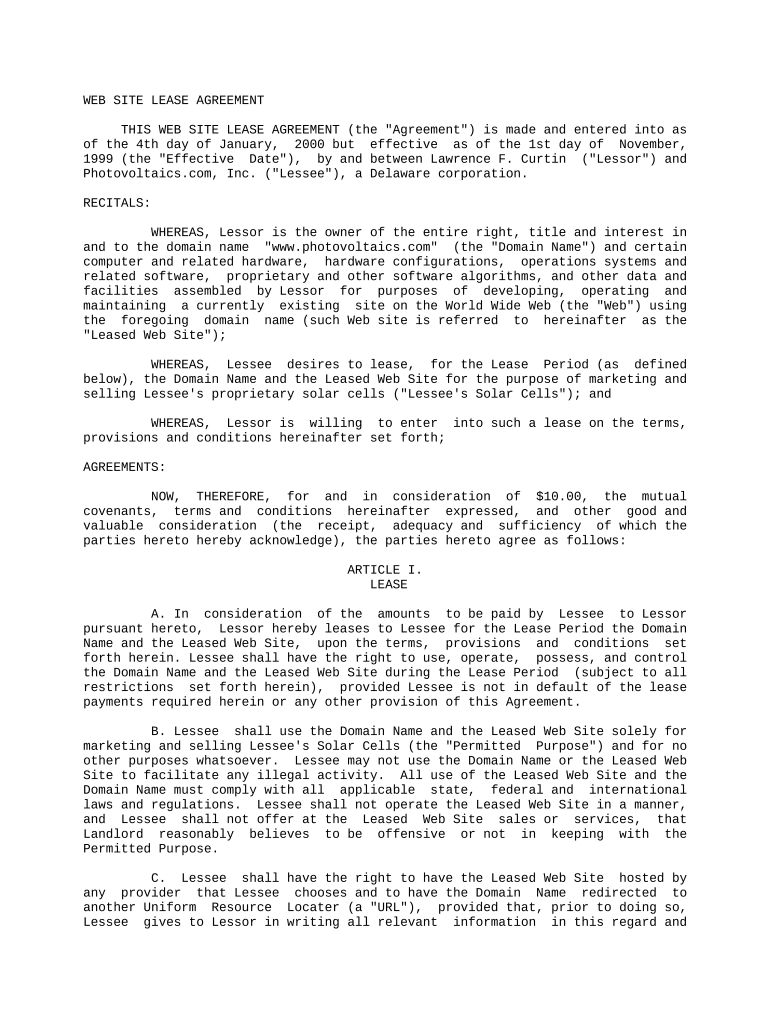
A Web Site Lease Agreement documents the rights and obligations when one party (the Licensor) grants another party (the Lessee) the right to use, host, or operate a website or web property for a defined period. Typical provisions cover the scope of hosted content, licensing of code or design, uptime and maintenance responsibilities, fees and payment schedule, intellectual property ownership, data handling, termination and transition assistance, and dispute resolution. This agreement clarifies operational duties and preserves each party’s legal remedies in case of breach.

Why a Written Lease Agreement Benefits Both Parties

A clear Web Site Lease Agreement reduces operational ambiguity, defines performance metrics, and allocates liability between host and operator. It also documents payment terms and IP ownership so disputes are easier to resolve and enforcement is more straightforward under contract law.

Why a Written Lease Agreement Benefits Both Parties

Who Typically Uses a Web Site Lease Agreement

Entities that commonly use this agreement include website owners licensing managed sites, marketing agencies leasing campaign microsites, SaaS providers granting temporary site access, and investors acquiring operating control of web properties.

  • Small businesses leasing a storefront website to a third-party manager for sales and analytics.
  • Digital agencies hosting client microsites with specified uptime and content rules.
  • Investors or portfolio managers acquiring operational control of existing web properties.

Use this agreement when the website operator will exercise ongoing control or when the owner requires contractual protection for intellectual property, data handling, or revenue sharing.

Who Signs and Why

Owner / Licensor

The legal entity or person who owns the site assets or trademarks. The Licensor signs to retain ownership rights while granting a defined license to operate, and to set limitations on modifications and sublicensing.

Operator / Lessee

The party that will host, maintain, or monetize the website. The Operator signs to accept operational responsibilities, payment obligations, and the contract’s indemnity and confidentiality provisions.

Key Clauses Every Professional Web Site Lease Agreement Should Include

A robust agreement balances operational detail with clear legal protections. Include clauses that allocate risk, set performance measures, and plan for transfer or termination to avoid service disruption.

Scope of License

Defines exactly what the Operator may do (hosting, updates, content changes), any prohibited uses, and whether the license is exclusive or nonexclusive.
Fees and Revenue

Specifies fixed fees, revenue share formulas, invoicing cadence, late-payment penalties, and responsibility for transaction or gateway fees.

Service Levels

Sets uptime targets, response times for incident remediation, maintenance windows, and remedies or credits for downtime.

Intellectual Property

Clarifies ownership of site code, content, trademarks, and whether custom development is assigned or licensed upon termination.

Data Protection

Addresses handling of user data, compliance with HIPAA or other sector rules when applicable, breach notification, and retention limits.

Termination and Transition

Outlines early-termination rights, notice periods, return or migration of data, and post-termination assistance to avoid business interruption.

Step-by-Step: Filling Out a Web Site Lease Agreement

Follow these steps in order to complete the agreement accurately and prepare it for signature and recordkeeping.

  • 01
    Draft Key Terms: Agree on scope, fees, and IP ownership with counterparty.
  • 02
    Populate Fields: Complete legal names, dates, addresses, and payment details.
  • 03
    Attach Exhibits: Add schedules for services, pricing, and technical specs.
  • 04
    Review & Sign: Use eSignature and retain signed copies and audit trail.

How to Configure an Online Signing Workflow

Set up a digital workflow that reflects the agreement’s required signing order, authentication, and retention needs.

Field Configuration
Signing Order Sequential or parallel, depending on who must approve first
Authentication Email link, SMS code, or ID verification for high-risk transactions
Attachments Include exhibits as locked attachments to prevent later edits
Audit Trail Enable timestamps, IP logging, and completed-document certificate

Digital Signing and Technical Delivery Options

Choose a signing platform that supports the authentication level and retention rules your agreement requires.

  • Document Formats: PDF and DOCX are standard; also accept HTML exports for web-native handoff
  • Integrations: Connectors such as Salesforce, Microsoft 365, NetSuite, and Google Workspace simplify routing
  • Security: Use a solution that offers TLS 1.2/1.3, AES-256 at rest, and an auditable completion certificate

Ensure the chosen platform can deliver a tamper-evident signed PDF, store an audit trail, and meet any sector-specific compliance such as HIPAA when required.

Typical eSigning Flow for a Web Site Lease Agreement

A standard online signing process reduces turnaround time and preserves evidence of consent and execution.

  • Upload Document: Sender uploads final draft to the signing platform
  • Place Fields: Insert signature, initials, date, and optional checkbox fields
  • Add Signers: Enter signer emails and define signing order
  • Complete Signing: Signers authenticate, sign, and the system issues a completion certificate

Key Timing Considerations and Deadlines

Track dates that trigger performance, renewal, notice, and tax reporting obligations associated with the leased website.

Effective Date:

Date contract obligations begin; use MM/DD/YYYY format

Payment Due Dates:

Specify exact day of month or net terms to avoid disputes

Renewal Notice:

State notice window (commonly 30–90 days) before automatic renewal

Termination Notice:

Specify cure and termination periods, e.g., 30-day cure

Tax and Reporting:

Retain records for at least 3 years for IRS purposes

Common Preparation Mistakes to Avoid

  • Leaving IP ownership vague, which can lead to disputes over code or content rights.
  • Failing to attach technical exhibits, causing disagreement about performance expectations.
  • Using ambiguous compensation language without specifying currency or invoicing terms.
  • Not including data handling rules or breach notification obligations for user data.

Consequences of an Incorrect or Incomplete Agreement

Contract Disputes: Litigation or arbitration costs
Service Interruptions: Loss of access or unplanned downtime
Revenue Loss: Unclear revenue share leads to missed payments
Regulatory Exposure: HIPAA or privacy violations for mishandled data
Tax Penalties: Inadequate records may complicate reporting obligations
IP Claims: Disputes over code or content ownership

Sample eSignature Vendor Pricing and Feature Comparison

Compare common vendor features relevant to executing and storing signed Web Site Lease Agreements; signNow is listed first for comparison parity.

signNow DocuSign Adobe Sign PandaDoc HelloSign
Starting Price $8/user/mo $15/user/mo $14/user/mo $19/user/mo $15/user/mo
Free Trial 7-day free trial Yes Yes Yes Yes
Bulk Send Yes Yes Yes Yes Yes
Audit Trail Yes Yes Yes Yes Yes
HIPAA Compliant Yes Yes Yes No No
Envelope Cap No envelope cap 100 envelopes/user/year Varies by plan Varies by plan Varies by plan

Real-World Use Cases for a Web Site Lease Agreement

Sample scenarios show how different parties structure the agreement to match operational needs.

Agency-Operated Campaign Site

An agency leases a microsite during a marketing campaign and manages hosting and updates

  • Lease limits content changes to approved assets only
  • The agreement required defined handback steps and an IP clause ensuring campaign assets revert to the owner at termination, preventing client-facing downtime.

Investor-Controlled Property

An investor acquires operational control of a monetized site and leases it to a specialist operator

  • Revenue share tied to ad net revenue
  • The lease required audit rights, monthly reporting, and an expedited transition plan to preserve revenue during operator changes.

Practical Tips for Drafting a Clear Web Site Lease

Applying these drafting tips reduces ambiguity and speeds execution.

Use Defined Terms
Define 'Site', 'Operator', 'Licensor', 'Net Revenue', and other recurring terms to avoid interpretation disputes.
Attach Technical Specs
Include exhibits for hosting specs, backup schedules, and maintenance windows so expectations are measurable.
Limit Delegation
Specify whether the Operator may subcontract and require prior written consent for core functions.
Include Exit Plan
State data export formats, transition assistance hours, and timelines to reduce downtime at termination.

Essential Data and Security Provisions to Include

Encryption: Require TLS for data in transit and AES-256 at rest for hosted data
Access Controls: Specify role-based access lists and multi-factor authentication for administrators
Breach Notification: Set timing and method for notifying affected parties and regulators
Backups: Define frequency of backups and retention period for backups
Audit Logs: Require logging of admin actions and user changes for forensic review
Compliance: State applicable frameworks such as HIPAA, PCI-DSS, or 21 CFR Part 11 when relevant

FAQs and Troubleshooting for Web Site Lease Agreements

Answers to common execution, enforcement, and compliance questions about site leasing.


Need help? Contact support

be ready to get more
Join over 28 million airSlate SignNow users