Establishing secure connection…Loading editor…Preparing document…

West Virginia Marital Property Agreement

This template is fully customizable. Edit the text, fill out the fields, and send it for signature. Give it a try!
West Virginia Marital Property Agreement

What the West Virginia Marital Property Agreement Is

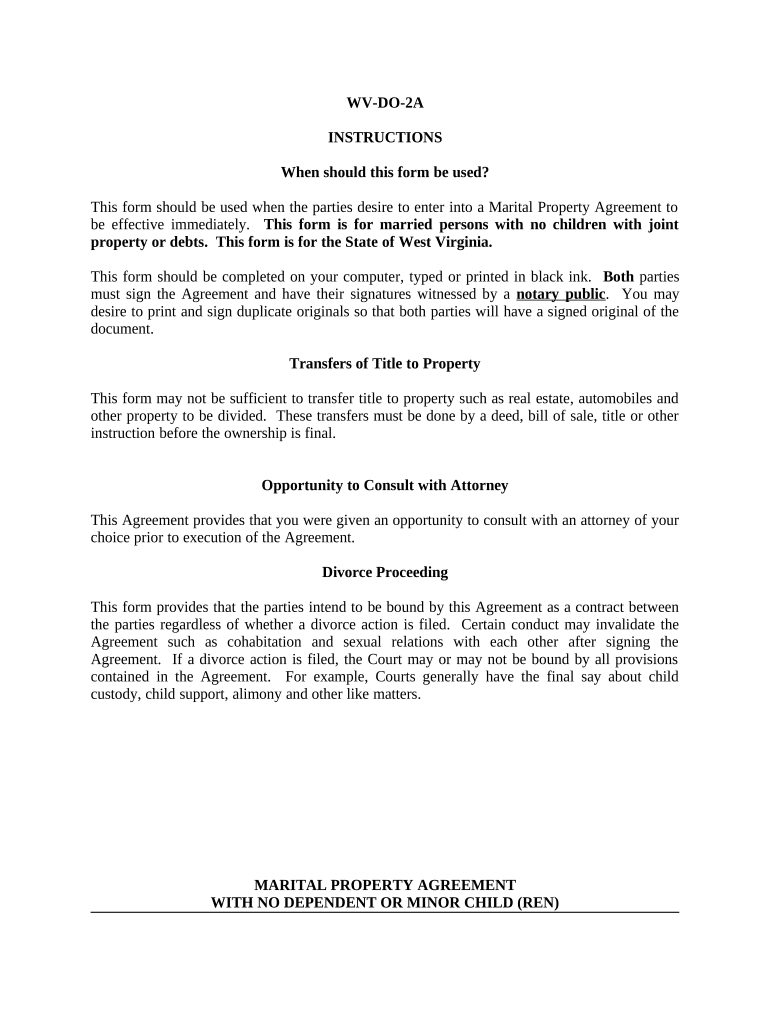
A West Virginia Marital Property Agreement is a written contract between spouses or prospective spouses that defines ownership, use, and rights in property during marriage and on separation, divorce, or death. These agreements can categorize assets as separate or marital property, allocate income and debts, and specify disposition on termination. In West Virginia the agreement is governed by state contract and family law principles and should clearly state effective dates, parties, and the scope of property covered to reduce later disputes and ease court review if enforcement is needed.

Why a Written Marital Property Agreement Matters in West Virginia

A clear agreement provides predictability for asset division, protects separate property, and documents parties’ intentions before disputes arise.

Why a Written Marital Property Agreement Matters in West Virginia

Who Typically Prepares and Signs These Agreements

The agreement is used by couples and advisors to manage property rights before or during marriage.

  • Couples planning marriage who want to set expectations for property ownership and division.
  • Married couples seeking to reallocate property rights or clarify financial responsibilities during the marriage.
  • Attorneys and estate planners preparing enforceable provisions and advising on tax and probate effects.

Primary Signers and Authorized Representatives

Spouse

Each spouse is the primary signer and must sign to demonstrate mutual assent. Courts review whether each party understood terms and had a fair opportunity to consult counsel before execution.

Attorney

An attorney for a party may prepare, review, or certify the agreement. Independent counsel reduces later challenges based on coercion, fraud, or lack of disclosure and supports enforceability in court.

Core Elements to Include in a Professional Agreement

A complete marital property agreement sets out the agreement scope, asset lists, debt allocation, liability treatment, dispute resolution, and governing law to ensure clear enforcement and predictable outcomes.

Parties & Recitals

Identify each party by full legal name, residency, and marital status. Recitals summarize background facts and the reason for the agreement to provide context for interpretation.
Property Schedule

Attach schedules listing separate property and describe marital property categories. Schedules should reference acquisition dates and identifying details for real estate, accounts, and business interests.

Rights & Allocation

State how income, appreciation, income from separate property, and debts will be allocated during marriage and upon dissolution or death to avoid ambiguity in later proceedings.

Waivers & Consents

Include explicit waivers such as spousal elective share, rights to homestead, or claims to specific assets, ensuring language is clear and knowingly executed by each party.

Estate & Divorce Terms

Provide directions for disposition at death and effects on divorce, including whether the agreement survives divorce or terminates upon certain events.

Governing Law

Specify West Virginia law or another chosen jurisdiction to govern interpretation, and include clause for dispute resolution mechanism such as mediation or arbitration.

Step-by-Step: Completing a West Virginia Marital Property Agreement

Follow these steps in order to prepare, review, execute, and retain a legally defensible agreement.

  • 01
    Draft: Assemble schedules and draft clear allocation language.
  • 02
    Review: Each party reviews with independent counsel if possible.
  • 03
    Execute: Sign, date, and notarize according to state practice.
  • 04
    Retain: Store originals and distribute copies to parties and counsel.

Typical Workflow for Digital Completion and Signing

Digital completion streamlines execution while preserving an audit trail and authentication evidence for enforceability.

  • Upload Document: Add the fully drafted agreement to the e-signature platform.
  • Place Fields: Insert signature, initial, date, and notary fields where required.
  • Send to Signers: Invite signers via email or secure link with instructions.
  • Collect Signatures: Capture signer authentication, timestamp, and audit trail.

Technical Considerations for eSigning and Storing the Agreement

Use an eSignature platform that supports audit trails, tamper-evident PDFs, and optional advanced authentication for higher-assurance signings.

  • File Formats: PDF and DOCX supported.
  • Authentication: Email, SMS, or stronger KBA options.
  • Integrations: Salesforce, NetSuite, Google Workspace.

eSignature Pricing and Feature Snapshot for Agreement Execution

Below is a concise vendor comparison for common eSignature needs when preparing and signing agreements. signNow is listed first per comparison format; use plan details to match volume and compliance needs.

signNow DocuSign Adobe Sign PandaDoc HelloSign
Starting Price $8/user/mo $15/user/mo $14/user/mo $19/user/mo $15/user/mo
Free Trial Yes, 7-day trial No No Yes, limited Yes, limited
Bulk Send Yes Yes Yes Yes No
Audit Trail Yes Yes Yes Yes Yes
HIPAA Compliant Yes Yes Yes No No

Timing Considerations and Typical Deadlines

Certain dates affect enforceability and administrative steps; plan signing, notarization, and any recording to match those timelines.

Effective Date Selection:

Enter effective date in MM/DD/YYYY format; it governs rights from that date forward.

Notarization Timing:

Notarize at time of signing to preserve contemporaneous acknowledgment.

Recording Option:

Record only if real property interest is conveyed; county recording delays vary.

Tax Reporting Window:

Tax consequences may depend on year of transfer; consult tax counsel for timing.

Retention Start:

Retention period generally begins on effective date or last amendment date.

Essential Information to Include for Clarity and Enforcement

Party Names: Full legal names
Property List: Detailed asset descriptions
Debts: Allocated liabilities
Effective Date: MM/DD/YYYY format
Signatures: Signed and dated
Notary Block: Notary acknowledgement

Common Risks and Consequences of Defective Agreements

Unenforceability: Agreement may be set aside by a court
Fraud Claims: Misrepresentation can void provisions
Improper Execution: Missing notarization or signatures
Tax Exposure: Unexpected tax consequences
Estate Disputes: Will contests or probate issues
Record Gaps: Loss of evidence if originals not retained

Practical Tips for Accurate and Efficient Completion

Adopt these practices to reduce challenges and administrative friction when preparing and signing the agreement.

Full Financial Disclosure
Provide complete asset and liability schedules to avoid later claims of concealment; full disclosure supports enforceability in court.
Independent Legal Review
Encourage each party to consult separate counsel; document whether independent counsel was available or waived in writing.
Clear, Specific Language
Avoid ambiguous terms and define categories (e.g., 'separate property'); attach exhibits for complex assets like businesses.
Secure Original Documents
Keep signed originals in safe storage and distribute certified copies to parties and counsel for redundancy.

Real-World Use Cases for Marital Property Agreements

Examples illustrate common scenarios where a marital property agreement clarifies financial rights and expectations between spouses.

Prenuptial for Business Owner

A business owner drafts an agreement to keep business equity separate

  • Protects business value from marital division
  • The agreement lists company shares, valuation method on divorce, and mediation steps to resolve valuation disputes.

Postnuptial Financial Reallocation

A married couple executes terms after a large inheritance

  • Designates inheritance as separate property
  • The document details account numbers, income treatment, and successor interests to reflect changed family finances.

Execution and Authentication Steps (Notarization and Witness Flow)

Follow a clear signing sequence to ensure contemporaneous authentication and meet state formalities when notarization or witnesses are required.

01

Prepare Final Draft

Confirm schedules and exhibit attachments before printing or uploading.

02

Independent Review

Allow parties time to consult counsel and review terms.

03

Arrange Notary

Schedule a notary who can witness or perform RON if available.

04

Sign in Presence

Parties sign in presence of notary and witnesses if required.

05

Notary Acknowledgement

Notary completes and signs the acknowledgement block.

06

Witness Signatures

Collect witness signatures where state law mandates them.

07

Record If Needed

Record only when the agreement transfers or affects title to real property.

08

Distribute Copies

Provide certified copies to parties, counsel, and escrow if applicable.

Frequently Asked Questions About West Virginia Marital Property Agreements

Answers to common questions about enforceability, notarization, revocation, and electronic signing for West Virginia agreements.


Need help? Contact support

be ready to get more
Join over 28 million airSlate SignNow users