Establishing secure connection…Loading editor…Preparing document…

Wisconsin Individual Easement

This template is fully customizable. Edit the text, fill out the fields, and send it for signature. Give it a try!
Wisconsin Individual Easement

What a Wisconsin Individual Easement Is and when it applies

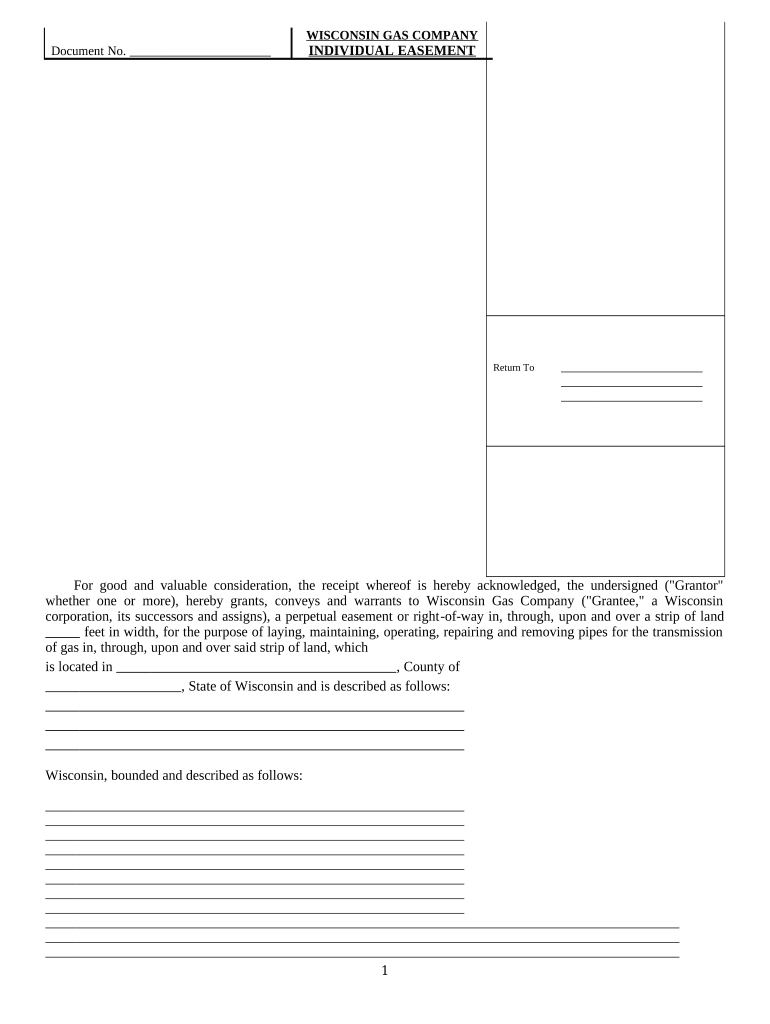
A Wisconsin Individual Easement is a written legal instrument by which a property owner (the grantor) conveys to a named individual (the grantee) a nonpossessory property interest that allows specified uses or access across, upon, or under land owned by the grantor. Typical easements include rights of ingress and egress, utility access, and conservation restrictions. The document identifies the parties, describes the servient and dominant tenements with a legal property description, specifies duration and permitted uses, and is usually notarized and recorded in the county register of deeds to protect priority against later claims.

Why an Individual Easement matters for property rights and title

A clear, signed, and properly recorded individual easement creates enforceable rights that survive changes in ownership and clarify responsibilities for maintenance, access, and liability. Accurate drafting minimizes disputes, protects title, and preserves future marketability of encumbered land.

Why an Individual Easement matters for property rights and title

Who typically prepares and signs an Individual Easement

Several different parties commonly prepare, review, or sign an individual easement depending on whether it benefits a private person, a utility, or a municipality.

  • Private landowners and individual grantees negotiating access, driveway, or path rights for personal use or neighborhood access.
  • Real estate attorneys and title agents who draft legal descriptions and verify title encumbrances for recording.
  • Local municipal or utility staff when easements affect public infrastructure or service lines.

Identify who must sign, whether notarization or witnesses are required, and who will handle county recording before final execution.

Key signatories and their roles

Grantor (Owner)

The person or entity that owns the servient parcel and grants the easement. The grantor must have capacity to convey and must sign the easement; a corporate grantor typically signs through an authorized officer with corporate attestation.

Grantee (Beneficiary)

The individual who receives the easement interest. The grantee's identity must match the name used for title and tax records to avoid future disputes; accepting the easement may require the grantee's signature or recorded written acceptance depending on local practice.

Core components to include in a professional easement

A complete Wisconsin Individual Easement should include precise party names, a legal property description, clearly defined permitted uses, duration and termination provisions, maintenance and liability rules, and recording instructions to protect priority.

Parties

Full legal names of grantor(s) and grantee(s) plus entity details for corporations or trusts; avoid nicknames or initials to prevent ambiguity.
Legal Description

Provide the full recorded legal description (metes and bounds or lot/block reference) rather than a street address to ensure precise identification for title and recording.

Scope of Use

Define permitted activities, dimensions, and any limits (e.g., pedestrian access only, utility conduit size) so enforcement and scope are straightforward.

Duration

Specify whether the easement is perpetual, for a fixed term, or conditional; include automatic termination triggers if applicable.

Maintenance and Liability

Allocate responsibility for repairs, vegetation, snow removal, and insurance; include indemnity clauses for foreseeable risks.

Recording Instructions

State the county where the easement will be recorded and require delivery of the recorded instrument or recording information to the parties.

Essential data fields to capture in the easement

Grantor Name: Exact legal name
Grantee Name: Exact legal name
Property Description: Recorded legal description
Consideration: Dollar amount or nominal
Easement Terms: Scope and duration
Recording County: County name

Step-by-step process to prepare and execute the easement

Follow these sequential steps to create, sign, and record a Wisconsin Individual Easement with minimal delays.

  • 01
    Draft: Draft or have counsel prepare the easement language and legal description.
  • 02
    Review: Confirm party names, property details, and scope with title or counsel.
  • 03
    Sign and Notarize: All grantors sign before a notary; grantee signature if required.
  • 04
    Record: File with the county register of deeds where the servient parcel is located.

How to set up an online signing workflow for this easement

Configure a digital workflow that preserves audit trails, enforces signer order, and stores the recorded copy for title continuity.

Field Configuration
Signer Order Grantor(s) first, then grantee, then witness/notary if required
Authentication Email link plus SMS or ID verification for higher assurance
Record Retention Capture signed PDF plus audit trail for perpetual storage
Notifications Set auto-notice to title agent and parties on completion

From draft to county record — the typical routing

A typical routing path ensures the document is drafted, signed, notarized, and delivered to the appropriate county office for recording.

  • Drafting: Prepare easement language and attach legal description.
  • Signature Capture: Collect signatures and notarization in the required order.
  • Recording Submission: Submit the signed instrument to the county register of deeds.
  • Delivery of Recorded Copy: Provide recorded instrument return to parties and title insurer.

Digital signing and platform considerations

Choose a signing platform that provides an immutable audit trail, secure storage, and supports notarization workflows where permitted.

  • File types: PDF and DOCX are accepted for upload
  • Integrations: Connectors for title, CRM, and cloud storage ease processing
  • Authentication: Support for SMS, email, or advanced ID proofing

Verify the chosen platform complies with ESIGN and UETA and supports secure retention; use a BAA for health-related attachments if applicable.

Timing and recording considerations to protect priority

Timely recording preserves the easement's priority and gives constructive notice to future purchasers; county practices and timelines vary and should be confirmed before submission.

Record Promptly:

Record as soon as reasonably possible to protect priority against intervening transfers.

County Processing:

Processing times vary — same-day to several weeks depending on county workload.

Notary Timing:

Signings must be notarized on the date of execution where acknowledgement blocks are used.

Title Update:

Notify title insurer to update the title report after recording.

Retain Originals:

Keep original signed and notarized instrument until recorded and returned.

Key milestones from negotiation to fully recorded easement

Track these milestones to manage approvals, signatures, and county recording without losing priority or creating gaps in responsibility.

01

Negotiation Complete

Parties agree on scope, duration, consideration, and obligations.

02

Draft Finalization

Attorney or title prepares the final instrument and legal description.

03

Execution and Notarization

All required signatures and notarizations are completed in proper order.

04

Recording and Delivery

Instrument is recorded in the county and recorded copy returned to parties.

Common mistakes to avoid when preparing an easement

  • Using informal descriptions (street addresses) instead of a recorded legal description, which can cause ambiguity in title searches and recording.
  • Failing to verify grantor capacity or corporate authority, leading to potential challenges to the easement's validity after transfer.
  • Omitting maintenance or liability language, resulting in disputes over who repairs or insures the easement area.
  • Recording an unnotarized or incorrectly executed instrument, which can delay acceptance by the register of deeds or affect priority.

Consequences of incorrect or incomplete easement documentation

Title Defect: Cloud on title
Priority Loss: Superseded by later recorded instruments
Enforcement Issues: Ambiguous scope limits remedies
Liability Exposure: Unclear maintenance responsibilities
Recording Rejection: County may refuse defective instruments
Increased Costs: Attorney and re-recording fees

Common eSignature vendor pricing and feature comparison

Compare basic pricing and capabilities relevant to signing and storing legal instruments; signNow is listed first per vendor guidelines.

signNow DocuSign Adobe Sign PandaDoc HelloSign
Starting Price $8/user/mo $15/user/mo $14/user/mo $19/user/mo $15/user/mo
Free Trial 7-day free trial Varies by plan Varies by plan Varies by plan Varies by plan
Bulk Send Yes Yes Yes Yes No
Audit Trail Yes Yes Yes Yes Yes
HIPAA Compliant Yes Yes Yes No No

Real-world scenarios where an individual easement is used

Two concise case examples show common outcomes and practical drafting focus areas.

Case Study 1

A rural homeowner grants a neighbor a driveway easement to reach a public road.

  • The easement specifies width, permitted vehicles, and maintenance split.
  • After recording with the county, the easement prevented a later adjacent sale from blocking access and clarified repair obligations for both parties, avoiding litigation.

Case Study 2

A private landowner grants a local utility a narrow utility corridor.

  • The document includes restoration obligations and access windows.
  • Clear scope and recorded notice allowed the utility to perform periodic maintenance without trespass disputes while preserving the owner’s use of surrounding land for farming.

Frequently asked questions about Wisconsin Individual Easements

Answers to common legal and practical questions about drafting, execution, notarization, recording, and amendment of individual easements.


Need help? Contact support

be ready to get more
Join over 28 million airSlate SignNow users