Establishing secure connection…Loading editor…Preparing document…

Wisconsin Marital Property Agreement

This template is fully customizable. Edit the text, fill out the fields, and send it for signature. Give it a try!
Wisconsin Marital Property Agreement

What the Wisconsin Marital Property Agreement Is

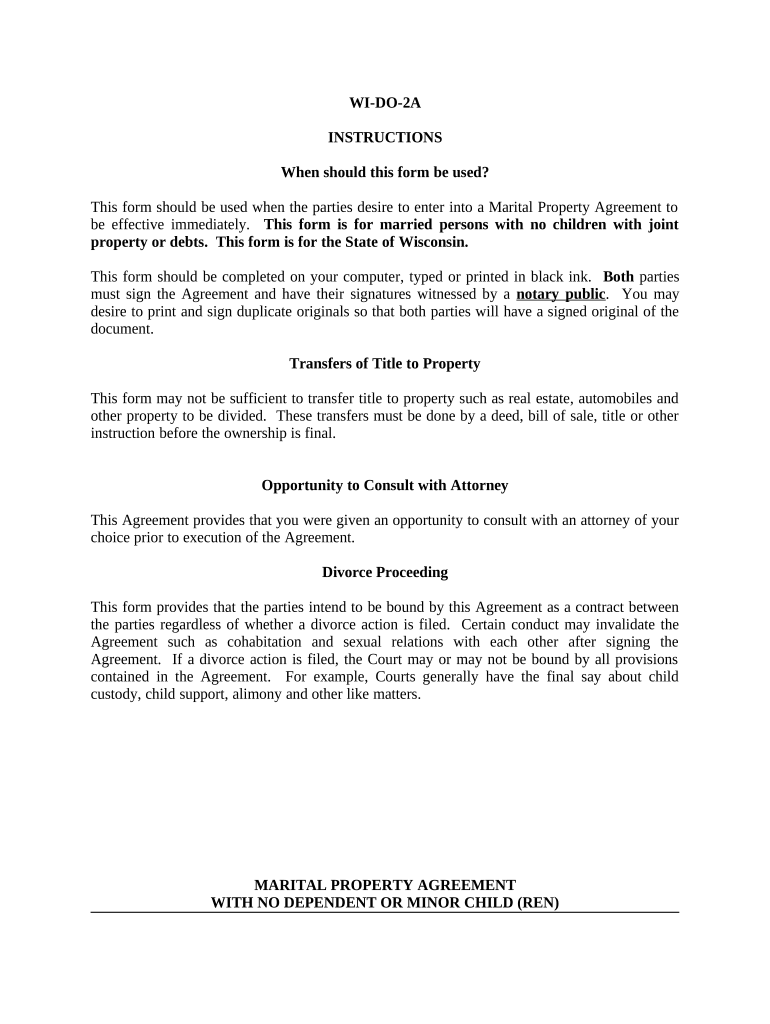
A Wisconsin Marital Property Agreement is a written contract between spouses that defines ownership, management, and division of property during marriage and upon divorce or death. Under Wisconsin law, spouses may create agreements to allocate assets as marital or separate property, set terms for spousal support, and specify division rules that differ from default marital property principles. These agreements should be drafted clearly, state governing law, and include full disclosure of assets. Proper execution typically requires signatures of both parties and is commonly notarized to aid enforceability; legal review is recommended.

Why this Agreement Matters for Spouses

A Wisconsin Marital Property Agreement lets spouses control property rights, reduce uncertainty at divorce or death, and preserve separate assets. It can simplify estate planning and clarify financial responsibilities while providing a contract-based alternative to default statutory division rules.

Why this Agreement Matters for Spouses

Who Typically Uses a Marital Property Agreement

Typical users include spouses planning asset allocation, family law attorneys preparing agreements, and estate planners coordinating property division.

  • Spouses before or during marriage seeking to define separate and marital property rights.
  • Divorce attorneys wanting clear contractual terms that limit litigation and ease settlement negotiations.
  • Estate planners who incorporate marital agreements to ensure intended postmortem asset distribution.

Core Sections to Include in a Professional Agreement

Core sections structure a clear Wisconsin Marital Property Agreement to reduce ambiguity, document disclosures, and strengthen enforceability in court or settlement.

Parties

Identify each spouse by full legal name, current address, and capacity to enter the agreement. Include separate legal entities if one party is signing on behalf of a trust or representative.
Recitals

State background facts, marriage date, and intent. Use concise recitals to frame the agreement's purpose without creating contradictory obligations. Reference any prior contracts or material financial facts that affect property classification.

Definitions

Define terms such as separate property, marital property, community income, and account types to prevent interpretive disputes, including retirement and business interests.

Asset Schedule

Attach schedules listing real estate, bank accounts, retirement plans, business interests, and debts. Use exact account identifiers and attach valuation dates and notarized appraisals when available for clarity.

Division Terms

Specify how marital versus separate property will be divided, including percentages, buyout formulas, or transfer mechanisms, and responsibility for taxes and liabilities. Address treatment of future accruals and appreciation.

Signatures

Provide signature blocks for both spouses, space for date, and notary acknowledgment. State whether witnesses are required and include witness signature lines if so, and retain executed originals.

Step-by-Step: Prepare, Execute, and Preserve the Agreement

Follow these steps to prepare and execute a compliant Wisconsin Marital Property Agreement accurately and consistently.

  • 01
    Draft: Gather full asset lists, debts, and prior agreements.
  • 02
    Disclosure: Exchange written financial disclosures and supporting documents.
  • 03
    Review: Have independent legal counsel review for fairness and clarity.
  • 04
    Execute: Sign, notarize where appropriate, and retain original executed copy.

Online Workflow Settings to Configure

Digital workflow settings relevant when completing and executing a marital property agreement online including authentication and retention options.

Field Configuration
Authentication Email link; SMS code; optional knowledge-based authentication
Notarization In-person or RON per state rules
Storage Encrypted storage with audit trail retention
Notifications Signer reminders and completion receipts

Platform Capabilities to Support Your Execution Plan

Choose platforms that support secure e-signatures, audit trails, and compliant storage for marital agreements and notarization workflows.

  • Formats: PDF, DOCX supported
  • Integrations: Works with Google Workspace and NetSuite
  • Authentication: Email, SMS, or SSO options

How the Signing and Recording Workflow Usually Proceeds

Typical workflow for preparing, signing, and storing a Wisconsin Marital Property Agreement electronically or on paper.

  • Prepare: Draft agreement and attach asset schedules.
  • Disclose: Exchange full financial disclosures and documentation.
  • Sign: Sign before notary and witnesses as required.
  • Store: Retain originals and secure electronic copies with audit trail.

Comparison: eSignature Plans for Executing Marital Agreements

Compare common eSignature plan features and costs relevant when executing a Wisconsin Marital Property Agreement, with signNow listed first for platform context.

signNow DocuSign Adobe Sign PandaDoc HelloSign
Starting Price $8 per user per month billed annually; lowest tier $15 per user per month billed annually $14 per user per month billed annually $19 per user per month billed annually $15 per user per month billed annually
Free Trial 7-day free trial, no credit card required Trial offerings vary by plan and region Trial availability varies; contact vendor for details Free trial typically available on select plans Free trial options depend on plan selection
Bulk Send Bulk send available on Business Premium and higher plans Bulk send offered on specific business and enterprise tiers Bulk send available through enterprise or business plans Bulk send included on business and enterprise plan tiers Bulk send functionality not available on standard plans
Audit Trail Comprehensive audit trail with timestamps and IP data Comprehensive audit trail with timestamps and IP data Comprehensive audit trail with timestamps and IP data Comprehensive audit trail with timestamps and IP data Comprehensive audit trail with timestamps and IP data
HIPAA Compliant HIPAA compliant; BAA available upon request HIPAA compliance available; BAA offered for covered entities HIPAA support for certain plans; BAA available Not HIPAA certified; limited healthcare features Not HIPAA certified; no BAA offered
Envelope Cap No envelope cap; unlimited sending depends on plan Limit of 100 envelopes per user per year on some plans Envelope limits vary by plan and vendor policy Limits vary by subscription tier and usage Envelope limits vary by plan; contact sales for details

How This Agreement Differs from Related Family-Law Documents

Key distinctions between marital property agreements and related family-law documents to guide proper selection for spouses and counsel.

Document Type Purpose Typical Timing
Marital Property Agreement property allocation before, during, or after marriage
Prenuptial Agreement premarital protections before marriage
Postnuptial Agreement adjust rights after marriage during marriage
Community Property Agreement state-specific community regime varies by state

Key Timing and Deadline Considerations

Timing considerations and key dates to observe when preparing and finalizing a Wisconsin Marital Property Agreement.

Effective Date:

Date entered as MM/DD/YYYY; determines when terms apply

Disclosure Deadline:

Exchange disclosures before signing to avoid challenges

Notary Scheduling:

Schedule notarization in advance, including RON session if used

Recording Window:

If recording is required, check county processing times

Amendment Effective:

Amendments take effect when signed by all parties

Security and Compliance Features to Seek

Encryption: TLS 1.2/1.3 in transit, AES-256 at rest
Audit Trail: Complete timestamped signing history
BAA Available: HIPAA BAA available on request
Certificate: Certificate of completion included
Authentication: Email, SMS, or advanced methods
Compliance: ESIGN, UETA, SOC 2, ISO 27001

Common Risks and Consequences of Deficient Agreements

Non-Disclosure: Agreement voided by hidden assets
Improper Execution: Missing signatures or notary reduces enforceability
Unconscionability: Court may rescind one-sided terms
Tax Consequences: Incorrect reporting triggers IRS penalties
Ineffective Amendments: Informal changes may be invalid
Witness Issues: Lack of required witnesses causes challenges

Frequent Preparation Mistakes to Avoid

  • Using vague language like 'fair share' leads to disputed interpretations and potential litigation; specify percentages, formulas, or precise transfer mechanics to avoid ambiguity.
  • Failing to disclose business interests or retirement accounts can be grounds to set aside the agreement for fraud or incomplete disclosure.
  • Relying on unsigned or initialed drafts during significant transactions risks unenforceability and downstream title or probate complications.
  • Ignoring state-specific notarization or witness rules, including RON restrictions, may invalidate acknowledgments; verify local statutes before execution.

Frequently Asked Questions About Wisconsin Marital Property Agreements

Answers to common questions about validity, execution, and revisions of Wisconsin Marital Property Agreements below.


Need help? Contact support

be ready to get more
Join over 28 million airSlate SignNow users