Wisconsin Order Limiting Time for Filing Claims
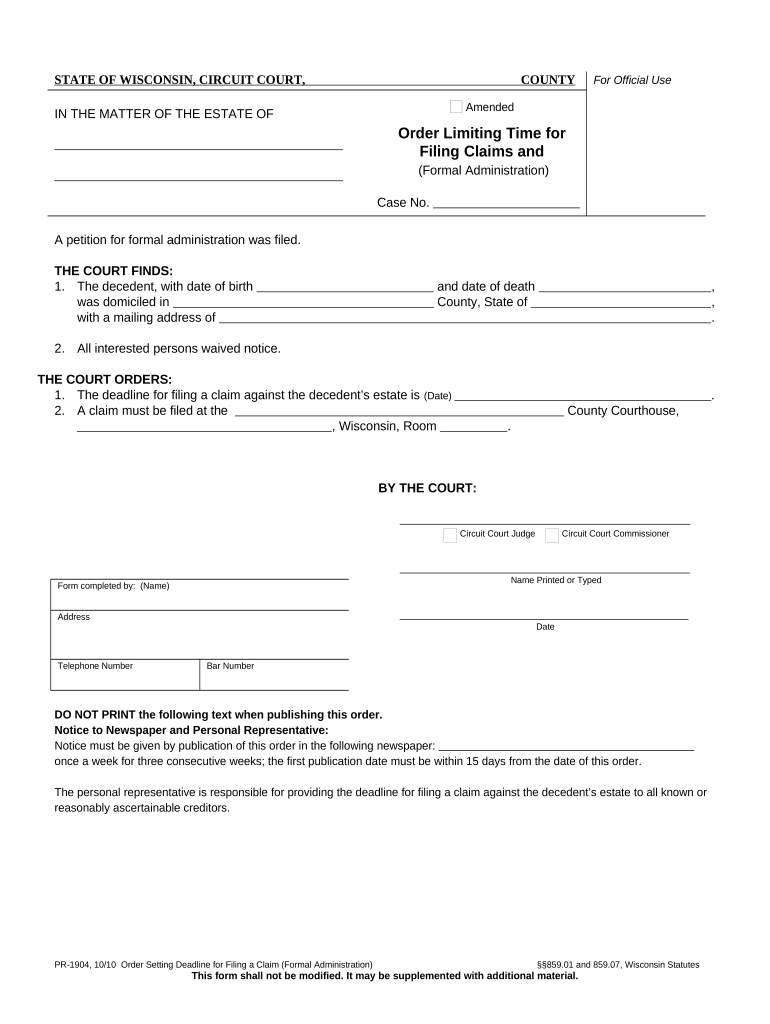
What the Wisconsin Order Limiting Time for Filing Claims Is
Why a Time-Limiting Order Matters in Estate Administration
A formal bar-date order clarifies claimant deadlines, protects estate assets by barring untimely claims, and helps fiduciaries and the court close estates efficiently while preserving due process for creditors.

Who Prepares, Receives, and Relies on This Order
This order is used by fiduciaries, counsel, and courts to manage creditor claims and finalize estate distributions.
- Personal representatives and executors — ensure claims are noticed and filed correctly.
- Creditors and claimants — follow the bar date to preserve recovery rights.
- Probate and estate attorneys — draft, serve, and object to claims on behalf of clients.
Step-by-Step: Preparing and Implementing the Order
-
01Identify case: Confirm court, case number, and fiduciary contact information.
-
02Propose bar date: Choose a deadline consistent with local practice and court guidance.
-
03Prepare notice: Draft service language, mailing list, and publication text as required.
-
04File and serve: File the order with clerk and serve all known creditors per the order.
Where to File and How to Serve the Order in Wisconsin
-
Circuit Court Clerk: File the signed order with the county circuit court clerk.
-
Mail to Creditors: Send certified or first-class mail to known creditor addresses.
-
Publication: Publish notice in an appropriate local newspaper if ordered.
-
Electronic Filing: Use the court's e-filing portal where available per local rules.
Configuring an Online Workflow for the Order
| Field | Configuration |
|---|---|
| Upload Template | Start from the court-approved form or template. |
| Populate Fields | Auto-detect names, dates, and case numbers with conditional fields. |
| Add Signers | Add fiduciary and judge or clerk per local practice. |
| Authentication | Choose signer verification: email, SMS, or KBA as required. |
Typical Timing Elements in a Claims-Bar Order
Order Issued:
Court enters the order and specifies the claims bar date.
Notice Mailing:
Mailing to known creditors usually occurs within days of entry.
Publication Period:
Publication runs as ordered, often weekly for a set number of issues.
Claim Filing Deadline:
Claims must be filed by the bar date with the court clerk.
Objection Period:
Parties have a limited period after filing to object to claims.
Key Milestones from Entry to Claim Resolution
Entry of Order
Court signs and files the order establishing the bar date.
Service and Publication
Clerk or fiduciary serves creditors and publishes notice, if required.
Claim Submission
Creditors present written claims to the court by the deadline.
Claim Adjudication
Court or administrator reviews, allows, or objects to claims.
Consequences and Risks of Improper or Late Claims
Common Preparation and Service Errors to Avoid
- Using an incorrect case caption or docket number causes misrouting and may result in claims being dismissed or not considered by the court.
- Failing to serve known creditors by the method ordered—mail or publication—can invalidate notice and lead to contested distributions.
- Entering an inaccurate bar date, wrong format, or typographical error can create confusion and risk rejecting timely claims.
- Relying on in-person only service where electronic filing is permitted may delay notice and increase administrative burden.
Technical and Compliance Requirements for Digital Workflows
Use platforms that support court-required formats, strong audit trails, and secure delivery; confirm local e-filing compatibility before e-submission.
- signNow: Supports PDF/DOCX, audit trail, HIPAA BAA
- Court eFiling: Must accept court-specified file types
- Integrations: Salesforce, NetSuite, Google Workspace supported
Typical eSignature Pricing and Capabilities for Court and Estate Workflows
| signNow | DocuSign | Adobe Sign | PandaDoc | HelloSign | |
|---|---|---|---|---|---|
| Starting Price | $8/user/mo | $15/user/mo | $14/user/mo | $19/user/mo | $15/user/mo |
| Free Trial | 7-day free trial | Varies by vendor | Varies by vendor | Varies by vendor | Varies by vendor |
| Bulk Send | Yes (Premium) | Yes | Yes | Yes | No |
| Audit Trail | Yes | Yes | Yes | Yes | Yes |
| HIPAA Compliant | Yes (BAA) | Yes (BAA) | Yes (BAA) | No | No |
Frequently Asked Questions About Timing, Service, and eSubmission
-
What if a claim is filed late?
Late claims are generally barred by the bar date set in the order; a claimant may petition the court for relief in narrow equitable circumstances, but relief is not guaranteed. Consult counsel promptly to assess potential motions to allow late claims.
-
Can I e-sign the order?
Electronic signatures are generally valid under the ESIGN Act (15 U.S.C. ch. 96) and UETA where adopted, but the court may have local rules about filing originals or scanned copies. Confirm the clerk's acceptance of electronically signed orders before e-submission.
-
Is notarization required for the order?
Notarization may be required for supporting affidavits or certain proofs of service. The order itself may not always require a notary; check local circuit court rules and the order language to determine notarization needs.
-
How must creditors be notified?
Known creditors are typically mailed notice at their last-known addresses; unknown creditors may be notified by publication if the court orders. Use certified or first-class mail as the order specifies and retain proof of mailing.
-
How do I amend a bar-date order?
File a motion to modify or clarify the order and serve all affected parties. Courts weigh due process considerations; obtain opposing-party notice and be prepared to explain reasons for the requested change.
-
How long should I keep the order and proofs?
Retain the order, service proofs, claims, and objections through administration and at least three years after closing. Follow IRS retention rules (IRC §6501(a)) and industry-specific periods such as HIPAA's six-year requirement (45 CFR §164.530(j)).