Establishing secure connection…Loading editor…Preparing document…

Motion for Order to Show Cause Regarding Contempt

This template is fully customizable. Edit the text, fill out the fields, and send it for signature. Give it a try!
Motion for Order to Show Cause Regarding Contempt

What the Motion for Order to Show Cause Regarding Contempt Is

A Motion for Order to Show Cause Regarding Contempt asks a court to require a person or entity to appear and explain why they should not be held in contempt for violating a prior court order. The motion typically identifies the prior order, the specific alleged breach, supporting evidence (affidavits, exhibits), and the relief requested, such as sanctions, attorney fees, or enforcement steps. Courts use an order to show cause to set an expedited hearing and to place the burden on the alleged contemnor to justify noncompliance.

Why Use This Motion and Its Legal Basis

The motion compels a hearing when a court order has been breached, enabling immediate remedial measures and sanctions. Contempt motions preserve court authority, seek compliance, and may recover costs; electronic filing and e-signatures are often accepted subject to ESIGN (15 U.S.C. ch. 96) and state rules such as UETA.

Why Use This Motion and Its Legal Basis

Who Typically Prepares and Files These Motions

Parties and counsel use this motion when a court order has been ignored or violated and immediate judicial intervention is needed.

  • Plaintiffs' or petitioners' counsel seeking enforcement or sanctions after noncompliance with court orders.
  • Defendants or respondents when asking the court to clarify allegations or contest improper contempt claims.
  • Court clerks and judicial staff who calendar show-cause hearings and manage associated filings.

Core Parts of a Professional Motion for Order to Show Cause

A well-crafted motion is concise, evidence-supported, and cites legal authority and the specific relief requested, plus a proposed order for the judge to sign.

Caption

Court name, case caption, docket number, and identification of moving and opposing parties formatted per local rules and caption style requirements.
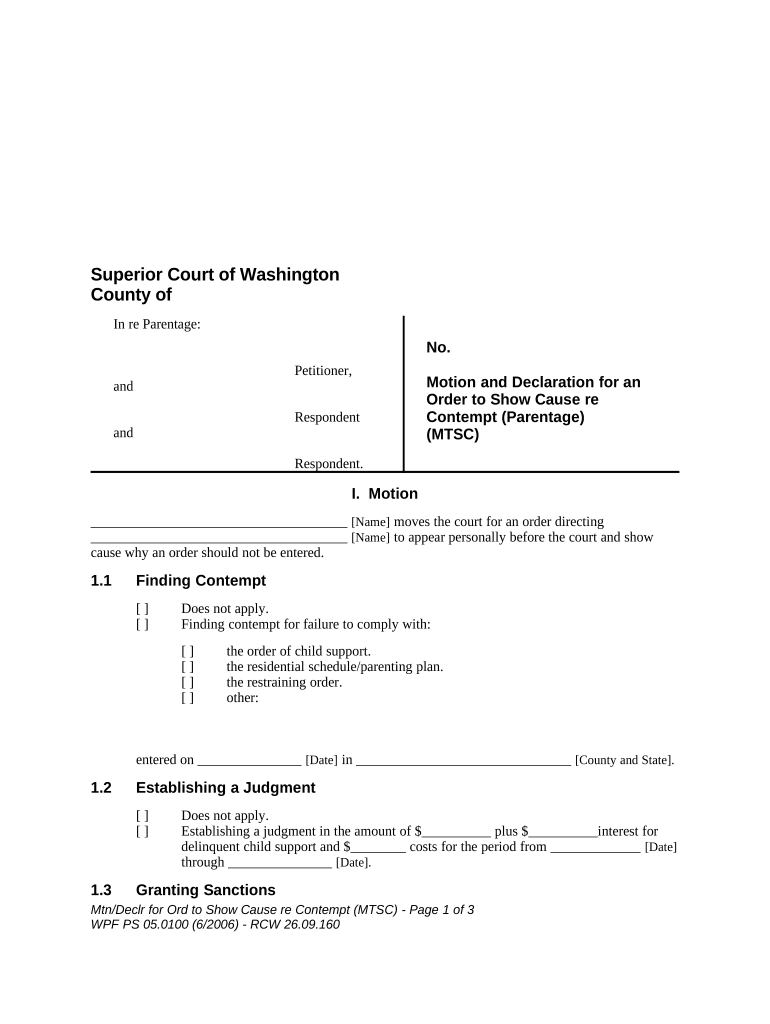
Statement of Facts

A chronological, testimony-based summary of events showing the prior order and facts demonstrating the alleged violation with dates and supporting exhibit references.

Argument

Legal standard for contempt, citations to statutes or case law, and application of the facts demonstrating willfulness, intent, or omission as required by jurisdiction.

Relief Sought

Clear request for remedies such as civil fines, attorney fees, coercive sanctions, injunctive enforcement, or specific performance tied to the alleged breach.

Affidavit / Exhibits

Sworn affidavit from the movant or witness plus documentary evidence (orders, emails, logs) labeled and paginated for easy judicial review.

Proposed Order

A ready-to-sign order specifying hearing date, required appearance, temporary relief (if any), and exact language for the contempt finding if granted.

Technical and Compliance Considerations

E-signature Law: ESIGN/UETA recognized
Audit Trail: Timestamp, IP, user email
Notarization / RON: Use per state rules
HIPAA Concerns: BAA required for PHI
Data Encryption: TLS 1.2/1.3; AES-256
Record Retention: Preserve originals and metadata

Possible Penalties and Risks if the Motion Is Incorrect

Monetary Sanctions: Fines or compensatory penalties
Attorney Fee Awards: Court may award counsel fees
Contempt Fine: Daily fines until compliance
Incarceration: Civil or criminal contempt jail terms
Case Dismissal: Procedural defects can lead to denial
Ethics Exposure: False affidavits risk sanctions

Common Preparation Mistakes to Avoid

  • Relying on hearsay without sworn affidavits and exhibits undermines credibility and may result in the motion being denied.
  • Failing to cite the exact prior order and relevant paragraphs makes it difficult for the court to find a breach.
  • Omitting proposed findings or a clear proposed order increases judicial workload and can delay relief.
  • Incorrect service or missing local filing requirements can invalidate the show-cause proceeding and waste time.

Step-by-Step: Drafting and Filing the Motion

Follow a clear sequence: prepare, attach evidence, file correctly, serve opposing party, and appear at the hearing.

  • 01
    Prepare Motion: Draft caption, facts, argument, and proposed order.
  • 02
    Attach Evidence: Include sworn affidavit and exhibits with exhibit index.
  • 03
    File with Court: Submit per local e-file rules or clerk requirements.
  • 04
    Serve Parties: Serve opposing counsel per rule and document proof.

How the Order to Show Cause Hearing Unfolds

The court typically issues an interim order setting a hearing date; parties present evidence and address compliance or defenses at the hearing.

  • Issuance: Court signs an OSC with hearing date.
  • Service: Opposing party must be served with the OSC.
  • Hearing: Judge hears testimony and reviews exhibits.
  • Ruling: Court may grant sanctions or dismiss claims.

Digital Workflow Settings for Preparing and Serving the Motion

Configure document format, signer authentication, and exhibit handling to meet court and local rules before filing or service.

Field Configuration
Document Format PDF/A preferred for court filings
Signer Authentication Use email plus SMS or ID proofing
Exhibit Handling Combine into single paginated PDF
Service Method eService if local rules allow

Platform Requirements for eFiling and eSigning

Courts and clerks vary in e-filing formats and whether they accept electronically signed affidavits or RON acknowledgements.

  • PDF Support: Must accept searchable PDF files
  • RON Compatibility: Audio-video recording and credentialing
  • Audit Evidence: Complete audit trail retained

Typical Timelines and Deadlines to Monitor

Timing varies by jurisdiction; plan for service lead time, court scheduling, and any expedited hearing windows when noncompliance is urgent.

Urgent Filings:

File immediately upon discovering a breach

Service Deadline:

Serve per local rules, often 7–14 days before hearing

Hearing Scheduling:

Courts may set hearings within 7–21 days

Response Time:

Opposing party may have limited time to respond

Appeal Period:

Standard appeal timelines apply post-judgment

Key Milestones from Breach to Enforcement

A concise milestone sequence helps track filing, service, hearing, and enforcement steps required to pursue contempt relief.

01

Alleged Violation

Document date and describe the specific order breach.

02

Motion Filing

Prepare motion, affidavit, exhibits, and proposed order.

03

Court Issues OSC

Judge signs an order setting show-cause hearing.

04

Hearing and Enforcement

Judge may impose sanctions or order compliance.

Practical Scenarios Where a Show Cause Motion Is Used

These brief examples illustrate common factual patterns that lead to a motion for an order to show cause regarding contempt.

Family Court Enforcement

Parent fails to comply with custody order

  • Movant files affidavit with proposed purge terms
  • Court sets expedited OSC hearing and orders prospective compliance and potential fines if noncompliant.

Discovery Noncompliance

Party refuses to produce ordered documents

  • Counsel files OSC with meet-and-confer history
  • Judge orders production at hearing and warns of contempt sanctions for continued refusal.

Frequently Asked Questions About Contempt Motions

Answers to common procedural and evidentiary questions to reduce filing errors and improve the chances of obtaining effective relief.


Need help? Contact support

eSignature Pricing Comparison for Preparing and Executing Contempt Motions

Select an eSignature provider that supports secure PDFs, audit trails, and, where applicable, RON or BAAs for sensitive exhibits; the table compares starting price and key features.

signNow DocuSign Adobe Sign PandaDoc HelloSign
Starting Price $8/user/mo $15/user/mo $14/user/mo $19/user/mo $15/user/mo
Free Trial 7-day free trial, no credit card Trial available Trial available Limited trial Limited trial
Bulk Send Yes Yes Yes Yes No
Audit Trail Yes Yes Yes Yes Yes
HIPAA Compliant Yes Yes Yes No No
be ready to get more
Join over 28 million airSlate SignNow users