Court identification
Full court name and seal; clerk signature or stamp showing official issuance and jurisdictional authority.
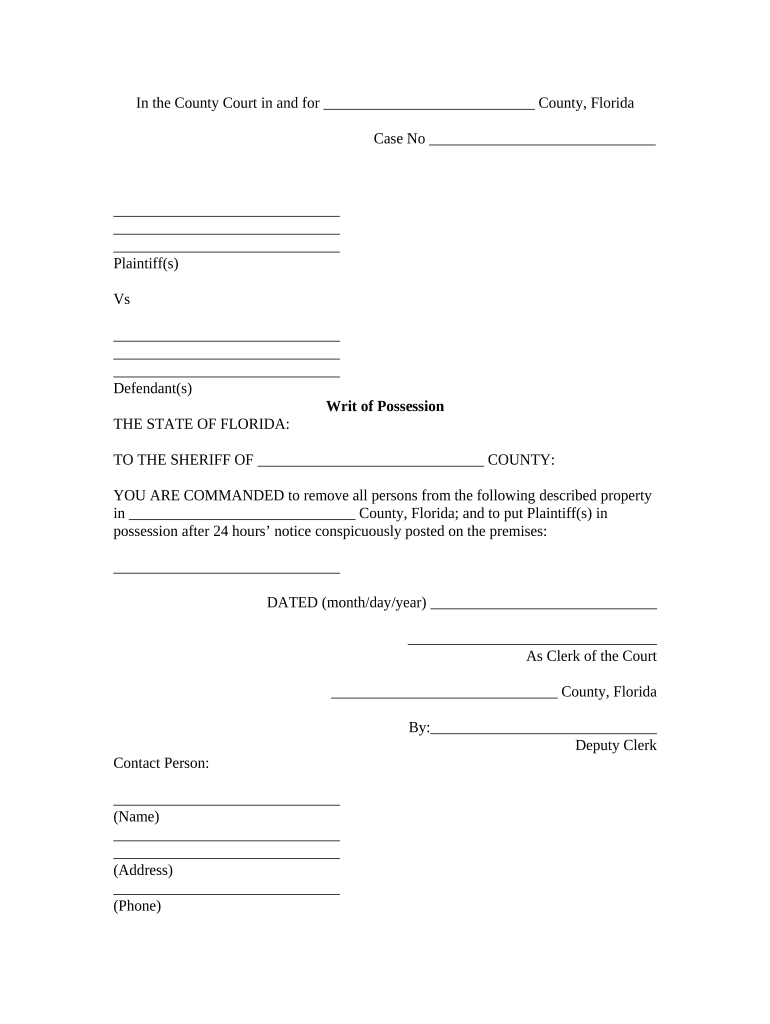
A Writ of Possession provides an enforceable, court-authorized mechanism to regain physical control of property after judgment, reducing risk of self-help eviction and ensuring removal is performed by law enforcement under court supervision.

Each participant has distinct responsibilities: the filer ensures correct paperwork and service, the court issues the writ according to local rules, and law enforcement enforces the writ per statutory requirements.
The filer is typically the judgment creditor or their attorney who prepares and files the writ with the court clerk, certifies the underlying judgment, and arranges for service and sheriff execution. Accurate party names and case numbers are essential to avoid denial or execution delays.
The sheriff or authorized law enforcement officer signs the execution return and carries out physical possession. Their role is governed by state statutes and local sheriff office procedures, and they may set execution dates or post notices at the property.
| Field | Configuration |
|---|---|
| Authentication | Email plus SMS code or ID verification |
| Routing order | Clerk → Sheriff → Plaintiff/Attorney |
| Attachments | Attach certified judgment and proof of service |
| Retention policy | Export PDF/A and store per retention rules |
Courts and sheriff offices vary on permitted electronic formats, notarization, and e-filing portals; confirm local rules before e-submitting.
Full court name and seal; clerk signature or stamp showing official issuance and jurisdictional authority.
Exact case number and docket entry referencing the final judgment that authorizes the writ.
Full legal names for plaintiff and defendant matching the judgment to avoid ambiguity at execution.
Complete physical address, unit numbers, and any legal description required by local enforcement offices.
Clear instructions for sheriff, including occupancy exceptions, storage directions for removed items, and timing constraints.
A return form or area for the sheriff to document execution, date, method, and any noncompliance observed.
File for a writ once judgment is final and appeal period expires
Sheriff assigns execution date per local backlog and office procedures
Some jurisdictions require additional notice or cure windows before execution
Appeal timelines affect enforceability; verify local appellate rules
Keep executed writ and return for statutory retention period
Court issues final judgment for possession and may set appeal period
Filer completes writ and files with the court clerk for issuance
Clerk signs and issues the writ with the court seal
Law enforcement arranges execution, posts notice, and restores possession if necessary
| signNow | DocuSign | Adobe Sign | PandaDoc | HelloSign | |
|---|---|---|---|---|---|
| Starting Price | $8/user/mo | $15/user/mo | $14/user/mo | $19/user/mo | $15/user/mo |
| Free Trial | 7-day free trial | Varies by vendor | Varies by vendor | Varies by vendor | Varies by vendor |
| Bulk Send | Yes (Premium tier) | Yes | Yes | Yes | Yes |
| Audit Trail | Yes | Yes | Yes | Yes | Yes |
| Envelope Cap | No cap | 100 envelopes/user/year | Varies | Varies | Varies |
Tim's property management firm digitized eviction paperwork to avoid in-person signing delays.
Optica adopted electronic forms for property recovery documentation to streamline tenant notices.