Establishing secure connection…Loading editor…Preparing document…

Letter Requesting Filing of Final Judgment and Writ of Possession

This template is fully customizable. Edit the text, fill out the fields, and send it for signature. Give it a try!
Letter Requesting Filing of Final Judgment and Writ of Possession

What this letter is and when it’s used

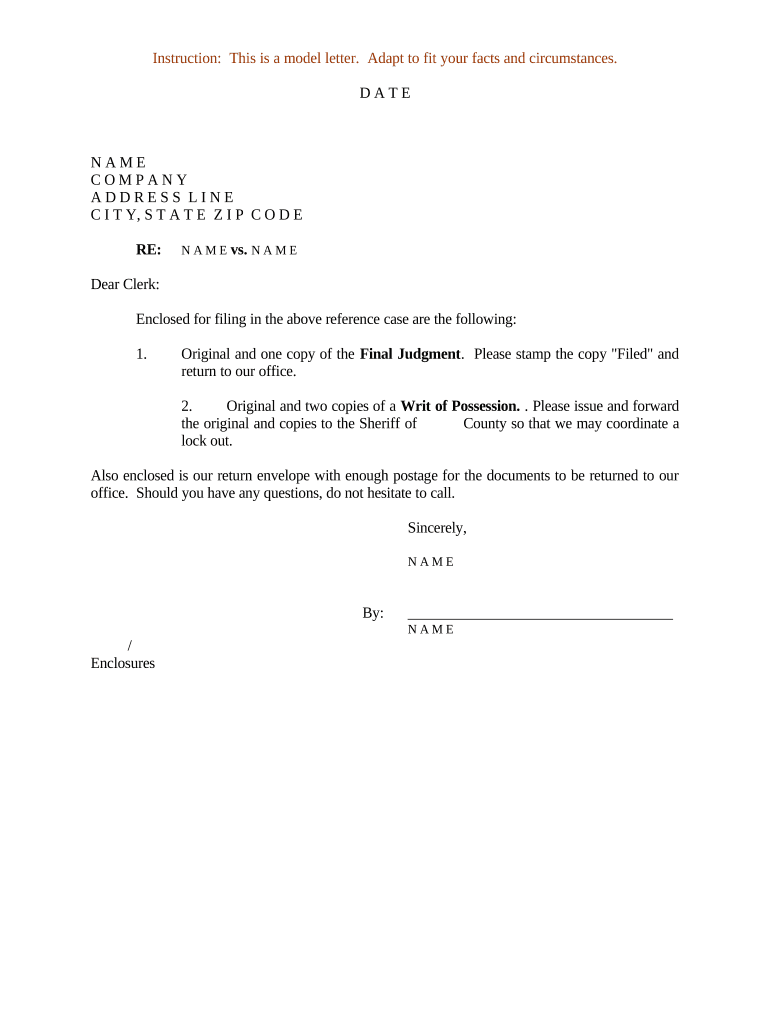
The Letter Requesting Filing of Final Judgment and Writ of Possession is a formal written request submitted to a court clerk after a judgment in an eviction or real property possession case. It asks the clerk to enter the final judgment into the record and to issue a writ of possession to enforce removal of occupants or regain control of the property. The letter typically cites the case number, judgment date, parties, and the relief awarded, and is used to start post-judgment enforcement steps with the sheriff or marshal.

Why you might prepare this letter

A clear request prompts formal filing and creates an enforceable record so the writ can issue without avoidable delay; it documents the filer’s authority and streamlines coordination with enforcement officers.

Why you might prepare this letter

Who typically prepares and sends this letter

The filer should be the party of record or their authorized counsel; filing rules vary by jurisdiction and court.

  • Plaintiff’s attorney preparing post-judgment enforcement paperwork and coordinating with court clerks.
  • Property managers or landlords seeking clerk action after a judgment to obtain a writ of possession.
  • Mortgage servicers or lienholders requesting clerk filing to clear title or pursue repossession where authorized.

Essential parts to include for a professional filing request

Include discrete, clearly labeled elements so the clerk can process the request without follow-up; organize exhibits and citations to the judgment for quick verification.

Court Caption

Full court caption naming the court, county, case caption, and parties exactly as on the judgment to avoid misfiling or clerical confusion during docket entry.
Case Number

Provide the precise case number and any docket entry identifiers so the clerk can locate the judgment record and verify that the requested final judgment corresponds to the case file.

Judgment Reference

Cite the judgment date, judge or magistrate, and the docket entry or judgment number so the clerk can confirm finality and that entry conditions for a writ have been satisfied.

Relief Requested

State specifically that you request filing of the final judgment and issuance of a writ of possession, including any limits on enforcement, occupant names, or exemptions known to the filer.

Attachments

Attach a certified or conformed copy of the judgment, any proof of service, and required filing fee information so the clerk has the underlying authority to issue a writ.

Signature Block

Include the signatory’s printed name, role, firm or company, contact information, and a dated signature; indicate authority to act for the judgment creditor or party of record.

Key data elements to include

Full Names: Plaintiff and defendant names
Case Number: Exact numeric docket ID
Judgment Date: MM/DD/YYYY format
Property Address: Street, city, state, ZIP
Relief Sought: Writ of possession request
Contact Info: Phone, email, mailing address

Consequences of incorrect or incomplete letters

Filing Rejection: Clerk may refuse entry
Enforcement Delay: Writ issue postponed
Increased Costs: Additional fees or hearings
Procedural Forfeiture: Statute-based time bars
Liability Exposure: Incorrect venue or party naming
Perjury Risk: False statements penalties

Common preparation pitfalls to avoid

  • Using an incorrect case caption or missing the official case number leads to clerks misplacing the request and delays in issuing the writ.
  • Failing to attach a certified copy of the final judgment or proof of service often triggers a deficiency notice and requires resubmission.
  • Omitting the full property description or including inaccurate tenant names can delay sheriff coordination for physical possession enforcement.
  • Relying on unsigned or improperly dated signature blocks risks rejection or a requirement to re-execute documents under oath.

Step-by-step: preparing and filing the request

Follow these steps in order to reduce processing time and avoid clerical rejection.

  • 01
    Confirm Judgment: Verify judgment is final and unappealed
  • 02
    Draft Letter: Reference case and attach judgment copy
  • 03
    Calculate Fees: Include filing fee or include fee waiver request
  • 04
    Submit to Clerk: File in person, by mail, or per court e-filing rules

How the filing and enforcement flow typically works

This sequence shows the usual path from request to physical enforcement; timelines differ by county and state.

  • Clerk Review: Clerk verifies judgment and attachments
  • Writ Preparation: Clerk issues writ of possession document
  • Sheriff Scheduling: Law enforcement schedules execution
  • Enforcement: Writ executed and possession restored

Digital workflow settings for online completion

When preparing this letter online, set fields and authentication to match court requirements and evidence standards.

Field Configuration
Case Caption Auto-populate from case template
Judgment Attachment Require PDF upload, conformed copy
Signer Authentication Email plus phone or ID check
Retention Store signed copy as PDF/A

Digital submission and signing considerations

Ensure the chosen platform supports required formats, audit trails, and any notary or RON workflows before submission.

  • eSignature Type: Typed or PKI per court
  • Authentication: Email plus SMS or ID
  • File Formats: PDF/A and searchable PDF

Typical timing and processing expectations

Timing varies by court and enforcement agency; the following are common intervals to plan for.

Post-Judgment Filing:

File immediately after judgment finality to avoid delay

Clerk Processing:

Clerks often take 1–14 business days to review and enter filings

Sheriff Scheduling:

Sheriff scheduling can add 7–30 days depending on workload

Appeal Stays:

If an appeal or stay is filed, enforcement pauses until resolved

State Variations:

Some states have statutory minimum notice periods before execution

Key milestones from judgment to possession

A clear milestone list helps you track next steps and predict enforcement timing.

01

Judgment Finalized

Court enters the final judgment; no outstanding appeals active

02

Request Filed

Letter and attachments are submitted to the clerk for entry

03

Writ Issued

Clerk issues writ of possession after verification

04

Enforcement Date

Sheriff or marshal executes writ and restores possession

eSignature vendor pricing snapshot for filing and signing

Compare baseline costs and feature availability when choosing an eSignature provider to support letter preparation and authenticated signing.

signNow DocuSign Adobe Sign PandaDoc HelloSign
Starting Price $8/user/mo $15/user/mo $14/user/mo $19/user/mo $15/user/mo
Free Trial 7-day free trial Varies by vendor Varies by vendor Varies by vendor Varies by vendor
Bulk Send Yes Yes Yes Yes No
Audit Trail Yes Yes Yes Yes Yes
HIPAA Compliant Yes Yes Yes No No

Frequently asked questions and answers

Answers to common questions about preparing, signing, and filing the Letter Requesting Filing of Final Judgment and Writ of Possession.


Need help? Contact support

be ready to get more
Join over 28 million airSlate SignNow users