Fusiona Varios Documentos En Uno De Forma Fácil Y Eficiente

Selecciona varios documentos y combínalos en uno. Puedes fusionar documentos en un orden específico y renombrar el documento fusionado en un solo clic.

Solución de firma electrónica galardonada

What it means to merge several documents into one

Merging several documents into one is the process of combining multiple files—such as contracts, forms, attachments, or PDFs—into a single consolidated document for distribution, archiving, or signing. This reduces administrative overhead, prevents file version confusion, and produces a single audit-ready record. In eSignature workflows the merged file can be prepared for field placement and recipient routing before sending. Vendors such as signNow support multi-file combination and maintain metadata and audit trails so the resulting single document remains clear, auditable, and compatible with downstream systems.

Why merge documents before sending

Combining documents streamlines review, reduces signer confusion about multiple attachments, and simplifies record retention while preserving a single audit trail and integrity of the transaction.

Why merge documents before sending

Common challenges when combining multiple files

  • Inconsistent page sizes or orientations can disrupt layout and require manual correction before combining.
  • Different file formats may need conversion to PDF to ensure consistent appearance and field placement.
  • Large combined files can exceed upload limits on some platforms or slow down recipient downloads.
  • Maintaining page numbering and cross-references across merged documents often requires editing after the merge.

Typical user profiles for document merging

Office Manager

An office manager often prepares multi-page onboarding packets and vendor agreements. They combine completed forms, ID scans, and contract exhibits into one PDF, add signature fields, and route the single document for eSignature to reduce tracking and ensure all pages are included in the final record.

Sales Director

A sales director or operations lead consolidates proposals, quotes, and standard terms into one executable package. They use a merged document to maintain version control, present a single contract to customers, and capture signatures on all required sections in one process.

Who typically needs to merge documents

Teams that handle multi-part agreements, onboarding packets, or bundled attachments often merge files to simplify delivery and signing.

  • HR and onboarding teams preparing offer packages and policy forms as a single packet for new hires.
  • Sales operations combining proposals, price schedules, and terms into one executable document.
  • Legal and compliance groups consolidating exhibits, affidavits, and supporting evidence for signature and recordkeeping.

Consolidating files reduces administrative steps and improves the recipient experience while keeping a single, auditable document record for compliance purposes.

Additional features that improve merged-document workflows

Advanced tools extend core merging capabilities to automate tasks, ensure compliance, and integrate with other systems to streamline end-to-end processes.

Batch processing

Process multiple merge jobs automatically to reduce manual effort when many packets require consolidation and distribution across teams.

Template support

Save common document order and field layouts as templates to reuse consistent merged packages across similar transactions.

Conditional logic

Apply rules that include or exclude specific attachments when criteria are met, resulting in tailored merged documents per recipient.

Optical Character Recognition

OCR scanned documents before merging to enable searchable text and reliable field population from extracted data.

API access

Programmatically combine files within other systems to integrate merging into automated business workflows and CRMs.

Storage connectors

Save merged documents directly to cloud repositories like Google Drive or Dropbox for centralized archival and access.

prepárate para obtener más

Elige una mejor solución

Core features needed when you merge several documents into one

Select tools that combine files, preserve fidelity, support field placement, and maintain compliance attributes like signatures and audit trails.

Multi-file Import

Allows uploading of varied file types (PDF, DOCX, JPG) and staging them for a single consolidated export to preserve original content and formatting while enabling batch operations before the merge.

Order and Pagination

Controls for arranging document sequence, updating page numbers, and setting consistent orientation so the combined file reads logically and references remain accurate across merged sections.

Field Placement

Tools to add signature, initial, and data fields across the merged document so all required inputs are present in the single file prior to sending to recipients.

Audit Trail

Automatic logging of upload, merge, send, and sign events so the single merged document includes a verifiable history for compliance and dispute resolution.

How the merge and sign flow typically works

Merging is an early step in a digital signing workflow: files are combined, fields added, and the single file is routed for signature, verification, and storage.

  • Upload files: Upload multiple documents to the platform.
  • Combine files: Use the merge tool to create one PDF.
  • Prepare fields: Place signature and data fields as required.
  • Send for signature: Route the consolidated document to recipients.
Recoger firmas
24x
más rápido
Reduce los costos en
$30
por documento
Guardar hasta
40h
por empleado / mes

Basic steps to merge several documents into one

Follow a straightforward sequence to combine files, verify layout, and prepare the merged document for signature or distribution.

  • 01
    Collect files: Gather all source documents and attachments.
  • 02
    Convert formats: Save documents as PDF where needed.
  • 03
    Arrange order: Set the intended sequence of pages.
  • 04
    Merge and verify: Combine files and inspect pagination.

Detailed steps to merge and prepare a document for signature

Use this more detailed checklist to ensure each merge is accurate and ready for signing.

01

Prepare sources:

Gather and standardize all files.
02

Convert to PDF:

Convert non-PDF files for consistency.
03

Order content:

Arrange pages into final sequence.
04

Merge files:

Execute the combine operation.
05

Add fields:

Place signature and data fields.
06

Review and send:

Preview then route to recipients.
prepárate para obtener más

Por qué elegir airSlate SignNow

  • Prueba gratuita de 7 días. Elige el plan que necesitas y pruébalo sin riesgos.
  • Precios honestos para planes completos. airSlate SignNow ofrece planes de suscripción sin cargos adicionales ni tarifas ocultas al renovar.
  • Seguridad de nivel empresarial. airSlate SignNow te ayuda a cumplir con los estándares de seguridad globales.
illustrations signature

Common workflow settings for merged-document processes

Configure these settings to control how merging operates within signing workflows and to standardize output across your organization.

Workflow Configuration and Setting Name Default Configuration
Document Merge Order and Priority Manual or defined order
Template Selection for Merge Jobs Predefined template
Reminder Frequency 48 hours
Authentication Method Email or SMS
Storage Location Cloud repository

Platform and device considerations for merging

Verify that your platform and recipient devices support the file formats and merged-document size to avoid compatibility issues.

  • Desktop: Full feature support
  • Mobile: Limited editing tools
  • Browser support: Modern browsers required

Test merges on target devices and browsers prior to broad distribution; mobile recipients may rely on simplified viewers, so ensure signature fields are accessible and clearly placed for smaller screens.

Security controls relevant to merging and signing

Encryption at rest: AES-256 or equivalent
Encryption in transit: TLS 1.2+ for uploads
Access controls: Role-based permissions
Document integrity: Checksum and tamper seals
Authentication options: Email, SMS, or certificate
Audit logging: Full event trail

Industry use cases for merging documents

Real-world examples show how merging files reduces steps across common workflows and preserves compliant records.

Employee Onboarding Packet

A human resources team compiles offer letters, tax forms, and policy acknowledgments into one PDF to simplify processing and signing

  • Single-file format allows consistent field placement across forms
  • Reduces back-and-forth and speeds completion

Resulting in quicker onboarding and a complete audit trail maintained for compliance.

Sales Contract Bundle

A sales operations team combines master agreement, SOW, and pricing schedules into one consolidated contract for signature

  • Ensures consistent terms across exhibits
  • Improves buyer clarity and prevents missing attachments

Leading to faster deal closure and a single signed record for legal retention and audits.

Best practices for secure and accurate merging

Follow standardized steps to reduce errors, preserve compliance, and make the merged document easy to review and store.

Standardize file formats before merging
Convert source files to a single stable format, usually PDF, to avoid layout shifts. This preserves fonts, spacing, and embedded images so signature fields align correctly after the merge.
Confirm page order and numbering
Review and adjust the sequence and page numbers before finalizing the merge. Clear ordering prevents misplaced exhibits and ensures references within the document remain valid.
Use role-based access for editing
Restrict who can merge and edit source documents. Limiting editing privileges reduces accidental changes and preserves the integrity of documents prior to signing and archiving.
Retain a copy of original files
Keep unmerged source documents in secure storage for audit and recovery. Storing originals separately helps validate the merged document and supports compliance records.

FAQs About merging several documents into one

Answers to common questions about combining files, preserving integrity, and ensuring the merged document is compliant and ready for electronic signing.

Feature comparison for merging and signing

Compare core merge capabilities and compliance features across common eSignature providers in the U.S. market.

Feature and Compliance Criteria Overview signNow (Recommended) DocuSign Adobe Sign
Merge multiple files
Reorder pages
Preserve original fields Limited
API merge support
prepárate para obtener más

¡Obtenga firmas legalmente vinculantes ahora!

Retention and deadlines to consider after merging

Establish retention and review schedules that align with legal, regulatory, and business requirements for the merged document.

Immediate verification:

Validate merge and fields within 24 hours.

Short-term retention:

Keep active transaction copies for 1–3 years.

Regulatory retention period:

Follow sector-specific statutory retention windows.

Periodic audit review:

Schedule compliance audits annually.

Secure archival:

Move finalized records to long-term storage securely.

Risks and penalties related to improper merging

Noncompliance fines: Regulatory fines
Data breaches: Exposed PII
Invalid signatures: Signature disputes
Contract disputes: Enforceability issues
Recordkeeping failures: Audit penalties
Operational delays: Processing backlogs

Plan-level comparison for merged-document features

Overview of representative entry-level and mid-tier plan types where merging is available; consult vendor pricing pages for real-time rates and exact terms.

Entry and mid-tier plan examples signNow Business plan includes document merging and API capabilities DocuSign Standard plan supports multi-file uploads and advanced routing Adobe Sign Individual/Team plans include file merging and cloud storage integration Dropbox Sign Essentials offers basic file combination and templates PandaDoc Essentials enables document bundling and template reuse
Collaboration and templates Included Included Included Included Included
API access availability Available on business plans Available on business plans Available on business plans Limited Available on higher tiers
Storage and connectors Google Drive and Dropbox supported Multiple connectors Adobe Document Cloud Dropbox native Google Drive and CRM connectors
Bulk operations support Batch merging via API Batch via higher tiers Batch via enterprise Limited bulk Bulk via API
Compliance features ESIGN/UETA, audit logs ESIGN/UETA, advanced controls ESIGN/UETA, Adobe compliance ESIGN/UETA basics ESIGN/UETA, audit history

Cómo fusionar documentos con airSlate SignNow

Todo lo que necesitas hacer es seleccionar los archivos para fusionar y organizar su orden. Fusionar archivos puede facilitarte a ti y a tus firmantes procesar documentos y solicitudes de firma.

Selecciona archivos para fusionar

Haz clic en el botón Más junto al documento que deseas fusionar y luego selecciona Fusionar Documento Con del menú desplegable.
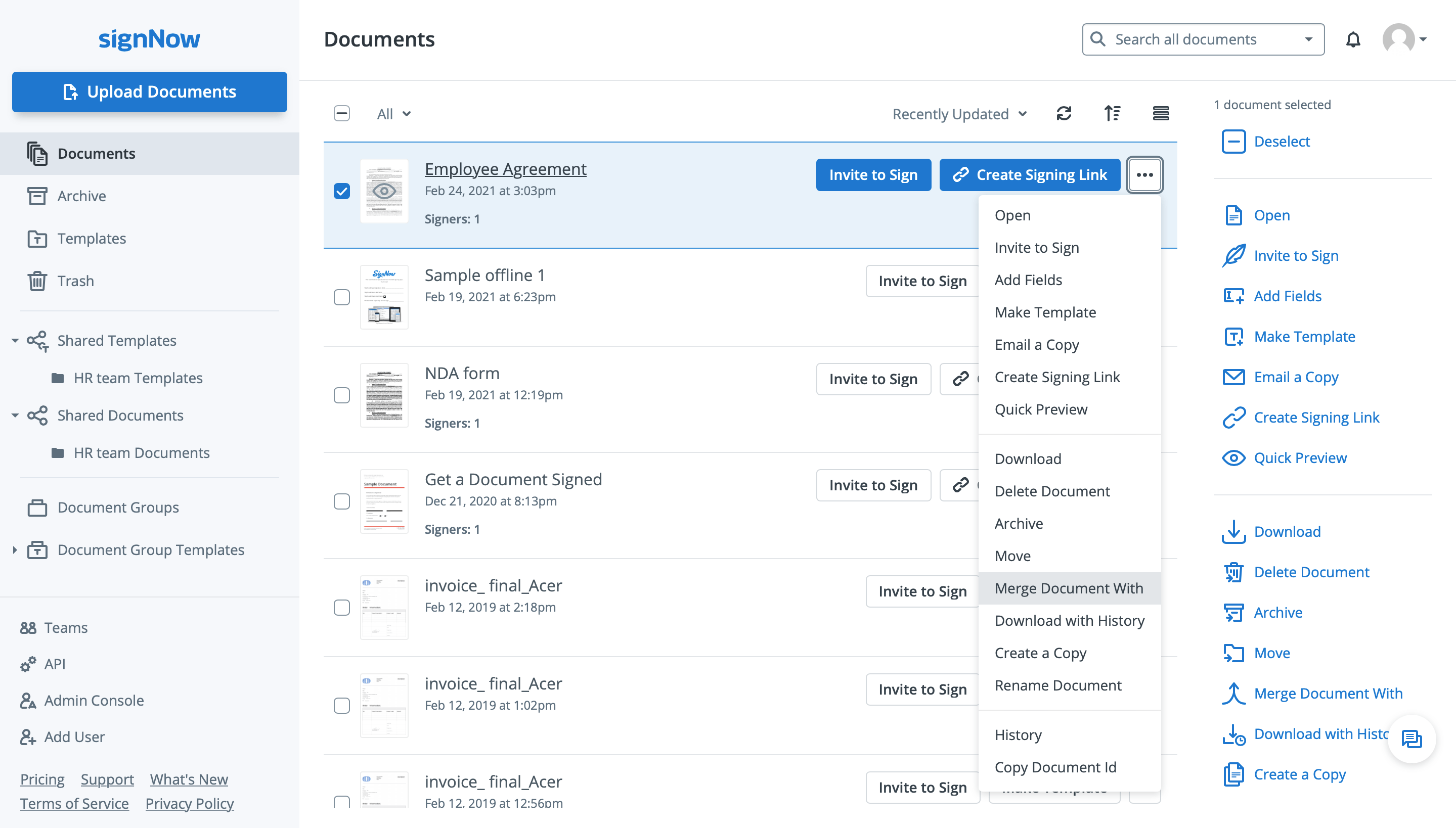
ilustración-guía-llenado

Elige los archivos que deseas fusionar de la lista y haz clic en Siguiente. Puedes cambiar entre carpetas para encontrar los documentos que necesitas. El menú de selección de carpetas aparece a la izquierda. También puedes ver todos tus archivos seleccionados cambiando a la pestaña Documentos seleccionados.
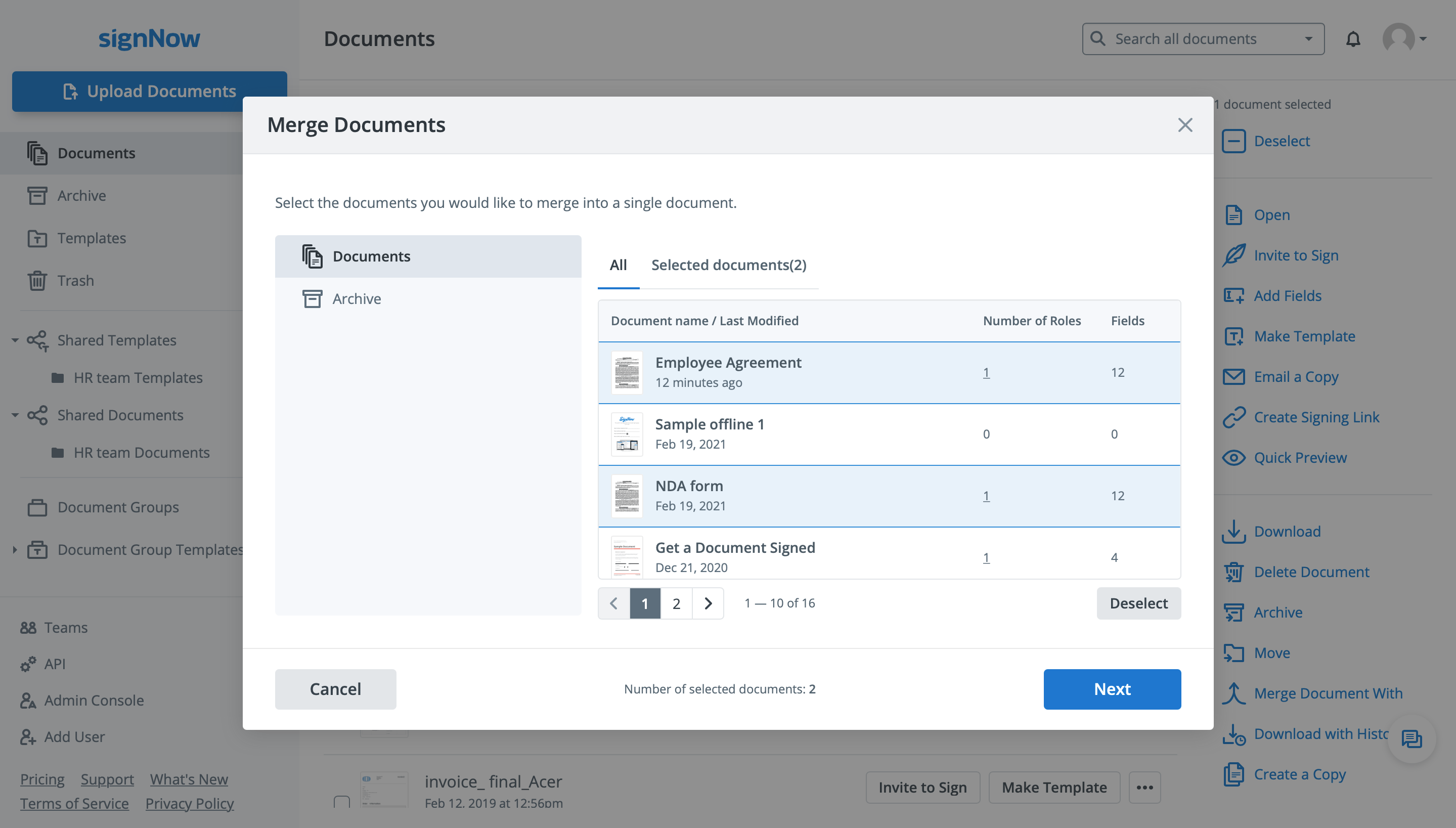
ilustración-guía-llenado

Organiza el orden de los documentos

Arrastra y suelta los documentos para establecer el orden en que aparecerán en el archivo fusionado. Luego, completa el campo Nombre del Nuevo Documento y haz clic en el botón Fusionar.
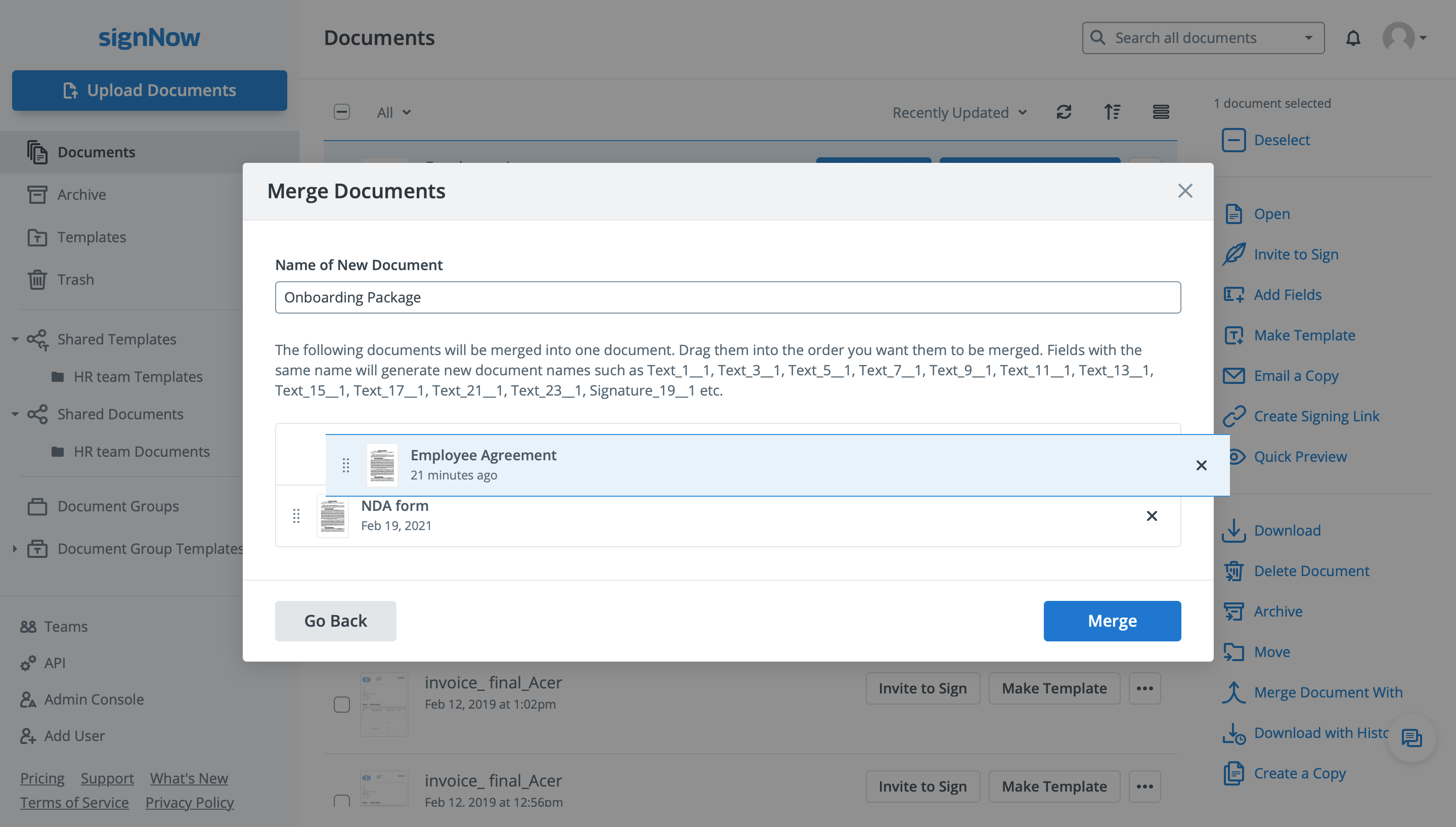
ilustración-guía-llenado

El PDF fusionado aparecerá en la parte superior de la lista de documentos. Los archivos que usaste para crear el documento no se verán afectados y permanecerán en sus directorios anteriores.


walmart logo
exonMobil logo
apple logo
comcast logo
facebook logo
FedEx logo
esté listo para obtener más

¡Obtenga ahora firmas vinculantes desde el punto de vista jurídico!








