Automate Contracts for Planning with SignNow

Experience seamless document sending and eSigning. Empower your business with a cost-effective and user-friendly solution.

Award-winning eSignature solution

What automating contracts for planning means

Automating contracts for planning refers to using a digital system to generate, route, manage, and execute planning-related agreements with minimal manual intervention. Typical components include reusable templates, conditional fields, automated signing sequences, identity verification, and integration with project management and document storage systems. Automation reduces repetitive tasks, standardizes language, and centralizes recordkeeping while preserving legal and audit requirements under U.S. frameworks. The approach supports version control and provides a single source of truth for planning teams, legal reviewers, and external stakeholders.

Why automate contracts in planning workflows

Automating contracts streamlines repetitive preparation and approval steps, reduces errors from manual handling, and accelerates signature turnaround while maintaining standardized terms and consistent compliance controls.

Why automate contracts in planning workflows

Common challenges that automation addresses

  • Inconsistent templates across teams leading to contract mistakes and negotiation delays.
  • Lengthy approval chains that create bottlenecks and extend project timelines significantly.
  • Manual data entry errors when copying details between planning documents and agreements.
  • Difficulty tracking execution status and version history across multiple stakeholders.

Typical users and their priorities

Project Manager

Project managers prioritize predictable timelines and clear approval routing. They use automation to remove repetitive form completion, track signature progress, and integrate executed contracts back into project schedules to reduce delays and administrative overhead.

Legal Counsel

Legal counsel focuses on clause consistency, retention policies, and audit trails. They configure templates, enforce required fields and authentication, and review automated logs to ensure every executed planning contract meets regulatory and organizational standards.

Who typically uses automated contract systems

Project managers, planners, and legal teams commonly rely on automation to maintain consistency and speed for planning agreements.

  • Municipal planning departments managing permits, developer agreements, and interagency contracts.
  • Architecture and engineering firms coordinating client contracts and subconsultant agreements.
  • Real estate and development teams handling purchase agreements, easements, and planning covenants.

Small municipal offices to large design firms benefit from centralized templates, role-based approvals, and audit-ready records for every planning contract.

Key tools to support planning contract automation

Successful automation relies on features that combine document control, workflow logic, identity verification, integration, and auditability to meet planning requirements.

Templates

Reusable, versioned templates reduce drafting time and ensure consistent clauses across planning contracts and permit-related agreements.


Workflow Automation

Define sequential or parallel approval paths with conditional branching to model review cycles for planning boards and legal sign-off.

Conditional Logic

Show or hide fields and sections based on project type, jurisdiction, or scope to keep contracts concise and accurate.

Bulk Send

Distribute identical agreements or notifications to multiple recipients while tracking individual signature status for batches.

Integrations

Connect to Google Docs, CRMs, and cloud storage to auto-populate fields and store executed agreements with project records.

Audit Trail

Maintain a tamper-evident log of events, IP addresses, timestamps, and authentication proof for each transaction.

be ready to get more

Choose a better solution

Integrations and template capabilities

Linking contract automation to other tools and using flexible templates speeds planning workflows and centralizes data.

Google Docs integration

Two-way sync lets teams author clauses collaboratively, then convert documents to template format with mapped fields for automated population during contract creation.

CRM connectivity

Sync contact and project metadata from CRM records to auto-fill party information, billing details, and contract terms to reduce manual entry errors.

Cloud storage

Save executed contracts directly to cloud repositories with folder rules and retention tags to keep project archives organized and discoverable.

Template library

Centralized, permissioned templates with versioning let legal maintain approved language while project teams can quickly generate tailored agreements.
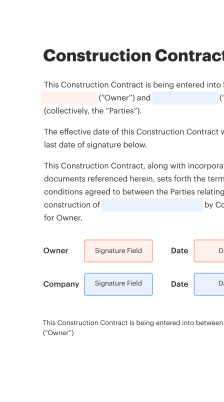
How automated contract execution flows

A typical execution flow moves a document from template to signed record, with automation applied at each stage.

  • Template generation: Populate contract with project-specific data automatically.
  • Pre-sign checks: Validate required fields and attachments before sending.
  • Signing sequence: Route documents in order with authentication steps.
  • Post-sign processing: Archive executed contracts and update related systems.
Collect signatures
24x
faster
Reduce costs by
$30
per document
Save up to
40h
per employee / month

Quick setup steps to automate a planning contract

Follow these core steps to configure templates, approvals, and signing so contracts align with planning processes.

  • 01
    Create template: Prepare a standard contract with placeholders for project data.
  • 02
    Add fields: Insert signature, date, and conditional fields for required information.
  • 03
    Define workflow: Set signing order and approval gates for reviewers.
  • 04
    Test and deploy: Run sample transactions and confirm audit logs before live use.

Audit trail checklist for each automated transaction

Verify these items for a complete, court-admissible record of every planning contract execution.

01

Event timestamps:

Record creation, send, view, and sign events with timezones.
02

Signer authentication:

Capture the method used and any verification artifacts.
03

IP address capture:

Log originating IP for each event.
04

Document hash:

Store cryptographic digest to demonstrate integrity.
05

Change history:

Preserve versioning and field edits during preparation.
06

Exportable logs:

Provide downloadable audit reports for compliance reviews.
be ready to get more

Why choose airSlate SignNow

  • Free 7-day trial. Choose the plan you need and try it risk-free.
  • Honest pricing for full-featured plans. airSlate SignNow offers subscription plans with no overages or hidden fees at renewal.
  • Enterprise-grade security. airSlate SignNow helps you comply with global security standards.
illustrations signature

Recommended workflow configuration for planning contracts

Configure these core workflow settings to support consistent approvals, reminders, and retention for planning-related agreements.

Default Workflow Configuration Setting Name Configuration
Reminder Frequency for Pending Signatures 48 hours
Signing Order and Routing Method Sequential
Recipient Authentication and Verification Method SMS code
Template Library Access and Permissions Team-based
Document Retention and Archival Period 7 years

Supported platforms and device considerations

Automated signing and workflows are accessible via modern desktop browsers and native mobile apps to support field staff and office teams.

  • Desktop browsers: Chrome, Edge, Safari
  • Mobile apps: iOS and Android
  • Offline access: Limited support

Ensure devices run supported OS versions and that users enable secure authentication methods; consider mobile data controls and offline document handling for inspectors working in the field.

Core security controls to expect

Encryption in transit: TLS 1.2+
Encryption at rest: AES-256
Access controls: Role-based
Authentication options: Password, MFA
Document integrity: Hashing
Audit logging: Detailed events

Use cases from planning organizations

Illustrative examples show how automation reduces cycle time and improves recordkeeping across planning activities.

Municipal Planning Department

The department consolidated permit agreements into templates to standardize terms and reduce drafting time.

  • They applied conditional fields to capture location-specific requirements.
  • This reduced manual reviews and data entry for inspectors and clerks.

Resulting in faster permit issuance and clearer audit trails for every project.

Architectural Firm

A mid-size architecture firm automated client engagement letters and subconsultant contracts to enforce scope and fee schedules.

  • Integrations pulled project metadata from the practice management system.
  • Automatic routing ensured legal review before signing.

Leading to fewer contract revisions and consistent contract records tied to project folders.

Best practices for secure and accurate contract automation

Adopt procedures that protect data, preserve enforceability, and make contracts easy to audit across planning operations.

Standardize approved templates and clauses
Maintain a single source of truth for contract language with version control and legal sign-off to reduce inconsistent terms and simplify reviews across projects.
Enforce multi-step approvals for high-risk agreements
Require additional approvers, conditional routing, or higher authentication for contracts that affect land use, financial commitments, or regulatory obligations.
Enable robust audit logging and export
Capture full event histories, cryptographic hashes, and signer verification artifacts so executed contracts withstand legal and compliance scrutiny.
Train staff on workflow and privacy policies
Provide role-based training so users understand template usage, authentication choices, data handling, and retention requirements for planning records.

FAQs About automate contracts for planning

Common questions cover legal validity, authentication, integration issues, and troubleshooting steps for automated planning contracts.

Digital signing: signNow compared to a major alternative

A concise comparison of core availability and compliance features commonly required for planning contracts.

Comparison Criteria and Vendor Columns signNow (Recommended) DocuSign
Legally binding in U.S.
HIPAA-capable deployment
Bulk Send capability
API and developer tools
be ready to get more

Get legally-binding signatures now!

Document retention and review timeline recommendations

Establish retention and review dates aligned with legal obligations, audit needs, and organizational policies for planning contracts.

Retention review frequency:

Annually

Minimum archival period:

7 years

Privacy impact assessment interval:

Every 2 years

Template legal review cadence:

Annually

Backup verification checks:

Monthly

Compliance risks and potential penalties

Invalid consent: Signature disputes
Data breach: Regulatory fines
Retention failure: Legal exposure
Unauthorized access: Contract alteration
Missing audit trail: Admissibility issues
Noncompliant storage: Privacy penalties

Representative pricing and plan characteristics

High-level pricing and support comparisons help planning teams evaluate operational costs and capabilities for recurring contract needs.

Plan / Vendor Pricing signNow (Recommended) DocuSign Adobe Sign HelloSign PandaDoc
Starting Price per User $8 monthly $10 monthly $14 monthly $13 monthly $19 monthly
Free Trial availability Yes Yes Yes Yes Yes
Phone support included Depends on plan Enterprise only Enterprise only No Enterprise only
Advanced API availability Available Available Available Available Available
Typical enterprise discounts Volume discounts Negotiated Negotiated Limited Negotiated
walmart logo
exonMobil logo
apple logo
comcast logo
facebook logo
FedEx logo
be ready to get more

Get legally-binding signatures now!