Best RFP Software for IT: Secure eSignature Solutions

Empower your business with airSlate SignNow's user-friendly and cost-effective solution for easy document sending and eSigning.

Award-winning eSignature solution

What the best RFP software for IT actually does

The best rfp software for it centralizes request-for-proposal creation, distribution, response tracking, and evaluation to streamline procurement for IT teams. It combines structured document templates, collaboration tools, and standardized scoring to reduce manual work and reduce errors when comparing vendor responses. These platforms often include access controls, audit trails, and integration points with CRM, procurement, and document storage systems so technical stakeholders can validate requirements, manage timelines, and maintain compliance with corporate policies and U.S. legal standards.

Why IT teams choose specialized RFP tools

RFP software standardizes vendor evaluation, shortens procurement cycles, and reduces manual reconciliation across spreadsheets and email threads, improving accuracy and vendor comparability.

Why IT teams choose specialized RFP tools

Common procurement challenges the software addresses

  • Fragmented responses across email and spreadsheets make side-by-side comparison slow and error-prone.
  • Version control issues lead to conflicting requirement documents and inconsistencies during vendor evaluation.
  • Manual scoring and scoring sheets increase bias and consume significant stakeholder time in IT procurement.
  • Tracking compliance documentation and proof of capability is difficult without centralized storage and audit logs.

Representative user roles and responsibilities

Procurement Manager

A Procurement Manager coordinates RFP timelines, consolidates vendor proposals, negotiates commercial terms, and ensures procurement policies are followed. They rely on scoring frameworks and centralized document storage to compare offers and produce decision-ready recommendation packages for leadership.

IT Security Lead

An IT Security Lead defines security requirements, reviews vendor attestations and controls, and confirms data handling meets regulatory obligations such as HIPAA or FERPA where applicable. They use audit trails and document attachments to validate vendor claims and preserve evidence for compliance checks.

Typical IT stakeholders involved in RFP processes

IT procurement, security reviewers, and application owners commonly collaborate on RFPs, each bringing distinct evaluation criteria and compliance concerns.

  • Procurement teams that manage vendor contracts and commercial terms across the organization.
  • Security and compliance reviewers who verify controls, certifications, and data handling procedures.
  • Technical leads and architects who assess interoperability, performance, and integration requirements.

A clear separation of roles and a shared platform reduces handoffs, speeds approvals, and documents decisions for audits.

Additional capabilities that matter for IT-focused RFPs

Beyond core features, several advanced capabilities improve efficiency and satisfy enterprise requirements for security, reporting, and automation.

Document Versioning

Track edits by user and timestamp to maintain a clear history of changes and ensure reviewers work from the latest RFP version during procurement cycles.


Attachment Handling

Allow vendors to upload technical artifacts, certifications, and diagrams and associate them directly with questionnaire items for easier verification.

Role-Based Workflows

Define approval chains, reviewer responsibilities, and conditional steps so RFPs move through legal, security, and IT review stages predictably.

Compliance Tracking

Flag mandatory regulatory criteria, collect attestation documents, and store evidence to support audits and meet obligations such as HIPAA or sector-specific rules.

Reporting & Export

Generate standardized comparison reports, export scoring data, and produce an audit package for procurement records and leadership review.

API & Webhooks

Automate status updates, push completed responses to downstream systems, and trigger notifications when vendor submissions require action.

be ready to get more

Choose a better solution

Four core features to evaluate in RFP tools

Focus on capabilities that reduce manual effort, enforce controls, and support reproducible decision-making across IT procurement cycles.

Template Library

A robust template library lets teams store standardized RFP questionnaires, legal clauses, and scoring rubrics so documents are consistent, compliant, and quick to assemble for recurring procurement needs.

Scoring Engine

Weighted scoring with customizable criteria ensures vendor responses are evaluated objectively, enabling side-by-side comparison, aggregated scores, and audit-ready decision records for stakeholders.

Secure Distribution

Secure distribution controls provide time-limited vendor access, document passwording or single-use links, and granular permissions to protect sensitive scope and architectural requirements.

Integration Connectors

Native or API-based connectors with CRM, contract management, and cloud storage systems reduce duplicate data entry and keep procurement records synchronized with enterprise systems.
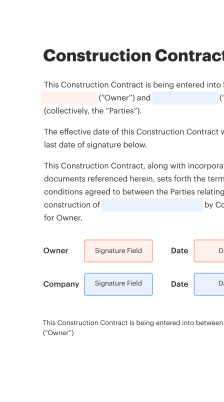
How RFP software coordinates contributors and vendors

The platform guides documents through defined stages while capturing actions and artifacts for each contributor and vendor.

  • Template creation: Centralize reusable RFP templates and clauses.
  • Collaborative drafting: Internal reviewers comment and approve content.
  • Vendor distribution: Send secure submission links with attachments.
  • Evaluation: Automated scoring and side-by-side comparisons.
Collect signatures
24x
faster
Reduce costs by
$30
per document
Save up to
40h
per employee / month

Quick steps to run an IT RFP using specialized software

Follow a repeatable sequence to reduce cycle time and keep stakeholders aligned when issuing IT RFPs.

  • 01
    Define scope: Document technical and commercial requirements.
  • 02
    Build questionnaire: Use templates and custom fields for clarity.
  • 03
    Invite vendors: Distribute secure links with deadlines.
  • 04
    Score responses: Apply weighted scoring and capture comments.
be ready to get more

Why choose airSlate SignNow

  • Free 7-day trial. Choose the plan you need and try it risk-free.
  • Honest pricing for full-featured plans. airSlate SignNow offers subscription plans with no overages or hidden fees at renewal.
  • Enterprise-grade security. airSlate SignNow helps you comply with global security standards.
illustrations signature

Recommended workflow settings for IT RFP processes

Standardize workflow defaults to keep RFP timelines consistent and ensure reviewers receive required notices at the right time.

Setting Name Configuration
Approval Workflow Two-step review
Reminder Frequency 48 hours
Response Deadline Buffer 7 days
Access Expiration 30 days
Attachment Size Limit 250 MB

Platform requirements and supported devices

Verify platform compatibility with desktop browsers, tablets, and mobile devices to ensure reviewers and vendors can access RFPs from their preferred devices.

  • Desktop: Chrome, Edge, Safari
  • Tablet: iPadOS and Android
  • Mobile: iOS and Android apps

Ensure browser and OS versions meet published minimums, enable secure browser settings, and confirm mobile app policies for device management to maintain consistent performance and data protection.

Security and authentication features to expect

Access controls: Role-based permissions
Data encryption: AES-256 at rest
Transport security: TLS for data in transit
Multi-factor auth: TOTP and SMS options
User provisioning: SCIM support
Audit logging: Tamper-evident records

IT RFP use cases in practice

Real-world IT RFP scenarios highlight efficiency gains from templates, scoring, and compliance tracking.

Cloud Migration RFP

The IT team needed standardized responses from cloud providers to evaluate SLA and security posture, including migration support and data residency requirements

  • Template-driven questions reduced vendor omissions and clarified responsibilities
  • Centralized scoring produced comparable performance metrics and cost estimates

Resulting in a faster vendor short-listing process and documented compliance evidence for audits

SaaS Procurement RFP

An enterprise sought to replace legacy software with a SaaS solution and required integrations, API capabilities, and uptime guarantees

  • Prebuilt technical questionnaires ensured consistent input on APIs and data export
  • Security attachments captured SOC reports and encryption details

Leading to a defensible selection that met both IT and compliance criteria while shortening procurement time

Best practices for secure and effective IT RFPs

Adopt consistent practices that reduce risk, accelerate review, and create audit-ready procurement records across IT RFP cycles.

Use standardized templates and scoring rubrics
Create and maintain canonical templates for common RFP types and pair them with weighted scoring rubrics that reflect technical priorities, security controls, and commercial considerations to produce consistent vendor comparisons.
Require evidence and attestation documents
Mandate vendor uploads of certifications, SOC reports, and data processing addenda to validate security claims and ensure documentation is readily available for compliance and procurement reviews.
Lock down access and track actions
Apply role-based access, time-limited links, and thorough audit logging so only authorized reviewers see sensitive RFP content and every action is recorded for later verification.
Integrate with enterprise systems
Connect RFP outcomes to contract management, procurement systems, and CRMs to keep vendor records synchronized, reduce manual entry, and maintain a single source of truth.

Common questions and troubleshooting for RFP workflows

Answers to frequent questions help IT and procurement teams resolve common issues quickly during RFP creation and evaluation.

Feature availability across leading eSignature and RFP-adjacent vendors

Compare core availability and compliance features that commonly matter to IT teams when RFP platforms include or integrate with eSignature providers.

Comparison Criteria and Vendor Columns signNow (Recommended) DocuSign Adobe Sign
Legal validity under U.S. law (ESIGN/UETA)
Bulk Send / Bulk Send capacity
REST API and developer SDK support REST API REST API REST API
HIPAA-compliant configuration available Optional Add-on Optional
be ready to get more

Get legally-binding signatures now!

Compliance risks and contractual penalties to monitor

Data breach liability: Regulatory fines
Noncompliance costs: Contract termination
Privacy violations: Civil penalties
Service interruptions: Business loss
Misstated certifications: Reputational harm
Unapproved subcontracting: Legal disputes

Pricing snapshot for eSignature vendors commonly paired with RFP workflows

High-level pricing and plan details vary by vendor; this snapshot helps IT teams anticipate licensing and enterprise feature availability when integrating eSignature into procurement workflows.

Plan Details and Vendors signNow (Recommended) DocuSign Adobe Sign PandaDoc Dropbox Sign
Starting price (per user, monthly) $8/user/month $10/user/month $12.99/user/month $19/user/month $15/user/month
Free trial or free tier availability Free trial available Free trial available Free trial available Free trial available Free tier available
Enterprise admin features included SAML, SSO, advanced roles SSO, advanced roles SSO, user management Role-based access SAML, SSO options
Contract/template management Template library and reusable fields Template tools included Template management included Contract templates included Template support available
HIPAA-ready option Available upon request Available via enterprise Available on select plans Enterprise option Available on enterprise plans
walmart logo
exonMobil logo
apple logo
comcast logo
facebook logo
FedEx logo
be ready to get more

Get legally-binding signatures now!