Bill Book Design Template for NPOs

Bill book design template for NPOs offers a structured approach to managing financial records. SignNow ensures secure and compliant eSignature solutions tailored for your needs.

Award-winning eSignature solution

Defining a bill book design template for npos and its practical purpose

A bill book design template for npos is a standardized invoice and receipt layout tailored to nonprofit operational needs, combining donor or client data fields, accounting line items, and compliance metadata. It streamlines recurring billing, tracks restricted funds, and includes sections for program codes, grant references, and acknowledgment language. The template reduces data-entry errors, ensures consistent financial records across teams, and supports auditing by keeping structured fields for dates, amounts, payment methods, and authorization signatures in one reusable document format.

Why standardized bill book design templates matter for nonprofits

Standard templates reduce administrative time, ensure consistent donor and payment records, and help maintain compliance with fund restrictions and audit trails while supporting clear reporting across programs and grants.

Why standardized bill book design templates matter for nonprofits

Representative user profiles for bill book design templates

Finance Manager

Oversees accounts receivable and grant reporting, configures template fields to capture fund codes and audit notes, and validates that invoices meet organizational accounting and audit requirements before finalization.

Program Coordinator

Uses templates to issue client receipts and program invoices, ensuring data fields align with eligibility criteria, service dates, and subsidy details while coordinating with finance for reconciliations.

Typical users of a bill book design template for npos

Teams across finance, development, and program operations commonly rely on standardized bill book templates to ensure consistent transaction records and streamlined billing.

  • Finance teams handling accounts receivable and grant accounting for nonprofits and social enterprises.
  • Development and donor relations staff issuing receipts and acknowledgment letters for donations.
  • Program coordinators tracking client fees, subsidies, and restricted fund disbursements.

Role-based use ensures templates match review workflows and retention policies while keeping approvals auditable and consistent.

Key features and tools to include in a bill book design template for npos

Design templates with features that support nonprofit workflows, auditability, and donor communications to improve accuracy and transparency across billing processes.

Custom Fields

Custom fields allow you to capture program codes, fund restrictions, and grant identifiers directly on invoices so each transaction maps to the correct budget line and donor designation.


Prebuilt Sections

Prebuilt sections for donor acknowledgments, tax language, and program descriptions ensure consistent messaging and meet common donor receipt requirements across different funding types.

Conditional Logic

Conditional fields display or hide sections based on payment type or fund restrictions, reducing clutter and ensuring only relevant information is presented to recipients.

Auto-Fill

Auto-fill pulls constituent and accounting data from integrations, reducing manual entry and minimizing errors during invoice creation and distribution.

Version Control

Versioning preserves historical templates and changes, helping teams track updates to pricing, terms, or funding language while supporting audit and compliance reviews.

Printable Formats

Templates export to print-ready PDFs for donors or partners who require paper documents while preserving layout and embedded metadata for digital records.

be ready to get more

Choose a better solution

Integrations that enhance a bill book design template for npos

Common integrations connect templates to document editors, CRMs, and cloud storage to reduce duplicate entry and keep records synchronized across systems.

Google Docs

Two-way integration lets you generate templates from Google Docs, merge donor and grant data, and preserve formatting while automating field population and version control workflows for consistent invoice presentation.

CRMs

CRM connectors sync constituent data, donation histories, and pledge records directly into template fields so invoices reflect accurate donor statuses and reduce manual reconciliation.

Dropbox

Cloud storage integration automatically archives finalized invoices and receipts to designated folders with metadata and retention tags for centralized recordkeeping and backup.

Accounting Systems

Linkages to accounting software export invoice line items and payment records to ledgers, improving reconciliation accuracy and reducing duplicate data entry between billing and accounting.
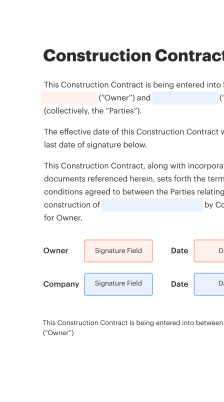
Online creation and use flow for bill book templates

This sequence explains how to create, populate, sign, and archive a bill book template using an online workflow.

  • Design: Compose layout and designate required fields.
  • Populate: Auto-fill donor and program data from records.
  • Authorize: Collect digital signatures or approvals as needed.
  • Archive: Store completed documents with metadata for retention.
Collect signatures
24x
faster
Reduce costs by
$30
per document
Save up to
40h
per employee / month

Quick setup: creating a bill book design template for npos

Follow these basic steps to set up a reusable bill book template that meets nonprofit accounting and compliance needs.

  • 01
    Create Template: Start a new document and define header fields.
  • 02
    Add Fields: Insert standardized donor, program, and accounting fields.
  • 03
    Set Validation: Apply field types and required validations for accuracy.
  • 04
    Publish: Save as a template and assign permissions to users.

Managing audit trails for bill book transactions

An audit-ready approach captures who did what and when across template creation, modification, and finalization.

01

Capture Signatures:

Record signer identity and timestamp.
02

Log Edits:

Track template and document changes.
03

Store Metadata:

Keep fund codes and program IDs.
04

Preserve Versions:

Retain historical template versions.
05

Export Reports:

Generate audit reports on demand.
06

Secure Backups:

Regularly back up audit logs offsite.
be ready to get more

Why choose airSlate SignNow

  • Free 7-day trial. Choose the plan you need and try it risk-free.
  • Honest pricing for full-featured plans. airSlate SignNow offers subscription plans with no overages or hidden fees at renewal.
  • Enterprise-grade security. airSlate SignNow helps you comply with global security standards.
illustrations signature

Recommended workflow settings for bill book templates

These example configuration settings support a typical nonprofit billing workflow, balancing automation with controls for accuracy and compliance.

Setting Name Configuration
Reminder Frequency First reminder after 7 days, then 14 days
Approval Requirement Two-tier approval for invoices over threshold
Auto-Archive Policy Archive completed invoices after 30 days
Field Validation Rules Require fund code and tax status fields
Audit Log Retention Maintain logs for seven years

Device and browser considerations for using templates

Ensure users access bill book templates from supported browsers and operating systems to maintain functionality and security.

  • Supported Browsers: Recent Chrome, Edge, Safari
  • Mobile Platforms: iOS and Android supported
  • Desktop Requirements: Modern OS with TLS support

Regularly update browsers and mobile apps, and confirm JavaScript and cookies are enabled for template editors and eSignature flows to operate reliably.

Core security controls relevant to bill book templates

Document Encryption: Data is encrypted at rest and in transit.
Access Controls: Role-based permissions limit edits and exports.
Authentication Options: Multi-factor authentication supported.
Audit Logging: Comprehensive logs record user actions.
Data Segmentation: Tenant separation for organizational data.
Retention Controls: Configurable retention and deletion rules.

How nonprofits apply bill book design templates in practice

Two concise examples show typical nonprofit workflows and measurable outcomes when using standardized bill book templates.

Case Study 1

A regional food bank standardized its billing template to include grant codes and donor acknowledgments for program fees

  • The template automated sectioned fields for donor IDs and grant tracking
  • That reduced manual reconciliation time and improved reporting accuracy

Resulting in faster month-end close and clearer grant audits.

Case Study 2

A community health clinic implemented a bill book design template for patient copays and sliding scale fees

  • The template captured eligibility and payer information in defined fields
  • Staff used the consistent layout to reduce billing disputes and follow-up time

Leading to improved cashflow visibility and fewer billing corrections.

Best practices for secure and accurate bill book templates

Follow these practical practices to keep templates consistent, legally sound, and easy to audit while minimizing staff time and errors.

Use standardized field naming and documentation
Define a clear field naming convention and maintain a template documentation file describing each field’s purpose, accepted values, and required validations to ensure consistent use across staff and to simplify training and audits.
Apply role-based approvals and edit restrictions
Limit template editing to authorized finance personnel and require approvals for changes to wording or accounting mappings to prevent unauthorized modifications that could affect reporting or compliance.
Include compliance-ready receipt language
Embed standard acknowledgment and tax language appropriate for donation receipts and fee invoices to satisfy donor expectations and regulatory recordkeeping requirements across jurisdictions.
Test templates with sample workflows regularly
Periodically run end-to-end tests using representative data to validate auto-fill values, conditional logic, signature capture, and downstream accounting exports, updating templates as needed.

FAQs About bill book design template for npos

Common questions and troubleshooting steps for template creation, signing, integrations, and compliance are answered here to assist administrators and users.

Feature comparison: signNow and other major eSignature providers

This concise comparison highlights common capabilities important for bill book templates, showing availability and key technical notes across vendors.

Feature or Compliance Requirement Name signNow (Recommended) DocuSign Adobe Sign
U.S. ESIGN and UETA Validity
Bulk Send / Bulk Send Support
Mobile Signing Experience Full mobile apps Full mobile apps Full mobile apps
HIPAA Support Availability Business associate agreement available Business associate agreement available Business associate agreement available
be ready to get more

Get legally-binding signatures now!

Retention and document lifecycle considerations for templates

Document retention schedules and archival steps ensure billing records meet audit and legal requirements while supporting data minimization policies.

Retention period for financial records:

Seven years recommended for federal audit readiness.

Donor receipt storage rules:

Keep donation receipts for IRS substantiation.

Template revision review schedule:

Review templates annually or with policy changes.

Archival location and backup:

Store finalized invoices in secure cloud archives.

Deletion and data minimization:

Purge redundant drafts per retention policy.

Pricing and plan comparison for common eSignature platforms

Below are representative plan and feature points for common providers; organizations should verify current pricing and specific plan terms before committing.

Plan or Pricing Tier signNow (Recommended) DocuSign Adobe Sign Dropbox Sign PandaDoc
Starting Price $8 per user per month $10 per user per month $14.99 per user per month $15 per user per month $19 per user per month
Free Trial 30-day trial available Trial available Trial available Trial available Trial available
Enterprise Features Included Advanced workflows and SSO options Advanced workflows and SSO options Enterprise integrations and SSO Team management and SSO Advanced templates and workflows
HIPAA-compliant Options Baa available under plan terms Baa available under plan terms Baa available under plan terms Baa available with enterprise Baa available with enterprise
API Access REST API included, developer keys provided REST API with developer plan REST API via Acrobat services API access via Dropbox Sign Full API with dev support
walmart logo
exonMobil logo
apple logo
comcast logo
facebook logo
FedEx logo
be ready to get more

Get legally-binding signatures now!