Bill Template Word for Banking

Effortlessly send and eSign documents with our user-friendly solution. Save time and reduce costs while streamlining your banking processes.

Award-winning eSignature solution

Understanding the bill template word for banking and its role

A bill template word for banking is a reusable Microsoft Word document formatted for invoicing, billing statements, or fee notices used by banks and financial teams. It standardizes layout, payment terms, account references, and legal disclaimers so staff can produce consistent, auditable bills. When paired with an eSignature and document workflow system, the template supports pre-filled fields, conditional content, and controlled distribution to customers or internal signers. Proper template design reduces errors, accelerates processing, and helps ensure records meet retention and audit requirements for banking operations.

Why standardized billing templates matter for banking

Using a consistent bill template word for banking reduces manual errors, shortens processing time, and supports regulatory recordkeeping and audit needs for financial institutions.

Why standardized billing templates matter for banking

Common challenges when adopting bill templates in banking

  • Inconsistent field names across templates cause data-mapping errors during automated processing and reconciliation.
  • Manual editing of Word bills introduces formatting drift and increases compliance review workload.
  • Lack of signer identity verification raises fraud risk for high-value or account-change notifications.
  • Poor retention and audit practices make regulatory responses more time-consuming and costly.

Representative user roles for bill templates

Billing Manager

Responsible for creating and maintaining the master Word bill templates, the Billing Manager ensures fields map to downstream systems, enforces formatting standards, and coordinates periodic reviews with compliance. They manage version control and approve changes before templates are released to operations staff.

Bank Compliance Officer

The Compliance Officer reviews billing language and retention settings to ensure templates meet regulatory requirements under ESIGN and UETA guidance, as well as internal policies. They validate audit trail settings and oversee periodic compliance testing and vendor assessments.

Typical teams and roles using bill templates in banking

Banking operations, billing teams and compliance units rely on bill template word for banking to standardize statements and approvals.

  • Retail banking billing teams that generate monthly account statements and fee notices.
  • Commercial lending groups issuing periodic invoices and escrow statements for borrowers.
  • Compliance and audit teams responsible for retention and regulatory reporting.

Centralized template management improves consistency, simplifies audits, and reduces time spent on manual corrections across teams.

Core features to look for with banking bill templates

Choose template and workflow features that address banking needs: standardization, secure signing, strong auditability, integrations, and scalable distribution for both retail and commercial workflows.

Template Library

Centralized storage for master Word templates with versioning and role-based edit permissions to enforce consistent billing formats across branches and service lines.


Conditional Fields

Support for conditional content and calculated fields within the Word template so invoices adapt to account types, fee waivers, or loan conditions without manual edits.

Bulk Send

Ability to send thousands of personalized bills in a single operation, using data merge to populate recipient fields and distribute statements at scale.

API Integration

Robust APIs to push and pull billing data with core banking systems, CRMs, and reporting tools for automated template population and reconciliation.

Audit Trail

Comprehensive logging of signer actions, timestamps, IP addresses, and document versions to support compliance reviews and dispute resolution.

Role Access

Granular permissions to limit who can edit templates, approve sends, and access signed documents, supporting segregation of duties and audit controls.

be ready to get more

Choose a better solution

Integrations and template customization options

Integration with common productivity and storage tools plus flexible template editing speeds adoption and reduces manual work for banking teams.

Google Workspace

Direct import and export of Word documents, automatic saving to Drive, and simple sharing controls to maintain template libraries within Google Workspace environments for distributed teams.

CRM Integrations

Bi-directional connectors with CRM systems let templates pull customer billing details and push signed confirmations back to customer records, improving data accuracy and workflow visibility.

Dropbox and Cloud Storage

Secure synchronization with cloud repositories for backups, retention policy enforcement, and centralized archival of signed bills across the institution.

Custom Template Builder

In-platform editing tools that preserve Word formatting while enabling drag-and-drop fields, conditional logic, and preview capabilities to reduce reliance on external editors.
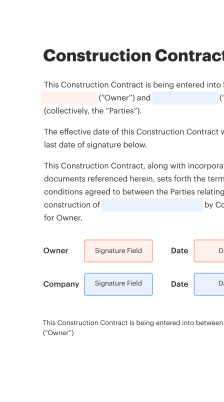
How to create and distribute bills online using your Word template

Upload the Word bill template into the document platform, map template fields to data sources, configure signer order, and send for electronic signature or automated distribution.

  • Upload template: Import the .docx master into your document system.
  • Map data: Link fields to account and billing data sources.
  • Configure workflow: Set signer roles and sequence for approvals.
  • Dispatch and record: Send documents and capture audit logs.
Collect signatures
24x
faster
Reduce costs by
$30
per document
Save up to
40h
per employee / month

Quick setup: Creating a bill template word for banking

Prepare a master Word document with standardized headings, payment instructions, legal language, and placeholders for signer and account data before integrating with your eSignature workflow.

  • 01
    Define fields: Identify placeholders and data mappings.
  • 02
    Standardize language: Include consistent payment terms and disclaimers.
  • 03
    Set permissions: Lock sections and limit edit rights.
  • 04
    Test template: Validate with sample data and signers.

Audit trail checklist for bill template transactions

Maintain an auditable record of every bill that is generated, sent, and signed by following these steps.

01

Enable audit logging:

Turn on event capture for template actions.
02

Capture signer metadata:

Record IP, timestamp, and device.
03

Preserve document versions:

Store each signed copy separately.
04

Export logs regularly:

Schedule periodic log exports.
05

Implement retention rules:

Apply legal retention schedules.
06

Review access reports:

Audit who viewed or edited templates.
be ready to get more

Why choose airSlate SignNow

  • Free 7-day trial. Choose the plan you need and try it risk-free.
  • Honest pricing for full-featured plans. airSlate SignNow offers subscription plans with no overages or hidden fees at renewal.
  • Enterprise-grade security. airSlate SignNow helps you comply with global security standards.
illustrations signature

Recommended workflow configuration for billing templates

Configure workflow settings to ensure timely delivery, reminders, and proper retention for bill template word for banking processes.

Feature Configuration
Reminder Frequency 48 hours
Signer Authentication Level MFA required
Default Retention Period 7 years
Bulk Send Chunk Size 500 per batch
Audit Log Export Interval Monthly

Device and platform requirements for bill template use

Ensure staff have supported browsers or apps and compatible Word versions before using bill template word for banking across devices.

  • Desktop: Windows 10+, macOS 10.14+
  • Browsers: Chrome, Edge, Safari supported
  • Mobile apps: iOS and Android minimum versions

Keep software and app versions current and coordinate with IT to manage updates; confirm integrations with core banking systems for stable data mapping and secure transmission.

Security and protection controls for banking bill templates

TLS encryption: In transit protection
At-rest encryption: Stored file encryption
Multi-factor authentication: Stronger signer assurance
Role-based access: Controlled template edits
Audit logging: Tamper-evident records
Document watermarking: Deters unauthorized reuse

Banking use cases for bill template word for banking

Practical examples show how banks use Word templates with eSignature to streamline billing and maintain compliance.

Retail account statement

A retail branch issues monthly account statements using a Word bill template that auto-populates account and balance fields from core systems

  • Pre-filled fields reduce manual entry
  • Customers receive consistent, legible statements

Resulting in faster dispute resolution and clearer customer communication.

Commercial loan billing

A commercial lending team generates periodic interest and escrow invoices from a standardized Word template that includes conditional sections for fees

  • Template-driven calculations ensure consistent charge presentation
  • Integration with the loan servicing system reduces reconciliation time

Leading to fewer billing errors and improved auditability.

Best practices for secure and compliant billing templates

Follow these practical steps to keep bill templates accurate, auditable, and secure at scale within a banking environment.

Use standardized billing templates and centralized management
Maintain a single source of truth for Word templates with enforced version control, change approvals, and distribution rules. Central management reduces divergent formats, simplifies audits, and ensures every bill adheres to current legal and business language.
Enable audit trails and preserve signed records
Configure tamper-evident logs that capture signer metadata, timestamps, and document versions. Ensure signed documents are stored securely with encryption and retention schedules aligned to regulatory requirements for banking records.
Apply role-based access controls and separation of duties
Limit who can edit templates, approve sends, and access signed documents. Segregate duties between template authors, approvers, and operations staff to reduce error and support compliance oversight.
Validate signer identity for sensitive or high-value transactions
Apply stronger authentication methods when required by policy: multi-factor authentication, identity proofing, or certified signatures for transactions with elevated risk or regulatory sensitivity.

FAQs and troubleshooting for bill template word for banking

Answers to frequent operational and technical questions about creating, sending, and maintaining Word-based billing templates in a regulated banking environment.

Feature comparison for banking bill templates across vendors

Compare essential capabilities relevant to banks when selecting an eSignature provider to pair with Word billing templates.

Comparison: Feature and Compliance Criteria signNow (Recommended) DocuSign
Integrated template editor available for banking workflows
Bulk Send for batch billing and statements
Audit trail granularity and export options Detailed export Detailed export
API access for core banking integration REST API available REST API available
be ready to get more

Get legally-binding signatures now!

Operational timeline for transitioning to Word billing templates

A typical migration timeline includes discovery, template design, pilot testing, staff training, and full rollout with monitoring.

01

Discovery and requirements

2–4 weeks

02

Template design and approvals

2–3 weeks

03

Integration and testing

3–6 weeks

04

Pilot run and adjustments

1–2 weeks

05

Staff training

1 week

06

Full rollout

1 week

07

Post-rollout review

30–60 days

08

Ongoing monitoring

Continuous

Regulatory and business risks from poor billing controls

Regulatory fines: Monetary penalties
Breach liability: Legal exposure
Reputational harm: Customer trust loss
Document invalidity: Contract disputes
Data loss: Operational setbacks
Processing delays: Revenue impact

Pricing and plan comparison for common eSignature vendors

Estimated starting prices and common plan differences to consider when evaluating vendors for banking billing templates and workflows.

Pricing Plan and Limits signNow (Featured) DocuSign Adobe Sign HelloSign PandaDoc
Starting monthly price From $8/user/month From $10/user/month From $9.99/user/month From $15/user/month From $19/user/month
Bulk send capacity Up to 1,000 envelopes/month 100 envelopes/month 500 envelopes/month 200 envelopes/month 1,000 envelopes/month
API access inclusion Included in plans Available on higher plans Available Available Available
Audit and compliance features Comprehensive logs and exports Comprehensive logs Comprehensive logs Basic logs Detailed logs
HIPAA support availability Available on select plans Available via DPA Add-on support Available Available
Enterprise plan flexibility Custom enterprise options Custom enterprise Custom enterprise Custom enterprise Custom enterprise
walmart logo
exonMobil logo
apple logo
comcast logo
facebook logo
FedEx logo
be ready to get more

Get legally-binding signatures now!